Tamil Nadu Muslim Outfits Demand More Assembly Seats for 2026 Elections
In a significant political development, Muslim organizations across Tamil Nadu have issued a collective appeal to major political parties, urging them to field a greater number of Muslim candidates in the upcoming 2026 state assembly elections. The groups argue that the current representation of Muslims in the legislature is disproportionately low compared to their demographic share in the state's population.
Persistent Under-Representation Highlighted
Organizations such as the Manithaneya Makkal Katchi, Indian Union Muslim League (IUML), Manithaneya Jananayaga Katchi, and Tamil Nadu Thowheed Jamaath, along with Muslim leaders from various other parties, have pointed out a stark disparity. While Muslims constitute approximately six percent of Tamil Nadu's population, their representation in the state assembly has consistently fallen below three percent. This data, based on the 2011 census, underscores a long-standing issue of under-representation that has persisted through successive assemblies.
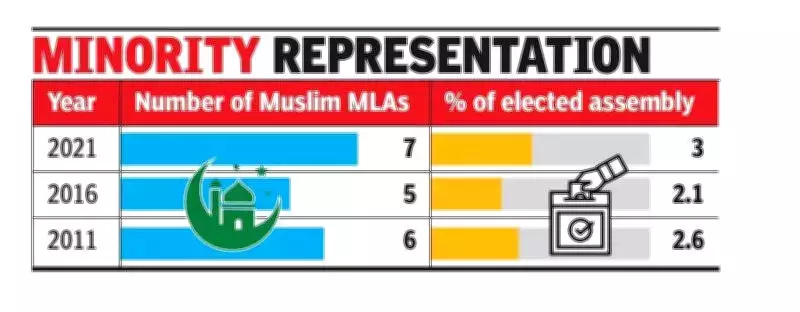
Historical data reveals a concerning trend:

- In the 2021 assembly elections, only seven Muslim MLAs were elected, with two—S M Nasar and K S Gingee Masthan—subsequently becoming ministers.
- The 2016-21 term saw just five Muslim MLAs, while the 2011-16 term had six.
- Representation in parliamentary elections has been even more limited, further exacerbating the community's political marginalization.
Calls for Fair Allocation of Seats
IUMP MP Kani K Navas from Ramanathapuram has been vocal in demanding that major political parties allocate at least 14 to 15 assembly seats to Muslim candidates. This call is rooted in the principle of proportional representation, aiming to bridge the gap between population share and legislative presence. Al Ameen, the state secretary of the Tamil Nadu Thowheed Jamaath, referenced the Sachar and Ranganath Misra committees, which have extensively documented the low levels of Muslim representation in Indian politics, including in Tamil Nadu.
"The Muslim outfits feel that major parties like the DMK and AIADMK are reluctant to field Muslim candidates directly," explained a senior functionary from one of the organizations. "Instead, they often allocate a limited number of seats to Muslim outfits, treating it as a token gesture rather than embracing inclusive candidacy."
Internal Resistance and Political Dynamics
Internal discussions within political parties have sometimes revealed resistance to fielding Muslim candidates. For instance, during AIADMK's internal deliberations in 2021, some leaders argued against nominating Muslim candidates, rationalizing that "Muslims would anyway vote for DMK." This perception, according to critics, reflects a broader trend of political complacency and strategic exclusion.
Aloor Sha Navas, a VCK MLA from Nagapptinam, attributed part of this situation to the influence of the BJP. He noted that the BJP's "social engineering" model, which has yielded electoral success in various regions, has created an impression that parties can win elections without actively courting minority votes. "Nevertheless, the bitter truth is that no party, including the DMK and Congress, has provided the rightful representation due to Muslims," he asserted.
Potential Electoral Impact and Democratic Imperatives
Al Ameen emphasized that Muslim voters could play a decisive role in an estimated 25 to 30 constituencies, such as Ramanathapuram, Gudalur, Vellore, Aranthangi, and Kadayanallur. "They deserve a bigger share of tickets and leadership roles. This would strengthen the democratic setup," he stated, highlighting the potential for Muslim voters to tilt the electoral balance in key areas.
The demand for increased representation is not merely about numbers; it is framed as a crucial step toward enhancing democratic inclusivity and ensuring that all communities have a voice in governance. As Tamil Nadu gears up for the 2026 elections, this issue is likely to remain at the forefront of political discourse, challenging parties to move beyond tokenism and embrace genuine diversity in candidate selection.