Udhayanidhi Stalin Accuses Union Government of Covert Hindi Imposition in Tamil Nadu
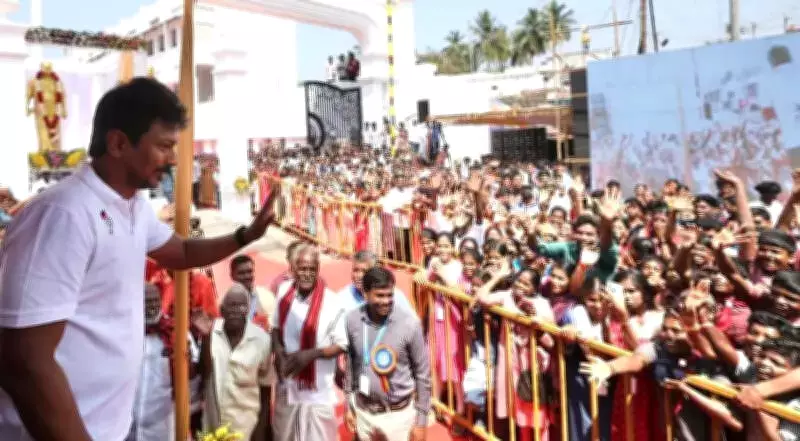
Deputy Chief Minister of Tamil Nadu, Udhayanidhi Stalin, launched a sharp critique against the Union government on Thursday, alleging systematic attempts to impose Hindi in the state while publicly professing support for the Tamil language. Speaking at a ceremonial event near Thanjavur, where he unveiled statues of former Chief Minister M. Karunanidhi and S. Ramanathan, the former secretary of Karanthai Tamil Sangam, at Karanthai Arts College, Stalin emphasized that resistance to Hindi imposition has deep historical roots in the region.
Historical Context and Contemporary Concerns
Udhayanidhi Stalin highlighted that the Karanthai Tamil Sangam had already passed a resolution in the 1930s opposing the introduction of Hindi in educational institutions, underscoring a longstanding cultural and linguistic struggle. "The imposition of Hindi continues even today," he asserted, pointing to tangible examples such as Hindi signage prominently displayed at the entrance of the Trichy divisional railway office. This, he argued, symbolizes a persistent effort to marginalize Tamil in official and public spaces.
Criticism of Education Policies and Funding Disparities
The Deputy Chief Minister directed particular criticism towards the Union government's education framework, accusing it of aggressively promoting Hindi through initiatives like the New Education Policy (NEP). He alleged that the Centre is withholding approximately Rs 3,500 crore in education funds earmarked for Tamil Nadu, linking their release to the state's acceptance of the NEP and the contentious three-language formula. "The Chief Minister has made it unequivocally clear that Tamil Nadu will not accept the imposition of Hindi or Sanskrit," Stalin declared, reinforcing the state's firm stance on linguistic autonomy.
Furthermore, Udhayanidhi Stalin raised concerns over funding imbalances, claiming that the Union government has allocated a mere Rs 147 crore for the promotion of Tamil over the past decade, in stark contrast to about Rs 2,500 crore dedicated to Sanskrit. This disparity, he suggested, reveals a hypocritical approach where verbal support for Tamil masks a preferential treatment of other languages.
Call for Transparency and Public Awareness
In his address, Stalin urged the public to discern between genuine advocacy and superficial gestures. "While repeatedly claiming to support Tamil, the Union government is deceiving the people. We must show clearly who is genuinely working for Tamil and who is only pretending," he stated, calling for heightened vigilance and collective action to safeguard Tamil linguistic and cultural identity.
The event, held in Trichy, served as a platform to reiterate Tamil Nadu's unwavering commitment to preserving its linguistic heritage against perceived central overreach, setting the stage for ongoing political and cultural discourse in the region.