

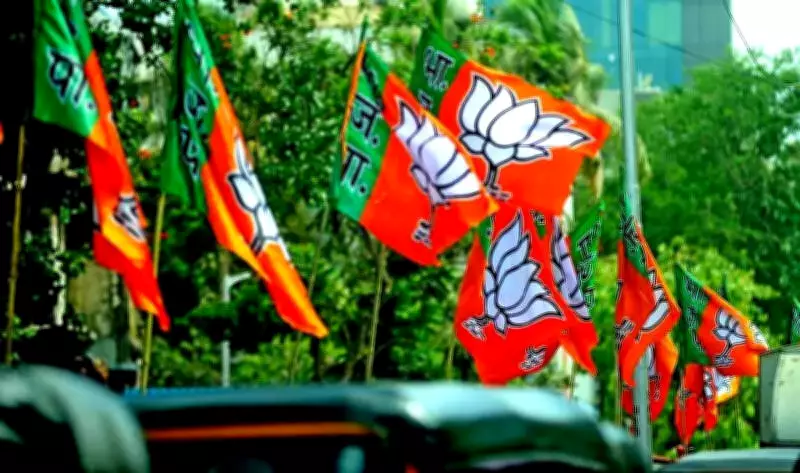
UP BJP's Organizational Reshuffle Aims to Balance Caste Equations Ahead of 2025 Assembly Polls
As Uttar Pradesh gears up for crucial assembly elections scheduled for early next year, the Bharatiya Janata Party's much-anticipated organizational restructuring, expected later this month, is poised to bring the spotlight firmly back on the party's delicate balancing act between its traditional upper caste base and the crucial OBC-Dalit combination.
Navigating Controversies and Consolidating the Core
Facing significant heat over the controversy surrounding UGC equity regulations and a notable confrontation with Swami Avimukteshvaranand Saraswati during the Magh Mela, the BJP leadership is reportedly treading a cautious path. The party is making strategic moves to consolidate its upper caste support, which has historically formed the backbone of its electoral successes since the early 1990s.
The party provided initial indications of its direction recently when it released a fresh list of eleven district presidents. This list revealed a careful distribution: six representatives from the upper caste (including three Brahmins, and one each from the Thakur, Vaishya, and Kayastha communities), three from Other Backward Classes, and two from the Dalit community. This distribution clearly signals the party's unwillingness to abandon its traditional base while simultaneously ensuring representation for backward and marginalized groups.

Current Leadership Composition and Expected Changes
All political eyes are now firmly fixed on the new Uttar Pradesh BJP state executive committee, which will be responsible for steering the party's organizational machinery throughout the critical election year. Significant changes are anticipated across the state leadership, which currently demonstrates a clear domination by upper caste representatives.
The current composition reveals:
- Among eighteen vice-presidents, ten belong to the upper caste, five are OBC, and three are Dalit.
- Of seven state general secretaries, three are from the upper caste, three are OBC, and one belongs to the Scheduled Caste category.
- Among sixteen state secretaries, nine are upper caste, three are OBC, and four are Dalits.
It is noteworthy that while Chief Minister Yogi Adityanath himself is a Thakur, Uttar Pradesh BJP president Pankaj Chaudhary and state general secretary (organization) Dharam Pal Singh both hail from OBC backgrounds.
Strategic Outreach to Broaden Social Coalition
Simultaneously, the BJP is pursuing a measured yet accelerated outreach program targeting non-Yadav OBC communities and non-Jatav Dalit groups. This strategic move aims to augment the social coalition that originally served as the launchpad for the party's remarkable electoral success under Prime Minister Narendra Modi's leadership in 2014.
The OBC-Dalit combination has assumed even greater importance for the BJP as it confronts a resurgent opposition and their Piccha Dalit Alpsankhyak (PDA) poll narrative. This narrative is widely believed to have significantly dented the saffron brigade's performance during the 2024 Lok Sabha elections, where its tally in Uttar Pradesh plummeted from sixty-two to thirty-three seats.
RSS Coordination and Regional Balance
According to informed sources, the Uttar Pradesh BJP leadership is coordinating closely with the Rashtriya Swayamsevak Sangh (RSS), the party's organizational fountainhead, while constituting the new team. BJP-RSS coordination meetings have already been conducted across various organizational regions to develop a formal blueprint for the upcoming organizational setup.
A senior Uttar Pradesh BJP leader emphasized that beyond caste balance, the party aims to establish equitable representation from all six geographical regions of the state. Currently, the balance appears tilted in favor of the Gorakhpur region, which coincidentally serves as the political backyard for both Chief Minister Yogi Adityanath and state president Pankaj Chaudhary.
Consequently, the organizational focus is expected to shift significantly toward the five other key regions: Kashi, Braj, Awadh, Western Uttar Pradesh, and Kanpur-Bundelkhand.

Youth, Women, and the Winnability Factor
Uttar Pradesh BJP spokesperson Hero Bajpai stated, "The party's foremost priority is to provide balanced representation to all castes, communities, and regions based primarily on the winnability factor. This critical element will be prominently factored in when the new team is officially announced."
Another senior party leader revealed that the BJP is expected to focus strategically on deploying youth and women functionaries. These two demographic blocs represent key electoral constituencies, and their inclusion is seen as a method to effectively cut across the traditional caste spectrum.
Political analysts note that while young voters constitute a substantial share of Uttar Pradesh's electorate, women voters are increasingly becoming decisive in determining electoral outcomes. The party's organizational reshuffle is therefore being watched closely for how it addresses these dynamic demographic realities alongside its complex caste calculus.





