UP Budget 2026-27 Earmarks Rs 207 Crore for Pioneering Kukrail Night Safari in Lucknow
The Uttar Pradesh government has taken a monumental step towards boosting tourism and wildlife conservation with its latest budgetary allocation. The UP Budget for the financial year 2026-27 has made a significant provision of approximately Rs 207 crore for the establishment of a night safari in the Kukrail forest area of Lucknow. This ambitious project is poised to become India's first-ever night safari, setting a new benchmark for ecological tourism in the country.
Financial Commitments and Project Phasing
The total cost for the inaugural phase of the Kukrail Night Safari project is estimated at Rs 631 crore. In a demonstration of sustained commitment, the state government had already released Rs 206 crore during the 2025-26 financial year. The newly announced provision of over Rs 207 crore for 2026-27 ensures continuous funding momentum, bringing the project closer to realization. This strategic financial planning underscores the administration's dedication to transforming Lucknow into a premier wildlife destination.
Innovative Visitor Experience and Safety Measures
The Kukrail Night Safari promises a unique and immersive experience for visitors. Guests will embark on a guided tour aboard a tram, traversing the safari under simulated moonlight conditions designed to mimic the natural nocturnal environment. The entire journey is expected to last approximately 40 minutes, offering an enchanting glimpse into the lives of nocturnal species. To ensure utmost safety for both animals and visitors, the design incorporates advanced separation mechanisms. A combination of moats and glass walls will securely divide the animal habitats from the visitor pathways, maintaining a natural barrier while allowing unobstructed viewing.

Awaiting Supreme Court Nod for Construction Commencement
Construction activities at the designated site are set to begin immediately upon receiving the necessary approvals from the Supreme Court of India. The matter was initially heard by the Supreme Court on August 29, following which it was referred to the Central Empowered Committee (CEC) for detailed evaluation. The CEC submitted its comprehensive recommendations on November 27. The final green light is now awaited from the Supreme Court, with sources within the forest department indicating that concerted efforts are underway to expedite the approval process as swiftly as possible.
Comprehensive Project Components and Ecological Integration
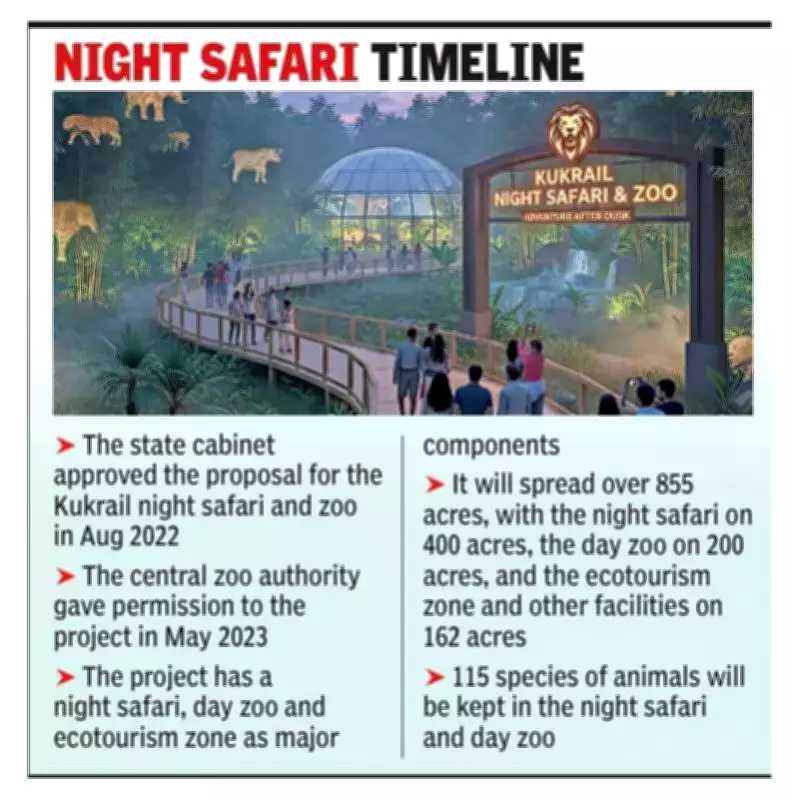
Spanning an impressive 855 acres in the northern sector of the Kukrail forest, the Kukrail Night Safari project is a multifaceted initiative comprising five key components:
- Relocation of the existing Lucknow Zoo to the Kukrail site.
- Development of a modern 4-lane road in front of the safari entrance to facilitate access.
- Construction of the flagship night safari spread over 400 acres.
- Establishment of a complementary day zoo occupying 200 acres.
- Creation of a dedicated ecotourism zone to promote sustainable tourism practices.
The night safari will exclusively house nocturnal species, while the day zoo will feature diurnal species, collectively showcasing approximately 115 different animal species. The site will be equipped with 63 state-of-the-art enclosures, ensuring optimal living conditions for the wildlife. Additionally, the project includes plans for a recreational area complete with lush green spaces, a cafeteria, and essential visitor amenities, enhancing the overall tourist experience.

Preserving Kukrail's Ecological Legacy
The Kukrail Reserve Forest, which spans a vast 5,000 hectares, is already renowned for its conservation efforts. It currently hosts a rehabilitation centre for gharials and provides a sanctuary for rescued spotted pond turtles. The new night safari and zoo project will be strategically located on the opposite side of the existing picnic spot within Kukrail, ensuring that these vital conservation activities continue uninterrupted. This thoughtful placement highlights the project's commitment to harmonizing development with ecological preservation, making it a model for future wildlife initiatives across India.