UP Assembly Speaker Hails Transformation of State Legislature into Vibrant Democratic Forum
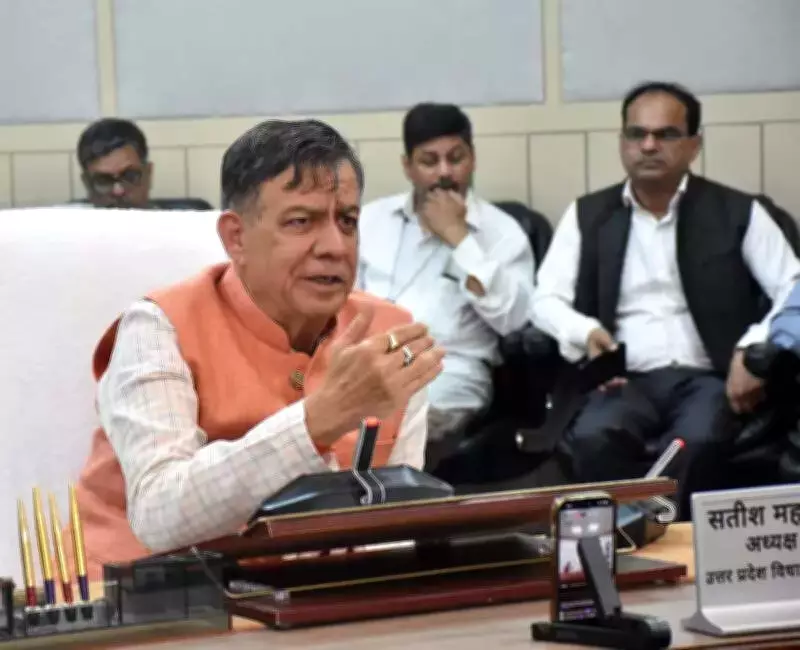
Lucknow: Uttar Pradesh Assembly Speaker Satish Mahana declared on Tuesday that public perception of the state legislature is undergoing a remarkable transformation. He emphasized that House discussions, once viewed with doubt and disappointment, are now increasingly recognized as serious, meaningful, and result-oriented forums for democratic debate.
Constitutional Limits and Democratic Responsibilities
Addressing a press conference in Lucknow four days after the conclusion of the UP House budget session, Mahana stressed that in a democratic system, every institution and individual must function within their constitutional limits while fulfilling their respective responsibilities. He highlighted how the 18th Assembly—the present House—has upheld democratic values while embracing innovation, transparency, and modern technology to reform its work culture.
"Assembly is no longer just a historic building. It has evolved into a vibrant platform of accountability, discipline, and the expression of public aspirations," Mahana stated emphatically.

Significant Budget Session with Detailed Deliberations
Describing the recently concluded budget session as significant and thought-provoking, the Speaker revealed that the annual budget for the financial year was discussed in detail with seriousness and depth. He noted that demands for grants from various departments were deliberated systematically, and several important public-interest bills were passed during the session.
Mahana explained that through the Question Hour, the accountability of government was effectively ensured, while Zero Hour provided members with valuable opportunities to raise pressing public issues in an organized manner. "All of this demonstrates that the Assembly continues to serve as a powerful bridge between the people and government," he affirmed.
Respect for Parliamentary Decorum and Healthy Debates
The Speaker expressed satisfaction that both government and opposition members respected parliamentary decorum throughout the session. "Differences of opinion are natural in a democracy, but dialogue, restraint, and civility form its true spirit," Mahana observed, noting that the session witnessed healthy debates, logical arguments, and constructive participation from all sides.
Recognizing the media as the fourth pillar of democracy, Mahana extended special thanks to journalists for helping convey a positive image of the Assembly to the public. He also expressed gratitude to all members of the House, parliamentary affairs minister Suresh Khanna, leader of the opposition Mata Prasad Pandey, and leaders of different political parties for their cooperation.
Commitment to Dignity and Transparency
Mahana reaffirmed his commitment to preserving the dignity, transparency, and accountability of the House while strengthening the tradition of healthy and meaningful dialogue in future sessions. "We are building an institution that not only debates but delivers for the people of Uttar Pradesh," he added.
Productive Session with High Member Engagement
Data shared by the Assembly secretariat reveals impressive statistics from the 10-day budget session:
- The session spanned over 75 hours with total operational period stretching over 72 hours and 45 minutes
- The House remained disrupted for only 2 hours 23 minutes
- Approximately 97% of the total session was deemed 'productive'
- A total of 2,427 questions were received during the session
- Of these, 2,322 questions (95.7%) were submitted through the online system
The digital engagement highlights the Assembly's increasing reliance on modern technological processes to streamline parliamentary work.
Detailed Breakdown of Parliamentary Notices
The session also saw substantial activity in various parliamentary notice categories:

- Under Rule 300, sixteen notices were received—three were admitted and thirteen rejected
- Under Rule 301, 694 notices were received—358 were admitted and 336 rejected
- Under Rule 56 (short duration discussion), 62 notices were submitted—sixteen were accepted
- Under Rule 51, 893 notices were received—twenty-three were admitted for discussion
These figures demonstrate robust participation from Assembly members across different parliamentary mechanisms, reflecting a legislature that is both active and disciplined in its approach to governance and public representation.