

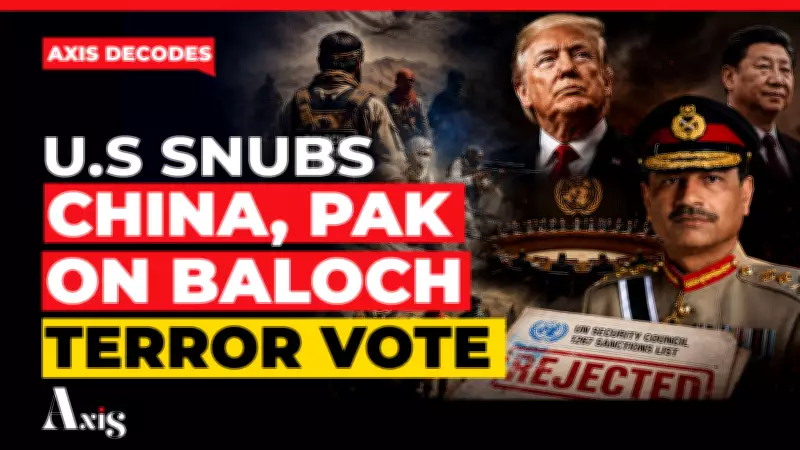
Pakistan thought it had all the pieces in place. China backed its proposal. Asim Munir had secured high-profile meetings in Washington. The United States had already designated the Baloch Liberation Army as a Foreign Terrorist Organization. Yet when Pakistan and China pushed to place the BLA on the UN Security Council's powerful 1267 sanctions list, Washington said no.
US Veto Shakes Pakistan's Grand Plan
The unexpected veto by the United States has dealt a significant blow to Pakistan's diplomatic efforts. The move underscores the complex geopolitical calculations at play, as Washington appears to be balancing its relationship with Pakistan while limiting China's influence in the region. This development also raises critical questions about the US stance on terrorism designations and its broader strategy in South Asia.
Implications for India
For India, this decision carries particular weight. New Delhi has long accused China of abusing the same UN mechanism to shield Pakistan-based terrorists. The US veto may signal a shift in how the international community views such designations, potentially opening new avenues for India to press its case against cross-border terrorism.

The UN Security Council's 1267 sanctions regime is a powerful tool used to freeze assets, impose travel bans, and enforce arms embargoes on individuals and entities linked to terrorism. Pakistan and China had hoped to use this mechanism to target the BLA, but the US decision has thwarted their plans.
Geopolitical Chess Game
This incident is part of a larger geopolitical chess game. The US has been careful not to alienate Pakistan entirely, given its strategic importance in Afghanistan and the broader region. However, by blocking the BLA listing, Washington has sent a clear message that it will not allow China to use the UN forum to advance its own interests at the expense of American objectives.
China's backing of Pakistan's proposal was seen as an attempt to strengthen its alliance with Islamabad and expand its influence in the region. The US veto, therefore, represents a setback not only for Pakistan but also for China's broader ambitions.
Asim Munir, Pakistan's powerful army chief, had invested significant diplomatic capital in securing the BLA designation. His meetings in Washington were intended to build trust and cooperation, but the US decision suggests that such efforts have not yielded the desired results.
What Lies Ahead?
The fallout from this decision is likely to be felt across the region. Pakistan may now reconsider its reliance on China for support in international forums, while India may see an opportunity to strengthen its own counter-terrorism initiatives. The US, for its part, will need to navigate the delicate balance between maintaining ties with Pakistan and countering China's rise.
In the coming months, the international community will be watching closely to see how this setback affects Pakistan's strategy and whether it leads to a realignment of alliances in South Asia.






