

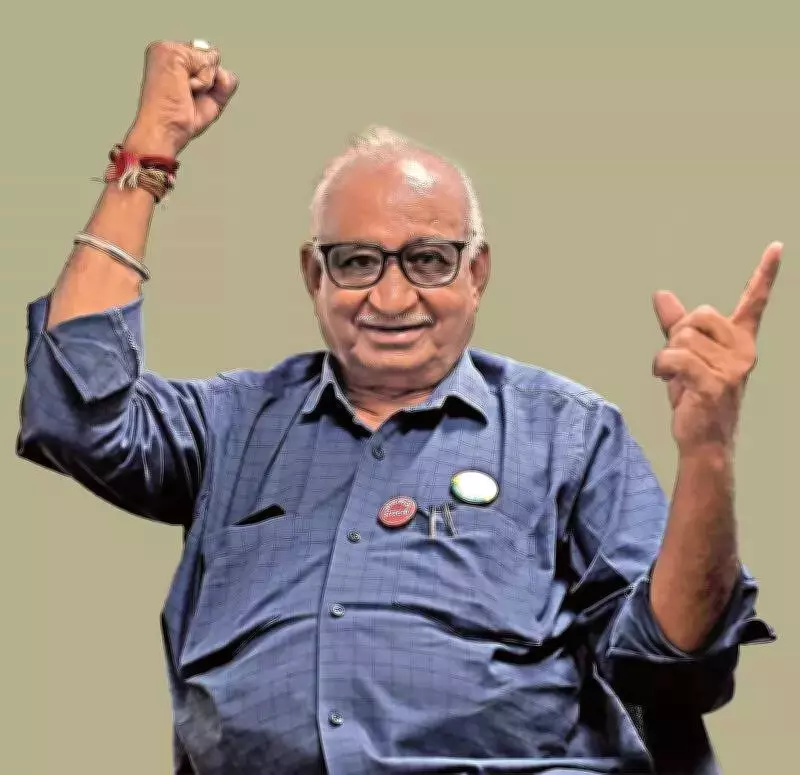
Vidarbha's Quest for Statehood Gains Momentum with 'Mission 2027' Campaign
In Nagpur, the historical capital of the erstwhile Central Provinces & Berar, the demand for a separate Vidarbha state is being reignited with a renewed sense of purpose. The Vidarbha Rajya Andolan Samiti (VRAS), a persistent advocacy group, has unveiled 'Mission 2027', a strategic initiative aimed at decisively advancing the movement for Vidarbha's statehood. This campaign marks a critical juncture in a struggle that traces its roots back to the 1960 formation of Maharashtra, when promises made to the Vidarbha region were allegedly left unfulfilled.
Decades of Grievances Fuel the Movement
The core argument of VRAS hinges on historical agreements known as the Akola and Nagpur Pacts, which were intended to safeguard Vidarbha's interests upon its merger into Maharashtra. Former MLA Wamanrao Chatap, the leader of VRAS, asserts that these promises were violated from the very beginning. He emphasizes that the delay in establishing the Vidarbha Statutory Development Board at the time of Maharashtra's formation severely hampered the region's progress. "Had it been implemented then, Vidarbha's developmental path would have been entirely different," Chatap stated, highlighting a long-standing sense of betrayal.
Arun Kedar, another prominent VRAS leader, points to institutional disparities within Maharashtra's administration. He notes that while projects like Koyna and Krishna Valley have dedicated departments and budgets, Vidarbha—despite being the largest and most resource-rich region—lacks equivalent protections. "Nagpur was already the capital of a significant state before Maharashtra's creation. We relinquished our status and economic prosperity based on lofty political assurances that proved empty," Kedar explained, underscoring the economic dimensions of the grievance.

'Mission 2027': A Grassroots Mobilization Drive
VRAS is implementing 'Mission 2027' through an extensive grassroots campaign, focusing on villages and educational campuses across the region. Over the past two years, the organization has conducted awareness programs in 120 towns and engaged with students at 152 colleges, targeting a younger generation unfamiliar with the movement's early battles. Chatap described this effort as "lighting a candle one-by-one" to spread enlightenment about the necessity of statehood for securing Vidarbha's future.
The movement is strategically shifting its focus toward youth mobilization and economic arguments, a departure from earlier generations that emphasized cultural and regional identity. Shreenivas Khandewale, a 90-year-old VRAS veteran, observed that this economic pivot makes the demand harder to dismiss. He linked this shift to the COVID-19 pandemic, which exacerbated job losses and highlighted the stark contrast between Vidarbha's natural resources and the economic hardships faced by its residents.
Political Landscape and Economic Realities
VRAS leaders are critical of Maharashtra's political establishment, accusing major parties of neglecting Vidarbha's statehood cause. Tatya Mate, a senior VRAS figure, claimed that Shiv Sena, NCP factions, and even BJP leaders have sidelined the issue despite previous support. Khandewale suggested that only political pressure might revive BJP's advocacy, particularly with upcoming delimitation exercises that could impact Vidarbha's representation.
The economic paradoxes in Vidarbha are a central theme in VRAS's campaign. Mukesh Masurkar cited Butibori, Asia's largest industrial estate near Nagpur, as a symbol of unfulfilled potential—where infrastructure exists but employment opportunities are scarce. Chatap repeatedly highlighted the irony of power production in Vidarbha, noting that while Mumbai enjoys uninterrupted electricity, many areas in Vidarbha experience load shedding. "We are treated as a resource warehouse, with materials extracted here but processed elsewhere for higher value," he lamented.

Additionally, VRAS connects administrative neglect to social issues, pointing out that Vidarbha continues to report the highest number of farmer suicides in the region. As 'Mission 2027' progresses, VRAS aims to channel the energy of a new generation, driven by economic imperatives and organized activism, to finally achieve the long-awaited goal of a separate Vidarbha state.





