

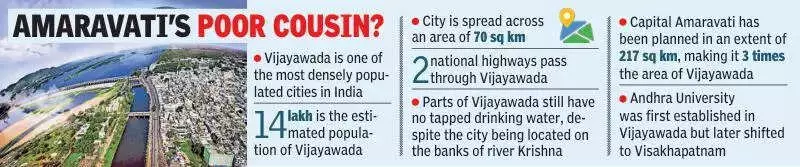
For the past ten years, the bustling city of Vijayawada has not witnessed the completion of a single major infrastructure project, highlighting a prolonged period of governmental neglect despite its pivotal role in the state's capital region. The last significant announcement, a Rs 460 crore storm water drainage system in 2015, remains incomplete with no clear deadline for its finalization. This stagnation has sparked deep concern among citizens and business leaders who feel the city is being deliberately sidelined.
A City Overshadowed in Its Own Capital Region
Despite being an integral part of the Amaravati capital region and housing nearly half of the state-level government offices, Vijayawada has consistently missed out on developmental projects. Under the state's clusterisation policy, cities like Visakhapatnam and Tirupati received multiple clusters, but Vijayawada was left out. This is in stark contrast to its historical significance as a hub for education, trade, and the automotive industry in the undivided Andhra Pradesh, a status it began losing with the IT revolution in the late 90s and early 2000s.
The initial vision for the capital region under the first NDA government (2014-19) aimed to attract IT investments to Vijayawada and Mangalagiri, with a focus on non-polluting industries for the blue-green city of Amaravati. An electronic city was part of the master plan. However, this momentum faded, and no major industry materialized. Even with the renewed focus on investments after the TDP-led NDA government returned to power in 2024, significant projects like the Quantum Valley are proposed for Amaravati, while North Andhra and Rayalaseema, along with Vijayawada, have seen little concrete action.

Voices of Frustration and Concern
Long-time residents and entrepreneurs express a growing sense of abandonment. B Sharath Kumar, a resident, rued that the city desperately needs an industrial trigger for job creation beyond organic growth, suggesting it seems "neglected intentionally to promote Amaravati." City-based entrepreneur Ashwin Nagalla opined that reverse migration to Vijayawada or Amaravati is essential for the capital city to thrive.
Satish Chaganti, another entrepreneur, highlighted a 75-year history of systematic neglect, denying meaningful investment in infrastructure and industry. He pointed out the irony that despite this, Vijayawada remains one of the strongest contributors to the state's GSDP and boasts a high per capita income rivaling Visakhapatnam. An unnamed legislator from the city revealed that Vijayawada did not secure a single project in the last 18 months, despite grand investment announcements for the state, and even ongoing housing, water, and drainage projects in the suburbs are delayed.
A Glimmer of Hope from Industry
However, the industrial sector offers a more optimistic outlook. Potluri Bhaskar Rao, President of AP Chambers, believes it is only a matter of time before Vijayawada transforms into a mega metro. He envisions Vijayawada and Amaravati merging into a single entity once ongoing infrastructure works—like the Outer Ring Road (ORR), Inner Ring Road (IRR), and improved rail and air connectivity—are finished. This, he asserts, will unlock private investment. He also noted the state government's plans to promote the knowledge economy, services, health, and education in the region encompassing Vijayawada.
The central challenge remains: bridging the gap between promising plans and tangible, completed projects on the ground. For now, Vijayawada continues to wait, its potential stifled by a decade of inertia, as it watches other cities in Andhra Pradesh sprint ahead in the development race.






