

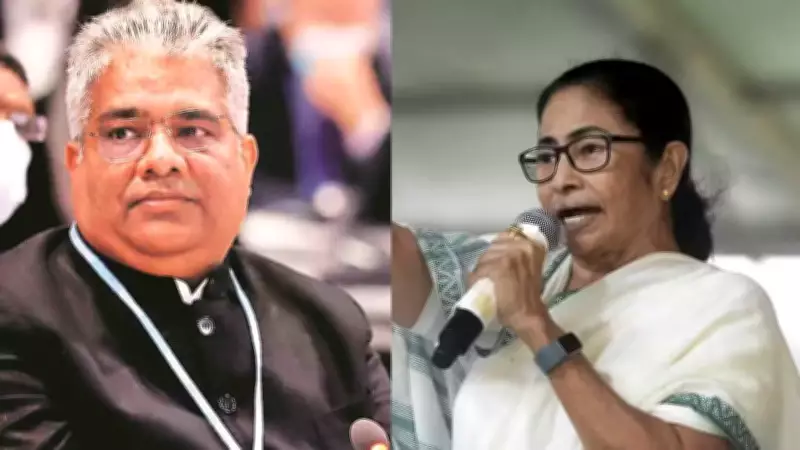
Union Minister Bhupendra Yadav Criticizes Mamata Banerjee Over DA Dispute and Governance Failures
Union Minister Bhupendra Yadav launched a sharp attack on West Bengal Chief Minister Mamata Banerjee during a press conference on the Union Budget, accusing her of being the only chief minister who files and fights cases against her own government employees. The remarks centered on the ongoing dearness allowance (DA) issue, where Banerjee's administration has moved to the Supreme Court.
Allegations Against the Bengal Government
Yadav stated, "Chief Minister Mamata Banerjee is the only CM who files and fights cases against her own employees. Twenty lakh people are fighting for the Sixth Pay Commission, but already, the Seventh Pay Commission is what all other Central government employees are getting." He emphasized that Banerjee has lost the legal battle and should apologize for failing to respect her employees.
Beyond the DA matter, Yadav leveled serious allegations against the Trinamool Congress government. He claimed that West Bengal's governance is compromised, with issues ranging from national security concerns due to infiltration from Bangladesh to political appeasement and violence during elections. "In West Bengal, the health care system and the education system are down. Political killings and violence during elections are the highest in West Bengal. Here, political appeasement is the highest," Yadav asserted.

Accusations of Fund Misuse and Corruption
The Union Minister accused the Bengal government of not utilizing funds allocated by the Centre and alleged corruption in central programmes. He highlighted the Cha Sundari project, launched in Assam, West Bengal, and Meghalaya, noting that while Assam utilized Rs 370 crore, Bengal has not formed a committee for four years. Yadav also pointed to infrastructure projects like the Surat–Dankuni Freight Corridor and Siliguri–Varanasi corridor, which aim to reduce transportation costs and enhance logistics efficiency, but claimed Bengal is deprived due to poor governance.
Yadav further alleged mismanagement in central schemes:
- Flawed implementation of MGNREGA with fund mismanagement allegations.
- Failure to properly submit utilisation certificates for PM Awas Yojana funds.
- Corruption allegations in PM Poshan Yojana.
- Non-conduct of Disha meetings mandated by the Centre.
- Restricted functioning of Ayushman Bharat and PM-Kisan schemes.
Economic and Sectoral Concerns
Yadav cited economic decline in West Bengal, with people migrating to other states and a drop in per capita income. He mentioned that during Banerjee's tenure, 6,800 listed companies have reportedly shut down, and the MSME sector has suffered, despite a proposed ₹10,000 crore MSME Growth Fund. "The state is operating with low capital expenditure, borrowing continuously without increasing income, thereby jeopardising West Bengal’s future. This is not just the Trinamool’s last budget, but its farewell document," he remarked.
He also criticized allocations in education, noting that while Bengal is the land of scientists like Satyendra Nath Bose and Jagadish Chandra Bose, no allocations have been made for science education, but ₹5,713.61 crore has been allocated to madrasas. In North Bengal, with a population of 3 crore, only ₹910 crore has been allocated. Additionally, Yadav stated that despite West Bengal's strong potential in textiles, the state government lacks a clear roadmap to develop the sector.
Broader Implications
Yadav's comments underscore ongoing tensions between the Centre and the West Bengal government, with allegations of poor governance, corruption, and neglect of employee welfare. The DA issue remains a focal point, reflecting broader disputes over fund utilization and administrative efficiency. The Union Minister's remarks highlight a narrative of decline and mismanagement under the Trinamool Congress rule, calling for accountability and reform in the state's governance structures.






