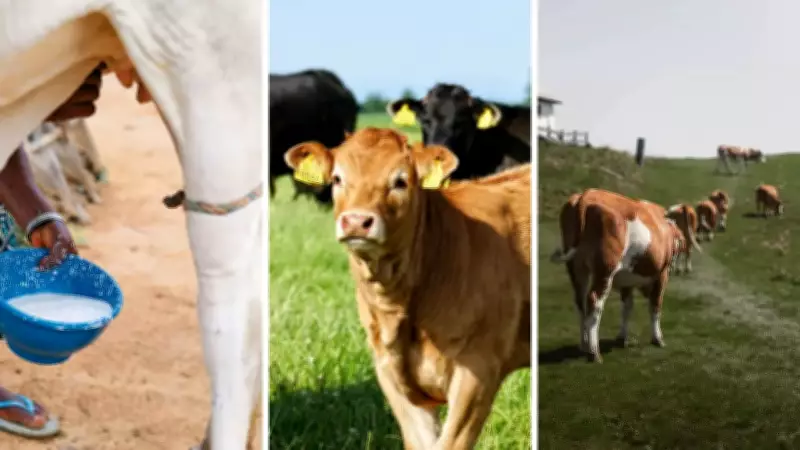
Cows are frequently overlooked as just passive grazers in the fields of the countryside; however, they are far more than they seem due to their complex intelligence and physiological structures and systems, which enable them to survive under various conditions. For example, they have specialised teeth to handle tougher fibrous plant materials, and they have formed complex social systems, including long-term bonds of friendship as well as the capability of holding grudges. Cows have highly developed senses which govern their lives, including an acute sense of smell and a range of hearing far greater than that of humans, allowing them to react to changes in their environment long before humans are able to detect them. When we understand these differences, we realise that cows are more than agricultural animals; they are intelligent, socially complex, and biologically interesting.
Cows Have 32 Teeth, Like Humans
Adult cows also have all of their teeth like humans (32 total); however, cows are herbivores, and therefore, their teeth have different shapes to accommodate a herbivore's diet. Cows have full access to grinding teeth that they utilise to break down and mash tough plant material into smaller pieces, but they do not have any front teeth in their upper mouth; they instead have a thick, tough tissue called the dental pad that aids in pulling the grass out of the ground against their lower front teeth and pulling it toward their back teeth.
Cows Have a Unique Way of Grazing
While cows cannot bite the grass off at the base of the grass, they have their own way of grazing. Cows will take a handful of grass, wrap their strong tongue around it, pull it against the hard pad in the upper front of their mouth, and then, with a quick jerk of their head, pull the grass up from the ground. By performing this motion over and over again, cows can eat a large amount of grass each day.

Cows Can Smell Things Up to 5 Miles Away
Along with their other senses, cows have a very strong sense of smell and can detect odours for 5 miles away if they are in a favourable environment due to the wind. This adds to their complete set of survival skills by enabling them to locate areas to graze that are fresh, stay clear of danger, and connect with their fellow herd members.
Cows Are Massive Milk Producers
A modern dairy cow has an incredible efficiency level; it can produce up to 23,000 pounds of milk in a year. This produced milk is a result of superior selective breeding and nutritionally enhanced management practices. To produce this amount of milk, dairy cattle must consume large amounts of water and high-quality feed each day to meet the high metabolic demands that their milk production requires.
Cows Have Best Friends
Dairy cattle are highly social animals and benefit from being in a group setting. They develop complex social hierarchies and will form close, long-lasting friendships with certain other cattle in their herd, often spending most of their time with these special friends and may exhibit complex behaviours such as holding grudges or remembering those who have mistreated them for many years.
Cows Have a Magical Digestive System
On average, dairy cattle feed for 8 hours per day and spend another 8 hours chewing their cud. Cattle are ruminants and consume their feed partially chewed, chewing it again after they regurgitate it to fully chew it. This unique type of processing allows them to digest fibrous cellulose material (which would otherwise be indigestible), yielding maximum nutrient extraction from their feed.
Cows Have Much Better Vision Than Humans
Cows are colorblind to red and green, which means they do not see the colourful world we do. Cows' eyes are much more sensitive than a human's eye to sudden movement and different levels of brightness. Farmers generally use soft neutral colour materials in their handling facilities, as this helps not to startle cows and creates calmness and reduces stress for the herd.
Cows Sleep Just 4 Hours a Day
Due to their size and the vast amount of energy they need, cows sleep very lightly. In 24 hours, they sleep for about four hours total time, but the total time will likely be broken up into many short, shallow bouts of sleep. They can often be seen dozing while standing up; however, they need to lie down to get into the deeper sleep stages.

Cows Have Super-Sensitive Hearing
Cows are capable of hearing sounds at a wide variety of frequencies greater than those humans can. For example, they are able to hear low-range sounds just before natural occurrences like storms, as well as higher-range sounds such as those made by nearby predators. Cows' increased sensitivity to sound assists them in being on alert and maintaining consciousness regarding changes and abnormal conditions that exist around them.
Cows Have a Staircase Problem
Cows can technically walk down stairs, but cannot walk down due to their unusual anatomy (types of knees and weight distribution) and how their legs are required to bend when walking down a steep hill or a staircase. Therefore, it is challenging for them to manage walking down a steep hill or staircase.