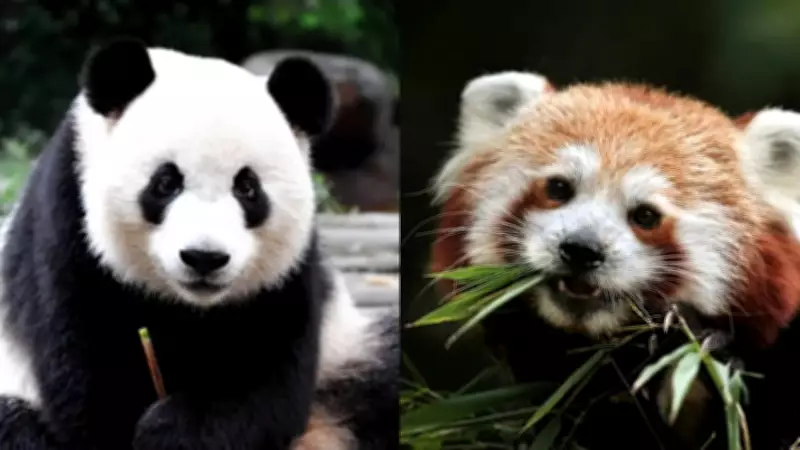
Both animals share the name "panda," and both are known for being incredibly cute, but giant pandas and red pandas are very different animals.
You may think that both species are closely related to one another, but the truth is that they belong to different families of animals and evolved differently throughout evolution. From physical traits to their habitat and way of life, giant pandas and red pandas are incredibly different. Here are seven ways the two species differ.
They belong to different animal families
Perhaps the main difference between the two is in classification. Giant pandas belong to Ursidae, the bear family. In contrast, red pandas belong to the Ailuridae family. At first glance, these two species might be considered to be more related to raccoons because they look similar to each other, but later genetic research proved that red pandas do not belong to the raccoon family.
Their size difference is massive
Size is an obvious difference between the two species. For example, an adult giant panda is significantly bigger than a red panda. In general, an adult giant panda weighs about 70–120 kilograms, but it may weigh even more. However, a red panda's body weight equals only 3–6 kilograms. The length of a giant panda is about 1.5 meters, which is much more than the length of a red panda, which is comparable to that of a domestic cat.

Their appearance is completely different
In terms of appearance, these two species also differ greatly from each other. Giant pandas are characterized by the combination of black and white fur colors, big round heads, and bodies like those of a bear. In turn, red pandas have reddish fur colors, white spots on their faces, and tails that are similar to those of a fox.
They live in different types of habitats
In spite of the fact that both species live in some parts of Asia, they occupy different types of habitats. In particular, giant pandas inhabit mountainous bamboo forests located in central China. In turn, red pandas can be found in the Eastern Himalayas and in China, Nepal, Bhutan, and India. These animals prefer temperate climates.
Red pandas are excellent tree climbers
In terms of behavior, there is a difference as well. For instance, red pandas are exceptional climbers and prefer spending a lot of time high up above the ground. Moreover, they have long sharp claws and flexible ankles to climb better. Even though young giant pandas can climb trees too, adult bears prefer living at ground level.
Their diets are similar but not identical
Giant pandas and red pandas eat mostly bamboo, but there are still slight differences in their diet. Bamboo makes a significant part of the giant panda's diet, and pandas feed on bamboo leaves all day. Nevertheless, red pandas eat mostly bamboo, but they also have other food options such as small fruits, insects, eggs, and seeds.
Both Giant Pandas and Red Pandas require conservation efforts
As far as conservation is concerned, both species require special conservation efforts to protect themselves from extinction. Habitat degradation, fragmentation, and human activities put pressure on these animals, so it is important to develop appropriate conservation strategies for each species. Although recently the population of giant pandas has recovered, red pandas continue to be an endangered species.