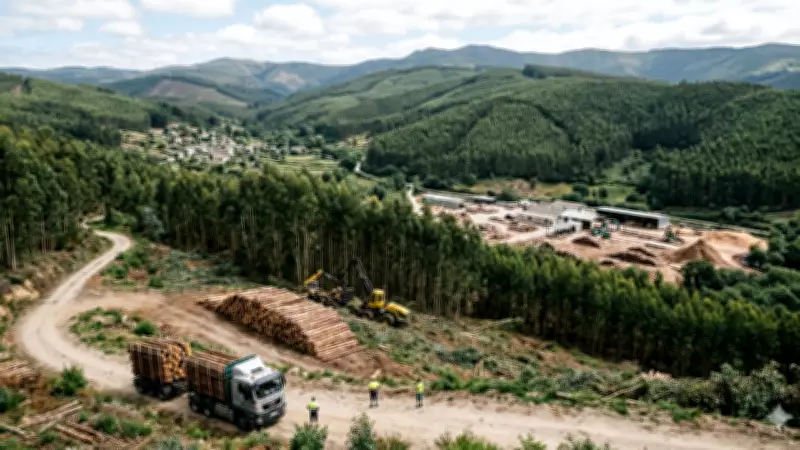
Spain's Eucalyptus Boom Transforms Galicia's Forests
For decades, eucalyptus trees were seen as a forestry success story in north-west Spain. Fast-growing, commercially valuable and capable of supplying the paper and timber industries, they transformed rural landscapes across Galicia from the 1960s onwards. To policymakers and landowners, planting more trees appeared to be an environmental and economic win.
Yet beneath the green canopy, researchers are documenting a quieter reality. Native birds are disappearing from areas dominated by eucalyptus plantations, while the ecological networks that support insects, plants and freshwater wildlife are steadily weakening. What looked like a practical solution for economic growth is now raising difficult questions about biodiversity, ecosystem resilience and the long-term costs of replacing native forests with fast-growing monocultures.
A growing body of scientific evidence suggests that the problem is not simply the presence of eucalyptus itself. Rather, it is the scale at which these Australian trees have replaced diverse native woodland ecosystems. The result is a landscape that may appear healthy from above but functions very differently for wildlife on the ground.

How Spain's Eucalyptus Boom Transformed Galicia's Forests
Eucalyptus was first introduced to the Iberian Peninsula during the nineteenth century, but its large-scale expansion accelerated dramatically during the second half of the twentieth century. Forestry policies promoted the species because it grows far faster than many native European trees and provides a reliable source of wood pulp for the paper industry.
According to a case study of Eucalyptus globulus Labill in Galicia (NW Spain), eucalyptus plantations now occupy around 44 per cent of Galicia's forested land, making them one of the region's dominant tree covers. Researchers describe this expansion as one of the most significant transformations of north-west Spain's rural landscape in modern times.
The economic appeal is easy to understand. Eucalyptus can be harvested within a relatively short cycle, often between 10 and 15 years, generating regular income for landowners. Native oak and chestnut forests, by contrast, require decades to mature.
However, forests are far more than collections of trees. They are complex systems of insects, fungi, birds, mammals and plants that have evolved together over centuries. Replacing diverse woodland with a single fast-growing species fundamentally alters those relationships.
In North-west Spain, native forests consistently supported greater bird richness, higher bird abundance and more diverse plant communities than eucalyptus plantations. The researchers concluded that eucalyptus plantations "cannot replace native forests' biodiversity".
Why Native Birds Struggle in Eucalyptus Plantations
A study titled 'Eucalyptus cover as the primary driver of native forest bird reductions: Evidence from a stand-scale analysis in NW Iberia' analyzed forests around Galicia's Fragas do Eume Natural Park and found a clear pattern: as eucalyptus cover increased, native bird communities declined. Researchers surveyed 240 forest plots and discovered significantly lower bird abundance and species richness in eucalyptus-dominated landscapes.
The reasons are rooted in ecology rather than tree numbers. Many woodland birds depend on layered vegetation consisting of shrubs, native trees, mosses and flowering plants. These habitats support insects that provide food throughout the breeding season. Eucalyptus plantations typically offer a much simpler structure, reducing feeding opportunities for insect-eating species.
Researchers identified several forest specialists particularly affected by eucalyptus expansion, including long-tailed tits, goldcrests, marsh tits, Eurasian treecreepers and common chaffinches. These birds rely on habitats rich in insects and native vegetation, both of which become scarcer as eucalyptus plantations expand.
Older native forests also provide nesting opportunities that plantation forestry often cannot replicate. Species such as woodpeckers and nuthatches depend on cavities formed naturally in ageing trees. Because eucalyptus plantations are harvested relatively young, many trees never develop the cracks, hollows and decaying wood essential for cavity-nesting birds.

According to Fernando García-Fernández, it was concluded that eucalyptus coverage was the main factor causing decreases in bird populations in the forest because eucalyptus is capable of having an enormous effect on the environment, even when it creates what seems like a forest ecosystem.
The Ecosystem Impacts Which Go Beyond the Forest Itself
The environmental impacts do not stop at birds. Eucalyptus is said to change undergrowth vegetation due to something called allelopathy, which means that certain chemicals produced by the tree are capable of inhibiting other plants. This leads to reduced vegetation around eucalyptus, such as shrubs, herbs and saplings of native trees.
There might be impacts on water bodies as well. As stated by Spanish scientific advisers, eucalyptus leaf litter is able to influence freshwater ecosystems by affecting decomposers of organic matter found in them. Decomposers are an integral part of aquatic food webs since they help feed insects, amphibians, fish and birds.
What emerges is a pattern familiar to conservation scientists. Biodiversity loss rarely arrives as a dramatic collapse. Instead, it unfolds gradually through thousands of small changes: fewer insects beneath leaves, fewer nesting sites, quieter spring mornings and simplified food webs.
The study also examined bird communities in eucalypt plantations and reached a similar conclusion, finding consistently lower avian diversity compared with native forests. The richness and abundance of bird species were both significantly lower in eucalyptus plantation areas. The percentage of eucalyptus was the most significant predictor in predicting the reduction in these two variables, possibly because of their scarcity of critical resources such as cavities and arthropods.
The existence of mature native trees was vital in maintaining the forest birds' species in particular. Mature eucalyptus trees, however, proved ineffective in replacing the role of mature native trees in providing habitat for the forest birds since they supported only a few species of forest birds. Likewise, dense shrubs within the eucalyptus plantation supported fewer generalist bird species.
A Path Forward
The researchers behind the Galicia study are not advocating the immediate removal of all eucalyptus plantations. Instead, they propose introducing unmanaged native vegetation corridors and retaining areas free from eucalyptus within plantation landscapes. Such measures could provide food, shelter and breeding habitat for birds while maintaining productive forestry operations.
The lesson emerging from Galicia is increasingly relevant worldwide. Planting trees can help restore landscapes, store carbon and support rural economies. But ecological restoration requires more than tree cover alone.
A forest is not simply a collection of trunks. It is a living network of relationships built over generations. Spain's eucalyptus experiment demonstrates what can happen when that distinction is overlooked: the landscape remains green, yet much of the life that once animated it begins to fade.