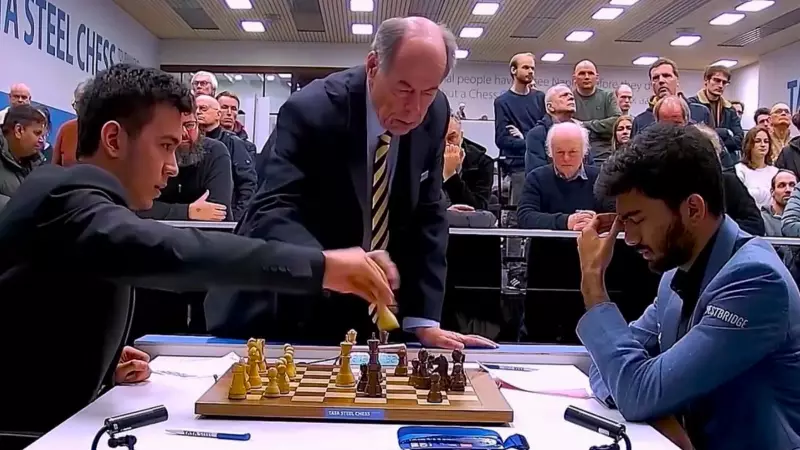
World Champion Gukesh Reflects on 'Unexplainable' Blunder at Tata Steel Chess
In a candid moment of reflection, world chess champion Gukesh Dommaraju has opened up about the stunning blunder that left him inconsolable during the Tata Steel Chess tournament in Wijk aan Zee. The young grandmaster, who recently claimed the world championship title, experienced a dramatic turn of events in his sixth-round match against arch-rival Nodirbek Abdusattorov.
The Moment That Shook the Chess World
Gukesh's blunder occurred in what appeared to be an equal position against Abdusattorov. The miscalculation proved catastrophic, immediately costing him a pawn and subsequently a rook, with checkmate looming inevitably. Recognizing the irreversible damage, Gukesh resigned from the game almost immediately after Abdusattorov's response.
The aftermath of the defeat was visibly emotional for the world champion. Tournament footage revealed Gukesh sitting speechless at the chessboard for approximately five minutes, even as his opponent attempted to engage him in post-game analysis. The Uzbekistan grandmaster showed remarkable sportsmanship, expressing sympathy for Gukesh's predicament.

Gukesh's Emotional Journey After the Blunder
Following the devastating loss, Gukesh retreated to the tournament's press room where he spent an additional 10 to 15 minutes in complete silence, his face turned away from observers as he processed what had transpired. The emotional toll was evident, with the world champion appearing genuinely inconsolable in the immediate aftermath.
The setback continued into the next round when Gukesh suffered another defeat, this time against Anish Giri. However, showing remarkable resilience, the Indian grandmaster bounced back in round eight with a victory over Vladimir Fedoseev, playing with the black pieces.
'Shit Happens': Gukesh's Frank Assessment
Speaking after his recovery victory against Fedoseev, a smiling Gukesh offered his perspective on the blunder that had captured global chess attention. "The best part about the blunder is that I cannot even explain how it happened," he stated frankly. "In a way, those kinds of blunders are perhaps easier to handle than the ones you can actually explain."
Gukesh continued with his characteristically honest assessment: "This just happens—I mean, shit happens—it's what happened. After that, I managed to move on. I think the more painful game was the one against Anish Giri because I was just completely off; I played one of my worst games in quite a while."
The world champion emphasized the challenge of maintaining performance after consecutive losses, noting: "It's been a good challenge: After two losses, I still have to play good chess, and I've managed to do that."
Opponent's Sympathetic Response
Nodirbek Abdusattorov, who benefited from Gukesh's blunder, expressed genuine sympathy for his rival's predicament. "I feel very sorry for him. It's a terrible feeling. I've done it myself many times. So it's an absolutely horrible feeling," Abdusattorov said in a post-match interview.
The Uzbekistan grandmaster analyzed the game dynamics, explaining: "This game was pretty much normal. At some point I think he was getting excited and he was obviously trying to push but I sort of controlled the margin. I thought I had a good margin to draw and at the end he was getting low on time and he felt nervous and he blundered horribly."
Indian Contingent Performance at Wijk aan Zee
While Gukesh's journey captured headlines, other Indian players continued their campaigns at the prestigious tournament. R Praggnanandhaa was held to a draw by Turkish prodigy Yagiz Kaan Erdogmus, while Arjun Erigaisi and Aravindh Chithambaram played out a stalemate in their encounter.
The Tata Steel Chess tournament in Wijk aan Zee remains one of the most prestigious events in the chess calendar, attracting elite players from around the world. Gukesh's experience highlights the intense psychological pressure that accompanies world championship status and the remarkable resilience required at the highest levels of competitive chess.