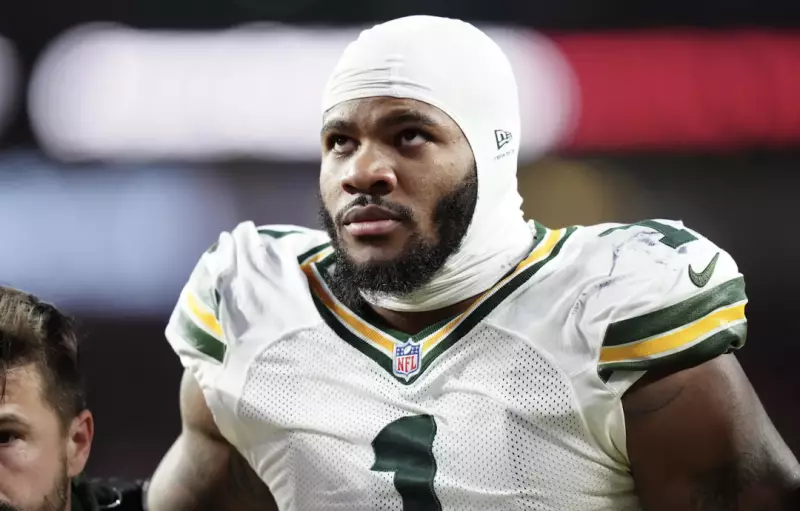
The Green Bay Packers have secured their spot in the NFL playoffs, but their journey towards the Super Bowl has suddenly become a much steeper climb. A devastating blow has struck the team at the worst possible time, casting a shadow over their postseason ambitions. The season is over for their most impactful defender, Micah Parsons, after he suffered a torn ACL, and his absence has ripped open a critical weakness in the team's defensive armor.
The Parsons Void: More Than Just a Missing Star
This isn't merely about losing a talented player from the roster. The Packers made a massive financial commitment to acquire and retain Micah Parsons, signing him to a record-setting contract with the clear expectation that he would be their game-changer. His role was to single-handedly disrupt opposing offenses with relentless pressure on the quarterback. On the surface, the team has managed to stay competitive in games since his injury. However, a deeper analytical dive reveals a defense that is beginning to fray at the edges, particularly in areas that are non-negotiable for success in January football.
The true impact of Parsons' loss is most glaringly visible on crucial downs. According to advanced metrics from ESPN, the Packers' defense has become alarmingly vulnerable on second, third, and fourth downs. Without Parsons' innate ability to generate pressure by himself, opposing quarterbacks are now operating with far too much comfort and time in obvious passing situations. The statistical fallout is severe: Green Bay now ranks near the bottom of the league in defensive efficiency on these critical later downs, consistently giving up explosive plays when a stop is absolutely essential.

A Crisis of Timing, Not Just Execution
The issue extends beyond simple mistakes like missed tackles or coverage lapses. It is fundamentally a problem of timing and intimidation. Micah Parsons' mere presence on the field forced offensive coordinators to make hurried decisions, adjust their protection schemes specifically for him, and scrap longer-developing passing routes. He was the disruptor who could end a drive before it even gained momentum. Without that central threat, the Packers' pass rush lacks its identity. While the secondary has performed admirably, coverage can only hold for so long. Quarterbacks are now buying extra time, and eventually, receivers are finding separation downfield.
Defensive coordinator Joe Barry has attempted to mask the issue with tactical adjustments. This includes mixing coverages, calling creative blitz packages, and rotating personnel. These are temporary fixes. The unforgiving nature of playoff football has a proven track record of exposing such fundamental limitations. When elite opposing offenses know a defense lacks a true one-on-one game-wrecker, they can formulate patient, confident game plans and execute them without fear.
Playoff Matchups Magnify the Problem
The concern becomes even more acute when examining the Packers' potential path in the NFC playoffs. Locked into the No. 7 seed, their journey will be entirely on the road, in hostile, loud environments where the margin for error shrinks to almost zero. Several of the top contenders they could face, like the San Francisco 49ers and Philadelphia Eagles, possess offenses that excel in the very area Green Bay now struggles with: converting second- and third-downs through the air. These teams are masters at extending drives, exploiting favourable matchups, and punishing defenses that cannot generate consistent pressure without committing extra blitzers.
Asking a patchwork pass rush to suddenly find its rhythm against top-tier quarterbacks in these high-stakes conditions is a monumental gamble. The Packers remain a dangerous, disciplined, and well-coached team capable of winning any given Sunday. However, the injury to Micah Parsons has starkly revealed their most significant defensive flaw at the worst possible moment: the inability to consistently close out passing downs against elite offenses. In the single-elimination crucible of the NFL playoffs, that one weakness could very well be the deciding factor between an early, hard-fought exit and an unexpected, deep run towards glory.