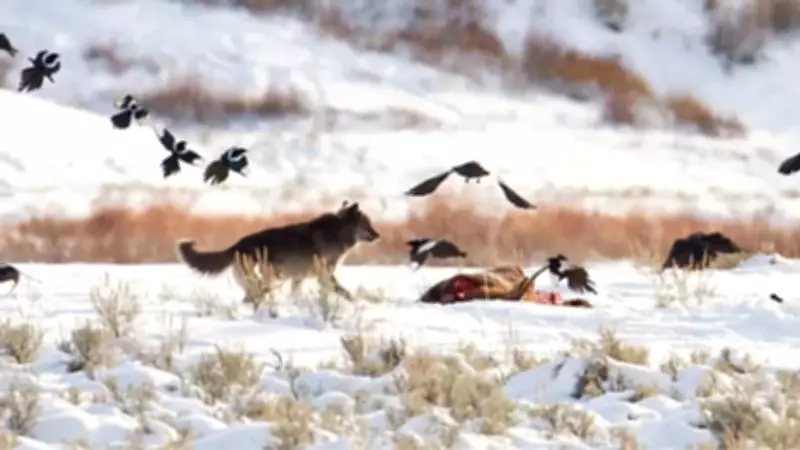
Ravens Rely on Spatial Memory, Not Wolf Tracking, to Locate Carcasses in Yellowstone
For decades, scientists held a straightforward belief about ravens and wolves: the birds simply trailed the predators to feed on fresh carcasses. The concept was intuitive—follow the hunter and feast while the blood is still wet. However, recent research conducted over two and a half years in Yellowstone National Park has dramatically overturned this assumption.
Groundbreaking Study Reveals Ravens' Cognitive Abilities
The study, published in the prestigious journal Science and led by the Research Institute of Wildlife Ecology at the University of Veterinary Medicine Vienna in collaboration with the Max Planck Institute of Animal Behaviour in Germany, demonstrates that ravens utilize their spatial memory to locate wolf kills rather than shadowing wolves closely. This finding suggests the birds possess sophisticated cognitive capabilities previously underestimated in scavenger species.
Researchers equipped 69 ravens with small GPS devices, as detailed in reports, enabling meticulous monitoring of their movements. Simultaneously, they tracked 20 wolves during winter months. Data collection occurred at regular intervals—ravens every 30 minutes and wolves every hour. Surprisingly, the results showed only one instance where a raven followed a wolf for more than a kilometer or longer than an hour.

How Ravens Remember the Landscape
The research, titled 'Ravens anticipate wolf kill sites across broad scales,' reveals that ravens appear to learn and remember which areas are historically prone to wolf kills. Flat valley bottoms where wolves hunt successfully emerge as particularly productive zones. While individual kills are unpredictable, certain regions consistently provide food over time.
Ravens exploit these patterns by flying substantial distances—some birds reportedly traveled up to 155 kilometers in a single day toward likely carcass sites. This behavior indicates they are not tied to specific wolf packs but instead scan vast areas and return to locations that have previously yielded results.
Reshaping Understanding of Scavenger Behavior
This discovery fundamentally changes how scientists perceive scavenger behavior. Ravens demonstrate flexibility in foraging, choosing spots based on memory and environmental cues rather than dependency on predators. Senior author John M. Marzluff of the University of Washington suggests that many scavenger species might have been underestimated in their cognitive abilities.
The study highlights that ravens combine instinct with memory to maximize survival, acting as planners in their own right. This challenges the traditional view of scavengers as opportunistic followers, revealing them as strategic thinkers capable of complex spatial reasoning.
The implications extend beyond ravens, potentially influencing broader ecological research on animal intelligence and foraging strategies. As scientists continue to explore these dynamics, the humble raven stands as a testament to the unexpected sophistication found in the natural world.