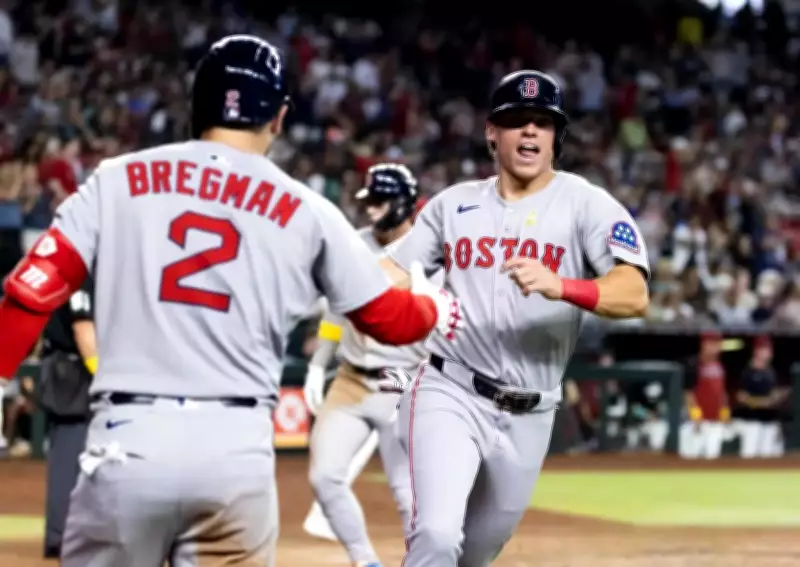
As the 2026 Major League Baseball season approaches, the Boston Red Sox are actively exploring strategic moves to compensate for the significant offensive production lost when star player Alex Bregman departed for the Chicago Cubs. Recent trade discussions have centered on acquiring Houston Astros third baseman Isaac Paredes, a move that could reshape Boston's lineup and provide much-needed right-handed power.
Proposed Trade Framework and Financial Implications
One prominent trade proposal circulating among baseball analysts would see Boston sending infielder Romy Gonzalez and their fifth-ranked prospect, outfielder Justin Gonzales, to Houston in exchange for Paredes. This potential deal represents a calculated gamble for both franchises, with Boston seeking immediate offensive reinforcement while Houston would acquire a major-league ready player, a promising young talent, and valuable financial flexibility.
Contract Details and Player Profiles
Isaac Paredes, age 27, remains under team control for two additional seasons through arbitration and is projected to earn approximately $9.35 million this year. His contractual situation makes him an attractive target for Boston, offering more predictability than pursuing free agents. Romy Gonzalez, 29, recently agreed to a one-year contract worth $1.6 million with Boston, while Justin Gonzales represents one of the organization's most promising young talents at just 19 years old.

Statistical Analysis and Player Strengths
Paredes demonstrated solid production during the 2025 season, posting a .254/.352/.458 slash line with an .809 OPS across 102 games. His 15 doubles and 53 RBIs showcase his offensive capabilities, while his positional flexibility—able to play third base, second base, and first base—provides valuable versatility for manager Alex Cora's lineup configurations. Though his defense at third base has been considered below average, his ability to shift to second base mitigates this concern.
Romy Gonzalez delivered impressive numbers in 2025, hitting .305/.343/.483 with 23 doubles, 3 triples, 9 home runs, and 53 RBIs in 341 plate appearances. His consistent contact hitting and improving power make him an attractive asset for Houston, though his defensive consistency has been questioned at times.
Justin Gonzales, as Boston's fifth-ranked prospect, brings significant long-term potential with his combination of power and speed, though he remains a developing talent requiring further refinement in the minor leagues.
Strategic Benefits for Both Franchises
Why This Trade Makes Sense for Boston
The acquisition of Isaac Paredes would address multiple needs for the Red Sox simultaneously. His right-handed power bat could particularly benefit from Fenway Park's unique dimensions, potentially unlocking additional offensive production. The two remaining years of arbitration control provide Boston with cost certainty and roster stability during a critical competitive window. Furthermore, Paredes' defensive versatility across multiple infield positions gives manager Alex Cora enhanced lineup flexibility and strategic options.
Potential Advantages for Houston
For the Astros, this trade offers both immediate and future value. Romy Gonzalez provides proven major-league production and defensive versatility that could strengthen Houston's current roster. Justin Gonzales represents a high-upside prospect who could develop into a cornerstone outfielder in coming seasons. Financially, moving Paredes' $9.35 million salary would create payroll flexibility that Houston could redirect toward addressing other roster needs, particularly pitching depth or outfield reinforcements.
Trade Evaluation and Risk Assessment
Boston Red Sox Potential Gains:
- Addition of a proven right-handed power hitter well-suited to Fenway Park
- Enhanced infield defensive flexibility with Paredes' multi-position capability
- Two affordable years of team control through arbitration
- Immediate offensive production to replace Bregman's contributions
Boston Red Sox Potential Risks:

- Surrendering a productive major-league infielder in Romy Gonzalez
- Losing a top-five organizational prospect in Justin Gonzales
- Potential defensive adjustments if Paredes struggles at third base
- Reduced organizational depth in both infield and outfield positions
Houston Astros Potential Benefits:
- Acquisition of immediate offensive production through Gonzalez
- Addition of a high-ceiling prospect with long-term potential
- Enhanced roster depth and defensive versatility
- Significant payroll flexibility by moving Paredes' contract
Houston Astros Potential Drawbacks:
- Trading a two-time All-Star in his prime years
- Weakening infield stability and defensive reliability
- Assuming development risk with a young prospect
- Potential offensive production drop at third base position
Comparative Analysis and Long-Term Implications
Demographically, this trade involves players at different career stages: Paredes at 27 enters his prime years with two seasons of control, Gonzalez at 29 has demonstrated major-league production capability, and Gonzales at 19 represents long-term developmental potential. The statistical comparison reveals Paredes' steady production versus Gonzalez's higher batting average but similar power numbers.
Most baseball analysts suggest Boston would gain the greater immediate benefit from this transaction. Paredes directly addresses their most pressing need—replacing Alex Bregman's offensive production—while providing defensive versatility and contractual control. Houston would receive valuable assets but trades certainty for potential, a calculated risk that could pay dividends if Gonzales develops as projected and Gonzalez maintains his 2025 production levels.
If completed, this trade would help Boston stabilize their lineup for the 2026 season while providing Houston with a balanced return of present value and future potential. The deal reflects the strategic calculations both franchises must make as they position themselves for competitive success in the coming MLB seasons.