An Unplanned Beginning on Ladakh's Icy Surfaces
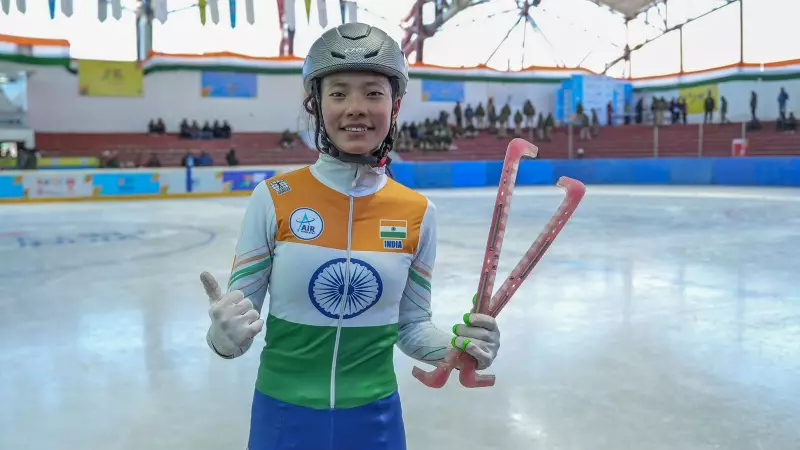
When Skarma Tsultim first laced up ice skating boots during the winter of 2018, there was no grand strategy, no external pressure, and certainly no colossal dream attached to the activity. She was merely a schoolgirl participating in a standard fifteen-day winter sports training camp, experiencing ice skating for the initial time alongside numerous other children from the Ladakh region. During that introductory camp, she acquired fundamental skating skills and discovered the sport felt surprisingly manageable. It neither frightened her nor seemed burdensome; instead, it felt completely natural. That camp bestowed upon her something beyond technique—it planted a seed of an idea. This idea would later blossom into reality, significantly aided by the emergence of the Khelo India Winter Games (KIWG). Winters arrived, the skating boots emerged, and when the season concluded, daily life resumed its ordinary rhythm.
The Unexpected Scout and National Debut
This pattern shifted dramatically in 2021. In Ladakh, where schools typically close during winter and most athletic activities decelerate, ice hockey and skating become ubiquitous. The frozen Gupukhs—Leh's natural ponds—transform into expansive playgrounds. Skarma and her brother skated there freely, just like any other local child. Unbeknownst to her, she was under observation. Coach Abbas Nordak, actively scouting for promising talent, noticed her fluid movements and selected her, a pivotal moment that subtly redirected her life's trajectory. From that point forward, Skarma began attending regular winter training camps. Remarkably, within a single year under Nordak's dedicated coaching, she earned a spot to compete at the prestigious 17th National Speed Skating Championship held at ISKATE in Gurugram.
Skarma Tsultim candidly describes that inaugural national experience as "bad." It marked her first encounter with artificial ice, her initial exposure to the immense scale of competitive sports, and the unfamiliar environment combined with the high caliber of athletes proved overwhelming. Despite this, her training persisted, extending even into summer months with focused muscle conditioning, roller skating practice, and maintaining overall physical activity. Her father would often drive her considerable distances, sometimes 20 to 40 kilometers, for roller skating sessions, while her mother consistently reminded her to stay humble and skate primarily for the inherent joy of the sport, not merely for accolades. She later participated in the 18th National Speed Skating Championship, though without achieving significant recognition at that stage.

The Turning Point at Khelo India Winter Games
The true turning point arrived in 2023 at the third edition of the KIWG in Gulmarg. This event was historic as it featured participation from seven athletes representing Ladakh. Skarma competed in short track speed skating and clinched a silver medal in the Junior Girls (15–19 years) 1000-meter event. This medal held profound significance—not just for its place on the podium, but for the realization it sparked within her. This performance led to her selection for the Indian speed skating contingent, propelling her to the South East Asian Championship 2023 in Singapore, which included preparatory training in the Philippines.
"My international journey started here," she reflects. It was slated to be her debut international competition, and she stood as the sole athlete from Ladakh on the national team. "It wasn't easy. I felt out of place," Skarma admits. Language posed a substantial barrier, and her inherent shyness made communication challenging, even within the Indian team. She recalls feeling intimidated by athletes from nations like Japan, Indonesia, Chinese Taipei, and China, noting their professional equipment, custom-made skates, physical stature, and palpable confidence. By her own assessment, her performance "wasn't good," resulting in an 11th-place finish in the 1000m. However, the result did not encapsulate the moment's true value. The Khelo India platform became her crucial launchpad—the definitive starting point of her international sporting journey.

Community Support and Renewed Determination
Following this, Skarma entered a phase of doubt, questioning whether speed skating was truly her calling, especially as her academic performance dipped and the transition from basic to advanced skills felt like an insurmountable wall. She returned home, and what awaited her at the airport profoundly moved her, providing a powerful reason to persevere. Family, friends, fellow villagers, and even the Goba (village head) had gathered to welcome her. Their reception was not for winning medals, but for honorably representing India on an international stage. She received recognition from the LAHDC councillor of her region, and Geshe-la, the head chamberlain of Thiksey Monastery, invited her for tea and presented gifts. This experience touched her deeply, making her feel seen and valued in an unprecedented way. This overwhelming support from her entire community became the foundational reason she chose to remain committed to the sport.
Dominance on Home Ice and Coaching Inspiration
At the 4th KIWG hosted in Ladakh, Skarma finally discovered her competitive rhythm. Medals followed in succession: a gold in the women's team relay (marking the first time a Ladakh team stood atop the podium), a silver in the long track 500m, another silver in the mixed relay, and a bronze in long track. The subsequent year, at the 5th edition, she secured her first individual gold medal in the 1000m short track among other achievements—a moment she holds especially dear. During this time, her coach Abbas Nordak was in Harbin, China, serving as head coach for the Indian Ice Skating contingent. Upon hearing of her victory, Skarma notes simply, "Sir was happy." That same year, Team UT Ladakh topped the overall medal tally for the first time. Skarma later represented India at the Asian Open Short Track Speed Skating Trophy in Jakarta in 2024.
She emphasizes that Coach Abbas Nordak has been her primary source of inspiration, motivation, and guidance. For years, he has coached numerous athletes from Ladakh without charging any fees, often personally covering various expenses. "We skipped training more than sir, and he worked harder than any of us," she acknowledges. Financial constraints continue to restrict access to many international leagues for athletes from the region. However, platforms like the Khelo India Winter Games have been instrumental in providing her with vital recognition, exposure, and self-confidence. They facilitated her critical transition "from basic to intermediate"—a phase she has now clearly surpassed, evidenced by her gold medal triumphs.
Olympic Dreams and Future Aspirations
Now, at the 6th edition of the Khelo India Winter Games, Skarma Tsultim is set to compete in not one but two individual events—the 500m and 1000m short track speed skating—in addition to the relay races. Her remarkable journey did not originate from burning ambition. Instead, it evolved organically through steadfast coaching, consistent national platforms like KIWG, and a supportive community that rallied behind her when she needed it most. The enduring hope that individual speed skating can one day lead her to the Olympic Games, a dream she has nurtured since first wearing skating boots seven years ago, offers inspiration not only to her coach and family but to the entire region of Ladakh. One day, the world may witness Skarma—living up to the meaning of her name, which translates to "star" in Ladakhi—shining brilliantly not just on the Khelo India stage, but potentially on the grandest athletic platform of all: the Olympics.