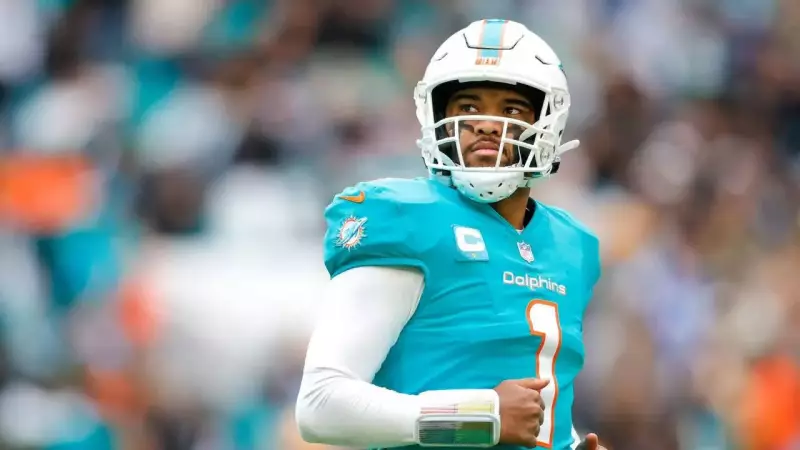
The whispers have turned into a public roar. Miami Dolphins quarterback Tua Tagovailoa, once the franchise's cornerstone, now finds himself at the centre of a storm of criticism, a demotion to the bench, and a contract situation that threatens to paralyse the team's future. What was quietly debated in NFL circles is now out in the open, forcing a brutal reassessment in Miami.
From Franchise Hope to League-Wide Skepticism
According to ESPN's Jeremy Fowler, who spoke to multiple league sources, the consensus on Tagovailoa has shifted dramatically. The tone is no longer one of concern but of outright skepticism. NFL evaluators are now openly questioning his decision-making and pointing to a clear regression in his play during the 2025 season.
The numbers paint a stark picture. Tagovailoa ranks 30th in the NFL with a QBR of 36.7, just behind the New York Jets' Justin Fields. More damning is his interception tally: 15 picks in 14 starts, tied for the most in the league. He threw at least one interception in nine of those games, with the Dolphins posting a 6-8 record in his starts.

"I saw a quarterback who couldn’t play football after his first read," one defensive coach who prepared for him told Fowler. "And then he was on the interception train damn near every week." This decline is particularly jarring after two solid seasons where he ranked 10th (2023) and 15th (2024) in QBR.
The On-Field Decline and a Defining Benching
Evaluators noted to Fowler that Tagovailoa's mobility has declined, and his ability to escape pressure has faded. A veteran scout pointed out he is "not as twitchy or explosive as he was a year and a half ago," adding that his previously sharp footwork, which helped offset arm strength limitations, has deteriorated.
His concerning injury history, especially regarding concussions, remains a shadow over his evaluation. One NFL personnel evaluator wondered if the mental pressure to stay healthy was affecting his play. This caution seemed evident in a critical Week 15 moment against the Pittsburgh Steelers. With playoff hopes alive, Tagovailoa scrambled for just one yard on a third-and-2 and did not push for the first down.
Head coach Mike McDaniel's response was decisive. He benched his starting quarterback, opting for rookie seventh-round pick Quinn Ewers. McDaniel stated he wanted "convicted play" at the position, a clear signal that confidence in Tagovailoa after 55 regular-season games together had eroded.
A Financial Quagmire With No Easy Escape
The on-field struggles would be challenging enough, but Miami's problem is magnified exponentially by Tagovailoa's contract. He is in the first year of a four-year, $212.4 million extension signed in July 2024, with $167 million guaranteed.
The financial ramifications of moving on are staggering:
- Releasing him before June 1 would trigger an immediate $99.2 million in dead cap money, plus an additional $42.8 million cap hit that year.
- A post-June 1 release would spread the pain to $67.4 million in dead money in 2026 and $31.8 million in 2027.
- A trade before June 1 would save only $11.2 million in cap space while still resulting in a $45.2 million dead cap hit. League executives are skeptical any team would take on the contract.
"Cutting him doesn’t help them financially," one NFC executive told Fowler. Another bluntly stated, "They are almost stuck with him."
This crisis hits as the Dolphins already face salary cap stress, projected to be $2.9 million over the cap for 2026 with the sixth-highest dead money. Fowler reported that the team might have to consider releasing high-priced veterans like Tyreek Hill, Bradley Chubb, or Minkah Fitzpatrick to create space, a move that would further weaken the roster.
The situation presents a brutal collision of football performance and financial reality. With the Dolphins yet to hire a permanent general manager, the decision on Tua Tagovailoa—once viewed as the long-term answer—hangs in the balance as the most expensive and pressing question in Miami.