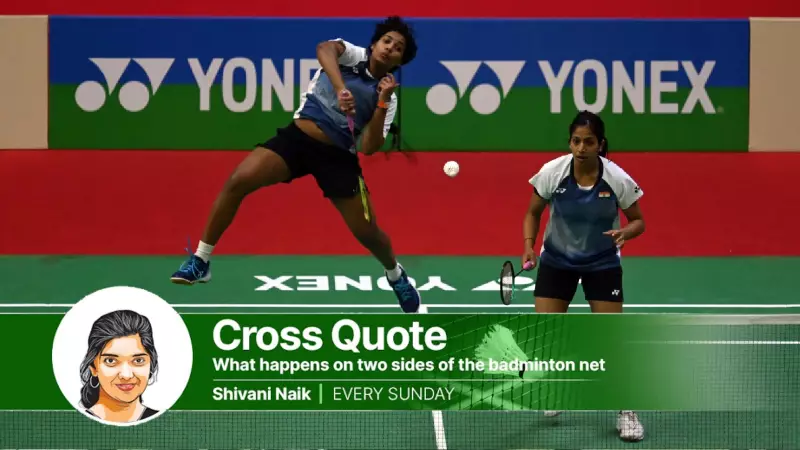
For Indian badminton stars Treesa Jolly and Gayatri Gopichand, the path to the top of the women's doubles circuit demands a new, sophisticated form of aggression. It's not just about power smashes; it's a complex blend of offensive intent and rock-solid defence, a style they are diligently crafting to compete with the world's best.
The Sindhu Blueprint and a Tougher Challenge
The concept of cultivated aggression is not new to coach Pullela Gopichand. Almost a decade ago, he transformed PV Sindhu from a mild-mannered player into a vocal, assertive champion, a trait that powered her to a World Championship gold in 2019. Today, he faces a different puzzle with Treesa and Gayatri. The aggression required in women's doubles is far more nuanced and difficult to execute than in singles.
This is because the defensive capabilities of top pairs from Japan, Korea, and China are exceptionally strong. A single powerful smash, like the ones Sindhu is famous for, is often not enough to finish a rally. Exchanges routinely stretch to 70-80 shots, a frequency rarely seen in singles. Therefore, their aggression must be multi-dimensional.

Deconstructing Modern Doubles Aggression
For Treesa and Gayatri, true aggression now encompasses a complete tactical package. It involves seizing front-court initiative, deploying last-second feints, and maintaining shuttle control that pressures opponents. Crucially, it requires a defence-on-loop that remains unshaken under heavy fire and the strategic patience to control the rally's pace before unleashing an explosive finish.
While Treesa possesses raw hitting power and Gayatri brings clever variations and a sharp wrist, their recent Syed Modi International Super 300 title in Lucknow highlighted a recurring goal. As Gayatri stated, the focus is on "balancing aggression with stability." This win, though a significant step for Indian women's doubles, underscored that an all-out attacking style is no longer optional against the elite—it's the bare minimum.
The Stability Shot: A Strategic Weapon
The duo's evolving strategy mirrors the approach of top singles players like Akane Yamaguchi and Tai Tzu-ying, who use accuracy and deception to set up killing opportunities. For Treesa and Gayatri, the key is a stabilizing phase built around long, deep lifts. These shots, used strategically like flick serves, serve a dual purpose.
They pin opponents to the backcourt, disrupt forecourt setups, and, due to their controlled parabola, buy precious time. The high, loopy trajectory makes the shuttle difficult to attack outright, forcing rivals to expend considerable energy. This patience allows the Indian pair to build patterns precisely to break them, waiting for the right moment to strike.
This means Treesa has refined her game, learning to nuance her smashes, play the extra shot, and maintain positional discipline. Gayatri, meanwhile, focuses on creating openings while knowing when to end a rally. Their journey is a masterclass in supplementing nano-doses of aggression with composed stability—the winning combination they must master to consistently challenge the world's best.