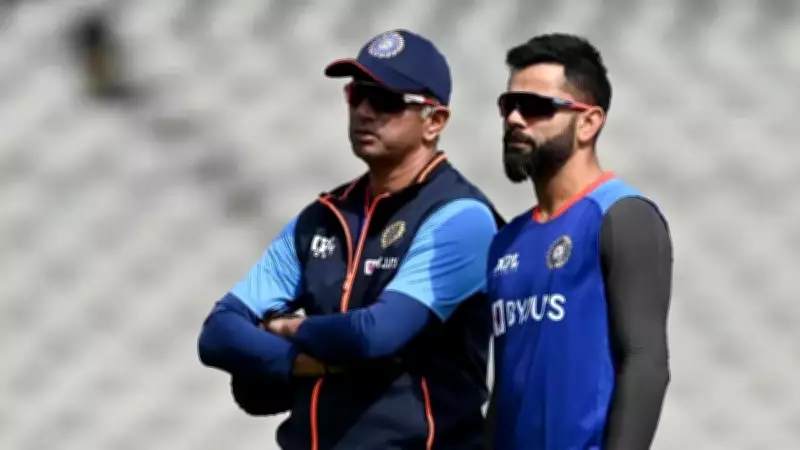
Former India head coach Rahul Dravid has expressed disagreement with Gautam Gambhir's vision of eliminating the superstar culture in Indian cricket. Dravid emphasized that every sport requires its heroes and that individual brilliance contributes significantly to team victories.
Dravid's Stance on Superstars
Gambhir has frequently advocated for reducing the emphasis on individual players and prioritizing collective success. Responding to this, Dravid stated that players achieve superstar status only through consistent performances that help their teams win. "Any sport needs its heroes, and I don't think people become heroes without performances. You can't capture the imagination of a nation if you don't deliver on the field, especially in India, where you get a lot of praise for what you do, but also a lot of brickbats," Dravid told Wisden on the Scoop podcast. He added that becoming a legend in India requires doing many things right while also contributing to team wins.
Reflections on Past and Present
Dravid, who played alongside icons like Sachin Tendulkar, Sourav Ganguly, VVS Laxman, and Virender Sehwag, noted that Indian cricket reached new heights during that era due to the presence of multiple star players. Addressing India's recent struggles in Test cricket under Gambhir's coaching, Dravid acknowledged the challenge of replacing retired stalwarts such as Rohit Sharma, Virat Kohli, and Ravichandran Ashwin. However, he expressed confidence in the team's ability to bounce back. "The passion to do well in red-ball cricket is definitely there. We've had a couple of series where we haven't performed as well as an Indian team, and that can happen. We are also missing a few key players... it is not easy to replace players like that. But Indian cricket remains very strong," he said.

Balancing Formats
Dravid also commented on the difficulty players face in balancing formats due to the crowded cricket calendar. He highlighted that while red-ball cricket remains important and personally satisfying, the volume of white-ball cricket makes preparation challenging. "Many of these players today are having to juggle multiple formats, and it is not always easy because they may not get as much time to prepare for red-ball cricket as my generation did," he explained.