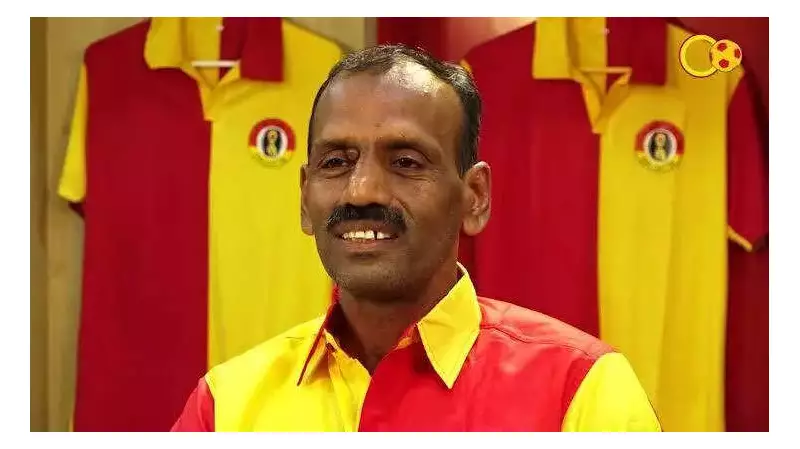
Kolkata: The crisp November air of 1993 carried a familiar chill through the Capital, but inside the Ambedkar Stadium dressing room, a different kind of nervousness gripped East Bengal's captain. As coach Shyamal Ghosh nudged Ilyas Pasha to deliver the customary pre-match speech before the Durand Cup final against Punjab State Electricity Board, the ever-reliable defender found himself at a loss for words.
A Captain of Few Words, A Player of Immense Substance
"Sab ko achcha khelna hain or final bhi jitna hain (Everyone has to play well and win the final)," Pasha managed to utter, rushing through his words much like he would sprint down the right flank. When a bemused teammate pressed for more, the shy captain blushed and added, "Theek hain, agar hum jit jaaye, main sab ko chocolate khilaunga (Alright, if we win, I will buy everyone a chocolate)." A few hours later, true to his unassuming promise, Pasha lifted the Durand Cup trophy after Sanjoy Majhi's solitary goal secured victory. This poignant moment perfectly encapsulated Ilyas Pasha—a man of simple words but sublime talent, reticent yet remarkably resolute on the pitch.
Carrying a Legacy from Karnataka to Kolkata's Maidan
Pasha, who passed away in Bengaluru on Thursday at the age of 61 after a prolonged illness, leaves behind a legacy that bridged two footballing cultures. Hailing from Karnataka, he carried the rich legacy of legends like Ahmed Khan and Mariappa Kempaiah, seamlessly assimilating into the fierce, competitive environment of Kolkata's Maidan. His journey to the top began with Bengaluru-based ITI before a pivotal move to Kolkata in 1989 with Mohammedan Sporting. "He was a raw and rare talent when he came," recalled Debabrata Sarkar, a senior East Bengal official. "Next season, we virtually 'kidnapped' him to ensure he signed for us. He was shy and simple—a perfect gentleman footballer."

The Cerebral Defender Who Let His Football Do the Talking
From 1990 to 1998, Pasha became the bedrock of East Bengal's defense, forming an impregnable backline with stalwarts like Manoranjan Bhattacharya and Krishnendu Roy. While his international career was brief—just eight caps for India after debuting in 1987—he became Mr. Reliable for every East Bengal coach in the 1990s. His former colleagues often highlight his cerebral defending as his standout quality. Unlike many defenders of his era known for aggression, Pasha relied on calm composure, exceptional peripheral vision, and an uncanny ability to read the game.
"When I joined East Bengal in 1997, he never saw me as a competitor," said former India defender Phalguni Dutta. "He was like an elder brother and a guide, always supportive." This selfless attitude translated into team success. In his very first season, East Bengal clinched the coveted triple crown under coach Syed Nayeemuddin. As captain from 1993, his leadership saw the club lift the Wai Wai Cup in Kathmandu—their first international trophy—and achieve a historic 6-2 victory over Iraqi powerhouse Al-Zawra in the Asian Cup Winners' Cup, a match still celebrated as one of Indian club football's greatest international triumphs.
A Bittersweet Twilight: Financial Struggles and Lasting Honors
However, life after retirement proved challenging for the football legend. Returning to Bengaluru, Pasha faced significant financial difficulties, a stark contrast to his glorious playing days. East Bengal stood by their former captain, providing financial assistance and honoring him with a special Lifetime Achievement Award in 2012. Yet, away from the public eye, his final years were marked by struggle, ending a brilliant career on a somber note.
Ilyas Pasha is survived by his wife, two daughters, and two sons. His passing marks the end of an era for Indian football, reminding fans of a time when grace, simplicity, and sheer talent defined the beautiful game. In the annals of East Bengal and Karnataka football, he will forever be remembered not for grand speeches, but for the quiet, powerful elegance he brought to every match.