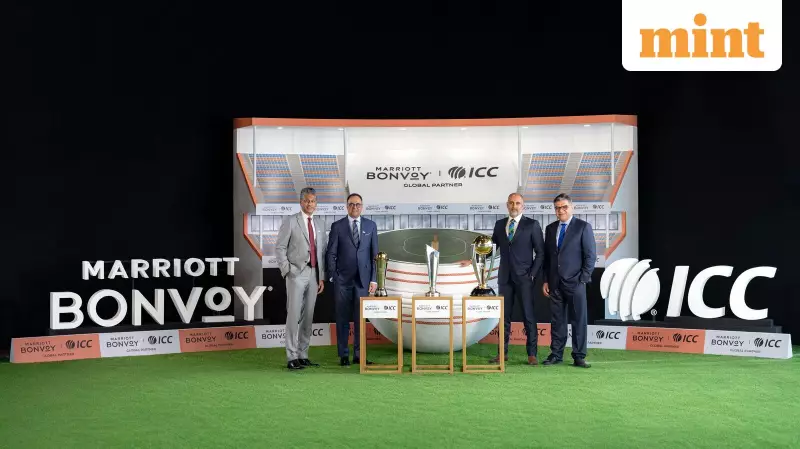
The International Cricket Council (ICC) has secured a significant, long-term global partnership with hospitality giant Marriott International. The deal names Marriott's Bonvoy loyalty programme as the official accommodation partner for all ICC men's events through 2029. This marks the third major global sponsorship announcement by the ICC in the past month, following agreements with AB InBev's Budweiser and Hyundai Motor.
A Strategic Alliance for Global Growth
Announced on Friday, this partnership spans major tournaments including the upcoming T20 World Cup in India and Sri Lanka (2026), the ODI World Cup in South Africa, Zimbabwe, and Namibia (2027), the 2028 T20 World Cup in Australia and New Zealand, and the 2029 Champions Trophy in India. The collaboration highlights a strategic shift for both entities. The ICC is securing longer-term sponsorships amid pressures on media-rights revenues, while Marriott aims to reposition Bonvoy from a points-based scheme to an experience-led platform, tapping into the growing sports tourism market.
Sanjog Gupta, CEO of ICC, emphasized the synergy in global reach. "We have close to 2 billion fans across the world, Marriott has a presence in more than 140 countries," he stated. "Cricket is now played in over 120 countries... its recognition and visibility around the world is only going to increase." For Marriott, cricket offers a path to deepen engagement with its 260 million members through curated content and local events.

Driving Experience Beyond Transactions
Rajeev Menon, President, Asia-Pacific (excluding China) for Marriott International, stressed the experiential focus. "It is critically important that we see ourselves far beyond just a transaction-based loyalty program. It really is an experiential-based loyalty program," he said. ICC executives believe the partnership will enhance the travel experience for fans attending matches domestically or overseas, aiming to mirror the spectacle of events like Formula 1 or the NFL.
Notably, the Marriott deal's duration stands out. While recent partnerships with Budweiser and Hyundai are for two years each, this agreement extends much further. Anurag Dahiya, ICC's Chief Commercial Officer, noted this as an exception, viewing it as a very long-term partnership aligned with Marriott's history of sustained sports collaborations.
The Sports Tourism Opportunity in India
Although focused on driving sports tourism, the segment remains nascent in India. KPMG estimated it was worth ₹9,200 crore in FY25, projecting growth at a 10% CAGR to ₹14,800 crore by 2030. Cricket is the largest driver, with IPL and ICC World Cups attracting millions of domestic travellers. Mega-events also bring significant international visitors, boosting host city economies.
Marriott executives also see potential in outbound tourism from India. Satya Anand, President for Europe, Middle East, and Africa at Marriott, highlighted the Middle East, particularly the UAE, as a key destination. "Whenever we host an event like cricket in the UAE, we get so many Indian travellers coming... It is a huge market to tap into," he said.
Sponsorship Strategy Amid Economic Headwinds
The Marriott deal comes as the ICC navigates a challenging media-rights landscape. Reports of broadcasters seeking early exits and warnings of potential revenue declines up to 30% in 2028 have surfaced. ICC's event revenue fell 13.1% to $728.4 million in 2024.
In response, the ICC has adopted a 'Less is More' sponsorship strategy. Starting in 2024, it reduced its partner roster to 10 slots (4 Premier and 6 Global Partners) from the previous cycle's clutter. This aims to give each brand a larger share of voice. "We are sold out on our tier-1... That is proof that the strategy has worked very well," affirmed Anurag Dahiya. This approach has attracted high-profile brands like Sobha Realty, Unilever (for Dove and Rexona in women's events), and now Marriott, securing the council's commercial future through 2029.