India's T20 World Cup Super 8 Campaign Begins with Devastating 76-Run Loss to South Africa
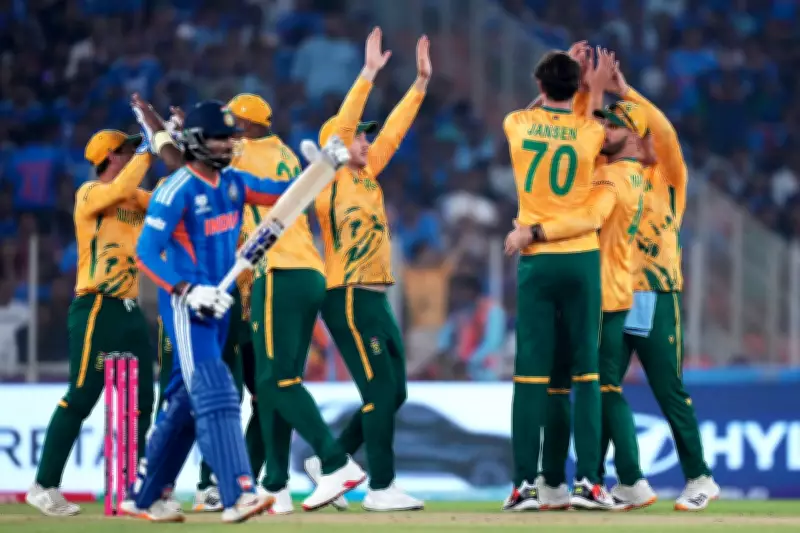
The Indian cricket team's journey in the Super 8 stage of the T20 World Cup 2026 commenced in the worst possible fashion, as they endured a comprehensive and demoralizing 76-run defeat at the hands of South Africa. The match, held at the iconic Narendra Modi Stadium in Ahmedabad on Sunday night, saw the hosts' batting lineup collapse spectacularly while chasing a target of 187/7, turning what was anticipated to be a thrilling contest into a one-sided affair.
Batting Collapse Leaves India Reeling
India's pursuit of the challenging total got off to a disastrous start when opener Ishan Kishan was dismissed for a duck in the very first over. This early setback set the tone for the entire innings, which never managed to find any stability or momentum. The middle order, comprising Abhishek Sharma, Tilak Varma, Suryakumar Yadav, Hardik Pandya, Rinku Singh, Shivam Dube, and Washington Sundar, all failed to make significant contributions, leaving the team in disarray.
Shivam Dube emerged as the top scorer with 42 runs, but his innings consumed 37 deliveries, highlighting India's severe struggle to maintain the required run rate. The overall batting performance was widely described as deeply disappointing and lacking in intent, with the team being bowled out well short of the target.

Expert Criticism of India's Batting Approach
Former Indian captain and legendary batsman Sunil Gavaskar was highly critical of the team's batting strategy during the post-match analysis. He pointed to the contrasting manner in which South Africa's Dewald Brevis and David Miller rebuilt their innings after an early stumble.
"If you observe how Brevis and Miller reconstructed the South African innings, they played a lot more shots straight down the ground, particularly when facing the short ball. They adapted exceptionally well, realizing that the ball wasn't coming onto the bat as quickly as anticipated—it was holding up slightly on the surface. Having witnessed how they constructed that partnership, that was precisely the kind of approach required, rather than merely swinging the bat at everything," Gavaskar explained to Star Sports.
South Africa's Resilient Recovery Sets Up Victory
South Africa themselves faced early pressure, finding themselves at a precarious 20/3 before the partnership between Miller and Brevis steadied the ship. Once settled, the duo accelerated aggressively, targeting the Indian bowling attack. Spinner Varun Chakaravarthy bore the brunt of the assault, conceding 47 runs for one wicket, while all-rounders Hardik Pandya (0/45) and Shivam Dube (1/32 in 2 overs) also proved expensive.
Proteas great Shaun Pollock supported Gavaskar's assessment, emphasizing India's failure to adapt to the match conditions. "I don't believe there was sufficient adaptability from India's perspective. South Africa had already played three matches on this ground, giving them a thorough understanding of the surface behavior. They struggled initially but adjusted, and only after the Brevis-Miller partnership gained momentum were they able to play more freely," Pollock noted.
Implications for India's Tournament Prospects
The heavy defeat has severely impacted India's net run rate, which now stands at a concerning -3.800. This significantly complicates their path to the semi-finals, as they must now secure convincing victories against both Zimbabwe and the West Indies to revive their chances. While Group 1 remains competitively open, immense pressure is mounting on captain Suryakumar Yadav and his squad to deliver improved performances in the upcoming crucial fixtures.
The team's inability to execute a coherent batting plan, coupled with expensive bowling spells, has raised serious questions about their preparedness and strategic flexibility in high-stakes matches. As the T20 World Cup progresses, India faces an uphill battle to qualify for the knockout stages, making every remaining match a virtual must-win encounter.