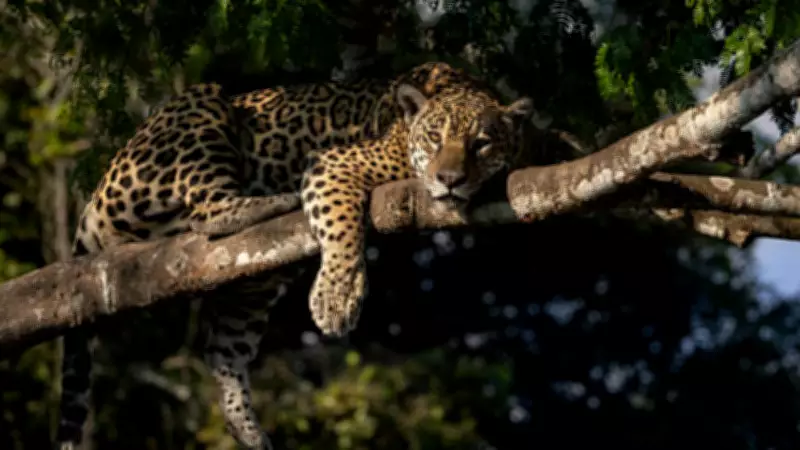
The Most Powerful Bite in the Cat Family
Pound for pound, no wild cat on Earth bites harder than a jaguar. The jaw muscles attach differently, giving it mechanical leverage that translates into crushing power most animals simply do not have. Lions and tigers go for the throat, but jaguars go straight for the skull or the spine. They have evolved a killing style that is uniquely brutal and uniquely efficient. One clean puncture through bone into the brain, and the prey does not suffer long.
Built for the Jungle, Not the Savanna
The jaguar's whole body is a study in adaptation. It is stocky, muscular, and lower to the ground than a leopard, less built for sprinting across open land and more built for wrestling things into submission in dense jungle. Its legs are shorter relative to body size, which gives it a low center of gravity. Jaguars love water. Most cats treat it like a minor inconvenience, but jaguars swim in it, hunt in it, and seem genuinely unbothered by rivers that would send other predators around the long way. They wade into the Amazon or the Pantanal and come out with a fish, a turtle, or something far more dramatic. The turtle thing is worth pausing on: they bite straight through the shell that evolution spent millions of years hardening.
What They Actually Eat (It Is a Long List)
Jaguars are what ecologists call apex predators. They eat pretty much whatever they can catch, and in the ecosystems they live in, that means an enormous variety: deer, peccaries, capybaras, caimans, anacondas, fish, turtles, and domestic cattle when food gets scarce. They are ambush hunters, not chasers. A jaguar will not run you down across a field. It waits, moves slowly through cover, closes the distance to almost nothing, and then explodes forward for one precise strike.

They Are Bigger Than You Think
Most people picture jaguars as slightly larger leopards, but that is not quite right. A big male jaguar can weigh 250 pounds or more, and they carry that weight in a way that is even more imposing than the number suggests. The head alone is massive. When you see one up close, in a sanctuary or in the wild if you are incredibly lucky, the size of the skull is the first thing that registers. It looks disproportionate, almost cartoonishly large, until you remember what that skull is built to do.
Why They Matter More Than We Realize
The jaguar's estimated world population sits at around 173,000, from rugged mountain terrain in the southwestern United States through tropical rainforests in Brazil and Belize and into the dry forests of Argentina. According to the U.S. Fish and Wildlife Service, the primary threats across the jaguar's range are habitat loss and fragmentation, killing for trophies and illegal trade in body parts, and retaliatory killing tied to livestock depredation. Jaguars are what scientists call a keystone species. When they disappear from an ecosystem, the whole thing tends to unravel. The jaguar's presence is quietly holding entire ecosystems together.