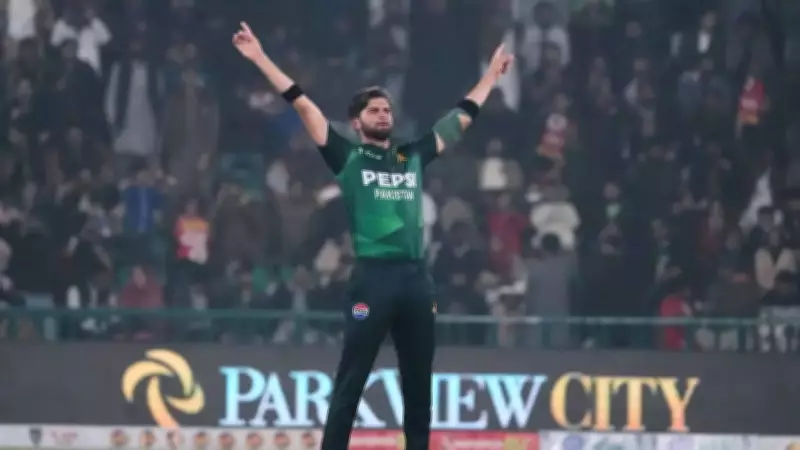
The cricketing world is bracing for a significant disruption as the Twenty20 World Cup approaches, with the looming possibility of Pakistan boycotting their highly anticipated match against India. This development threatens to make the tournament the first major International Cricket Council (ICC) event in fourteen years without a clash between these two arch-rivals, casting a shadow over one of sports' most intense rivalries.
Government Decision Hangs Over Group-Stage Match
The tournament commences this Saturday, with Pakistan scheduled to open their campaign against the Netherlands, while India faces the United States later on the same opening day. However, Pakistan's government has notably withheld permission for the national team to participate in the group-stage encounter against India. Although there remains a theoretical chance for the two sides to meet in the semifinals or the final scheduled for March 8, it remains unclear whether the potential boycott would extend to these knockout matches as well.
ICC Calls for Resolution Amidst Uncertainty
The International Cricket Council has formally urged the Pakistan Cricket Board to actively "explore a mutually acceptable resolution" that effectively "protects the interests of all stakeholders." This diplomatic intervention highlights the high stakes involved, as an India-Pakistan match traditionally generates immense global viewership and revenue.

Following Pakistan's impressive 3-0 T20I series victory over Australia on Sunday, captain Salman Ali Agha emphasized that the players would strictly adhere to government directives. "It's not our decision. We can't do anything about it," Agha stated, as reported by the Associated Press. "We will do whatever our government and the PCB chairman say." This statement underscores the political dimensions influencing what is primarily a sporting event.
Tournament Format and Venue Details
The tournament features twenty teams divided into four groups, with the top two from each group advancing to the Super Eights stage. Subsequently, two teams from the Super Eights will qualify for the semifinals on March 4 and 5. Matches in India will be hosted across five major cities: New Delhi, Kolkata, Chennai, Ahmedabad, and Mumbai. Sri Lanka, serving as co-host, will stage games in Pallekele and two venues in Colombo, with Pakistan scheduled to play all its matches in Sri Lankan territory.
Group A Analysis: Pakistan's Critical Path
In Group A, Pakistan faces the Netherlands, Namibia, and the United States. Should Pakistan forfeit the India match, they would concede two crucial points, making victories against the associate teams absolutely essential. The United States previously defeated Pakistan in a super over during the 2024 T20 World Cup in Dallas, a result that contributed significantly to Pakistan's early exit at the group stage. Meanwhile, the Netherlands had earlier caused a major upset in 2022 by defeating South Africa, which ironically helped Pakistan reach the semifinals that year.
India enters the tournament with strong momentum, having secured a 4-1 T20I series win over New Zealand, culminating in a formidable total of 271 runs in the final match.
Other Group Previews and Team Dynamics
Group B: Australia's Redemption Quest
Australia finds itself drawn alongside Sri Lanka, Ireland, Oman, and Zimbabwe. The Australian team arrives at the event following a 3-0 T20I series loss to Pakistan in Lahore, including a substantial 111-run defeat in the final match. Despite being the 2021 champions, Australia has failed to reach the semifinals in the last two T20 World Cup editions.
Sri Lanka finalized their squad relatively late, omitting Dhananjaya de Silva while recalling Kamindu Mendis and Kusal Perera. All-rounder Wanindu Hasaranga is expected to play a pivotal role for the team. Oman, participating in their fourth T20 World Cup, will be led by captain Jatinder Singh. Zimbabwe has added experienced spinner Graeme Cremer, who returned to international cricket last year after a seven-year hiatus. Ireland, under the leadership of Paul Stirling, retained twelve players from their 2024 squad and are making their ninth T20 World Cup appearance.

Group C: European and Associate Contenders
England and West Indies headline Group C, which also includes Italy, Nepal, and Scotland. England's squad boasts prominent names such as Jos Buttler, Harry Brook, Jofra Archer, Ben Duckett, Phil Salt, and Adil Rashid. West Indies, led by Shai Hope, enter the tournament after experiencing series losses to Afghanistan and South Africa. Coach Darren Sammy has specifically highlighted young talent Quenin Sampson as a valuable middle-order option.
Nepal, winless in the previous edition, will heavily rely on 23-year-old all-rounder Rohit Paudel. Scotland, a late addition to the tournament, includes players like Zainullah Ihsan, Tom Bruce, and Safyaan Sharif, who described recent visa delays as a "hell of a week." Italy will make their tournament debut against Scotland at Kolkata's iconic Eden Gardens.
Group D: Competitive Balance and Returning Stars
Afghanistan, New Zealand, and South Africa are grouped with Canada and the United Arab Emirates. Afghanistan reached the semifinals in 2024 before ultimately losing to South Africa. South Africa, runners-up in the last edition, welcome back Quinton de Kock from retirement and have David Miller fully fit for the event.
Canada returns to the tournament after winning all six matches in the Americas Regional Qualifier, while the UAE is making their third appearance but has historically not progressed beyond the group stage in past tournaments.
The potential absence of an India-Pakistan match represents more than just a scheduling change; it symbolizes the complex intersection of geopolitics and international sport. As the cricketing community awaits final decisions, the tournament's narrative has already been profoundly altered, with implications for fans, broadcasters, and the global cricket economy.