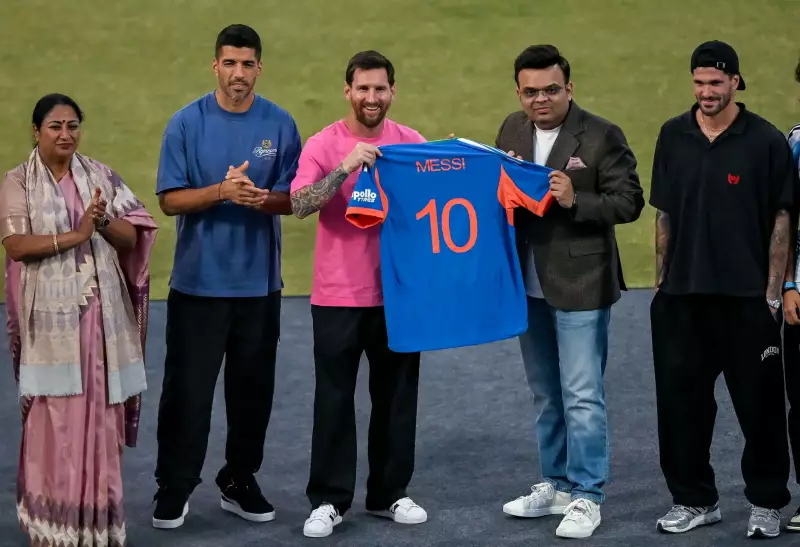
The recent whirlwind three-day tour of football icon Lionel Messi across India, accompanied by stars Luis Suarez and Rodrigo De Paul, has laid bare a painful paradox at the heart of the nation's sporting culture. While fans, corporates, and politicians fell over themselves to spend hundreds of crores for a glimpse of global superstars, the domestic football ecosystem is gasping for financial air, struggling to find sponsors for its very leagues.
The GOAT Tour Euphoria and Its Bitter Ironies
The tour, covering Kolkata, Hyderabad, Mumbai, and New Delhi, saw tens of thousands pack stadiums in each city. Organisers invested hundreds of crores of rupees to bring the trio, while fans spent heavily on tickets, with some paying upwards of Rs 4000 just to watch Messi walk and wave. Sponsors and broadcasters pumped in equivalent or greater sums. The event became a social media magnet, with politicians, corporate leaders, and celebrities vying for photos with the Argentine magician.
Yet, the irony was stark. Bhaichung Bhutia, the former Indian captain and a national legend, was reportedly stopped by security and struggled to enter the Delhi stadium as an official guest, unrecognised until a last-minute phone call facilitated his access. This incident, shared widely, became a symbolic snapshot of the disconnect.

The Bleak Financial Reality of Domestic Football
In stark contrast to the Messi-fueled spending spree, the All India Football Federation (AIFF) recently found no takers for a Request For Proposal (RFP) for the Indian Super League (ISL) that sought an annual payment of just Rs 37.5 crore. The situation was even grimmer for the I-League, the second tier, which required Rs 4 crore annually and also attracted no bidders.
This sponsorship vacuum has brought domestic football to a standstill. There is currently no confirmed timeline for the start of either the ISL or I-League seasons. Clubs, which spend approximately Rs 60 crore annually and face losses of around Rs 25 crore, are bleeding financially with no active football. In a recent meeting, ISL clubs proposed a "financial reset," including a revision of the officially capped but unofficially breached player salary limit of Rs 16.5 crore.
Sponsors' Double Standard and a System in Crisis
Adding another layer of irony, two sponsors of the Messi tour—JSW Group and RPSG Group—are directly involved in the struggling ISL through their clubs Bengaluru FC and Mohun Bagan Super Giant. While their top executives enjoyed meet-and-greet sessions with Messi, their own clubs face an uncertain future amid the league's broader financial logjam.
The core issue is highlighted by simple economics. Tickets for a regular ISL match are priced between a modest Rs 100 to Rs 300, yet stadium attendances are dropping. The massive expenditure on the Messi tour, as pointed out by Bengaluru FC's Director of Football Darren Caldeira, could have funded multiple domestic clubs. Instead, it was spent on a "sporting event" where very little football was actually played, and where Indian legend Sunil Chhetri was overshadowed in headlines by cricket great Sachin Tendulkar.
As Indian international footballer Sandesh Jhingan poignantly noted on Instagram, "What this tells me is that we do love the sport, but perhaps not enough to support our own players." He expressed hope that the occasion would spark a deeper conversation about sustaining football at home.
The euphoria has now subsided; Messi and his entourage have departed. The photos and videos will circulate for months. But Indian football remains at a critical roadblock, its future hinging on whether the nation's love for the global game can finally translate into tangible support for its own.