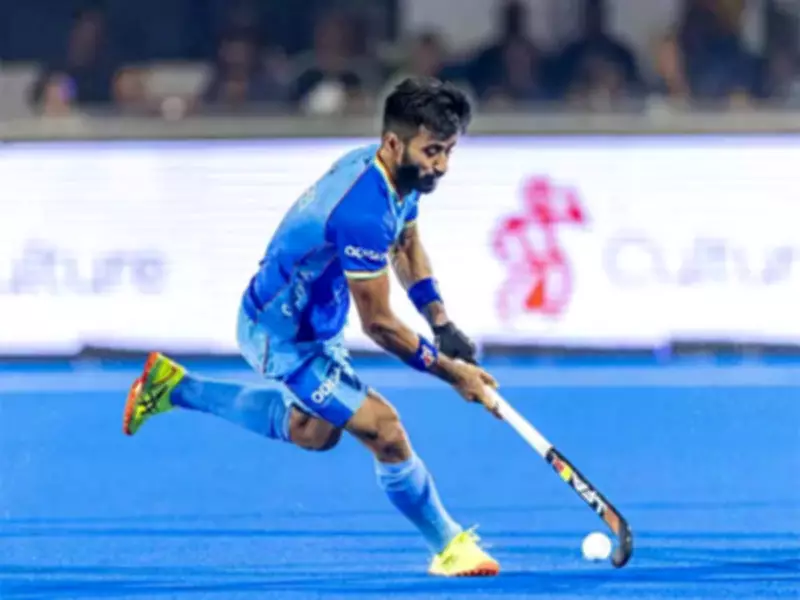
BENGALURU: The journey of Manpreet Singh in Indian hockey represents a remarkable arc from collective despair to individual excellence, now culminating in unexpected isolation. As a young 20-year-old, Manpreet experienced the profound disappointment of India's 2012 London Olympics campaign, where the national team failed to secure a single victory. That moment forged a personal commitment within him to dedicate his career toward ensuring Indian hockey would never again endure such humiliation.
The Unwavering Pillar Through Turbulent Times
Over the subsequent three Olympic cycles, Manpreet transformed himself into the indispensable fulcrum of India's midfield. Through periods marked by whispers of groupism and allegations of favoritism within team dynamics, his consistent presence at the heart of the squad provided stability and continuity. His evolution from that traumatized young player to a leader of consequence represents one of Indian hockey's most compelling narratives of resilience.
A Lonely Summit and Unexpected Exclusion
Now standing just one cap away from equaling Hockey India president Dilip Tirkey's record of 412 appearances, Manpreet finds himself in an ironic position of achieving statistical greatness while facing professional uncertainty. The midfielder, who has contributed significantly to India's two Olympic bronze medal triumphs, will for the first time in fifteen years be absent from the 33-member core probables list for the upcoming season.

This exclusion encompasses both the initial FIH Pro League matches scheduled next month and subsequent fixtures in Hobart. The formal announcement is anticipated on Thursday, though players have already received notification of the decision. More tellingly, Manpreet's omission from the Schengen visa processing for the European leg of the Pro League in June strongly indicates this move extends beyond mere rotational resting of an experienced campaigner.
Interrogating the Rationale Behind the Decision
The exclusion of such an accomplished player naturally prompts several critical questions about Hockey India's strategic thinking. Is this decision primarily driven by transition planning, age considerations, fitness assessments, performance evaluations, or perhaps reveals a concerning lack of judgment in team management?
Transition Timing and Strategic Planning
The logical transition toward the 2028 Los Angeles Olympics should ideally have commenced immediately following the conclusion of the Paris Games. Instead, Hockey India appears to have delayed decisive action, creating a situation where the transition sword now hangs precariously over one of India's most reliable midfield assets. This timing raises questions about the coherence of long-term planning within the national hockey administration.
Age and Fitness Metrics Defy Conventional Wisdom
At 33 years old, Manpreet continues to demonstrate exceptional physical conditioning that contradicts typical age-related decline narratives. He consistently ranks among the top three performers in Yo-Yo 1 endurance tests and has repeatedly achieved impressive scores of 21.5 in the more demanding Yo-Yo 2 assessments. During the Hockey India League, his performance in the grueling 1600-yard 'death run' clocked at 5.9 minutes significantly exceeded the expected benchmark of 5.30 minutes.
Sustained Performance Excellence
In the recently concluded Hockey India League, Manpreet maintained his crucial role as the vital connective tissue between defensive structures and attacking initiatives. His technical proficiency in ball retention remained exceptional, while his ability to disrupt opposition formations through precisely angled passing and sophisticated spatial awareness continued to distinguish his contributions on the field.
Questionable Judgment in Critical Year
The decision appears particularly puzzling considering the competitive calendar ahead, featuring both the World Cup and Asian Games where Olympic qualification stakes will be determined. Phasing out senior players who demonstrate both fitness and form seems counterintuitive when younger talents could be integrated gradually without sacrificing experienced leadership during crucial tournaments.

The Broader Implications for Indian Hockey
Manpreet Singh's exclusion represents more than just a selection decision about one player. It reflects broader questions about how Indian hockey manages the delicate balance between honoring past contributions and planning for future success. The treatment of a player who dedicated his career to redeeming Indian hockey from its London nightmare now finds himself potentially facing a premature conclusion to his international journey.
This development occurs against the backdrop of Hockey India's ambitious targets for future Olympic performances, raising fundamental questions about whether current selection policies align with stated performance objectives. The coming months will reveal whether this decision represents strategic foresight or missed opportunity as Indian hockey navigates its path toward the 2028 Los Angeles Olympics.