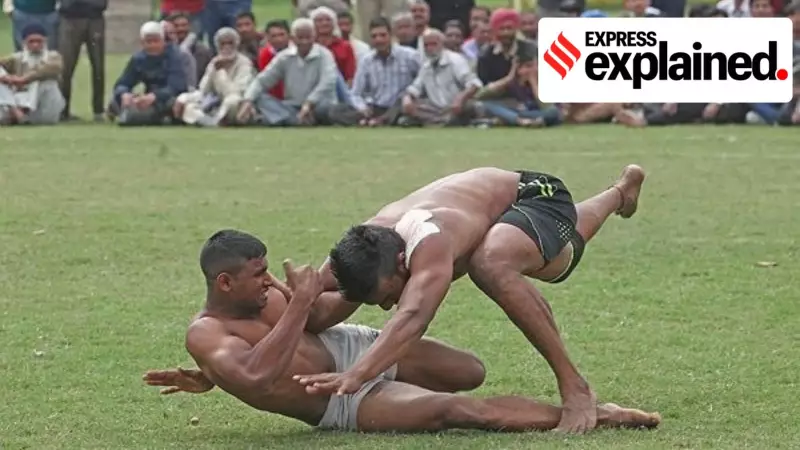
The recent killings of individuals associated with kabaddi have ripped away the sport's traditional veneer, exposing a dark underbelly of high-stakes finance, organized betting, and violent gang rivalries in Punjab. What was once a staple of rural festivals and community pride has transformed into a multi-crore business attracting dangerous interests.
From Village Fields to Multi-Crore Enterprise
For generations, kabaddi was synonymous with Punjab's cultural fabric, played in fields and celebrated at religious fairs. Its shift began in the late 1990s and early 2000s when organizers started offering cash prizes in lakhs of rupees, replacing traditional rewards. This opened a lucrative avenue for rural youth with limited job prospects.
The influx of big money is often traced to Non-Resident Indian (NRI) sponsors, particularly from the Doaba region. Gurmeet Chauhan, DIG of the Anti-Gangster Task Force, stated that "NRIs brought big money into kabaddi in the early 2000s." After a brief slowdown during the 2013-14 Jagdish Bhola drug racket investigations, which implicated several NRI promoters, the cash flow continued through "murkier routes."

Prizes escalated from cash to tractors, SUVs, combine harvesters, and Royal Enfield motorcycles, strategically targeting the rural audience. The recent Sohana tournament, cut short by murder, offered a tractor and lakhs in cash. According to expert 'Principal' Sarwan Singh, tournament budgets in Punjab now range from Rs 1 lakh to Rs 40 lakh, soaring to hundreds of thousands of dollars for events in England and Canada. He estimates the sport's annual value at around Rs 100 crore.
Betting, Fixing, and Gangster Infiltration
Where high stakes exist, gambling follows. Betting has proliferated not just in the professional Pro Kabaddi League but massively in the unregulated rural circuit. The sport's short, unpredictable nature, where a single raid can decide a match, makes it ideal for wagering.
An anonymous police officer revealed that pressure on players and support staff to influence results—by fixing raids or team placements—has become a disturbing norm. Refusal can lead to intimidation and physical attacks. Online betting platforms provide anonymity, shielding perpetrators from action.
Compounding this is the direct involvement of gangsters. Gangs like the Bambiha group and Lawrence Bishnoi syndicate are engaged in turf wars to control the kabaddi circuit. Another officer explained that these gangs seek to influence every aspect of tournament organization, from celebrity guests to prize distribution. Sponsors, often industrialists and real estate developers, are allegedly coerced into funding events under threat, allowing gangs to launder money legally through advertisements.
Governance Vacuum and Political Dimensions
A critical enabler of this chaos is the absence of a strong, unified governing body. In Punjab, multiple kabaddi federations operate, registered under the Societies Act but often not affiliated with the recognized Amateur Kabaddi Federation of India (AKFI). These federations, formed along political or personal lines, organize their own tournaments with no standard code of conduct, proper player contracts, or disciplinary system.
This fragmentation means no single authority has the power to investigate allegations of fixing or violence, allowing illegal money to flow unchecked. The state government has also played a role; in 2013, the then SAD-BJP regime announced cash awards totalling Rs 7 crore to promote kabaddi amidst the drug crisis, though these tournaments were discontinued after 2017.
The professional sphere mirrors this high-value trend. In the Pro Kabaddi League Season 12 auction in June 2025, Rs 37.90 crores was spent to acquire 121 players, with the most expensive player going for Rs 2.23 crore.
The murders of promoter Kanwar Digvijay Singh in Mohali and former player Gagandeep Singh in early January 2026 are not isolated incidents of violence but symptoms of a systemic capture. They signal how Punjab's beloved sport has become a battleground for money, power, and control, far removed from the spirit of the village fields where it began.