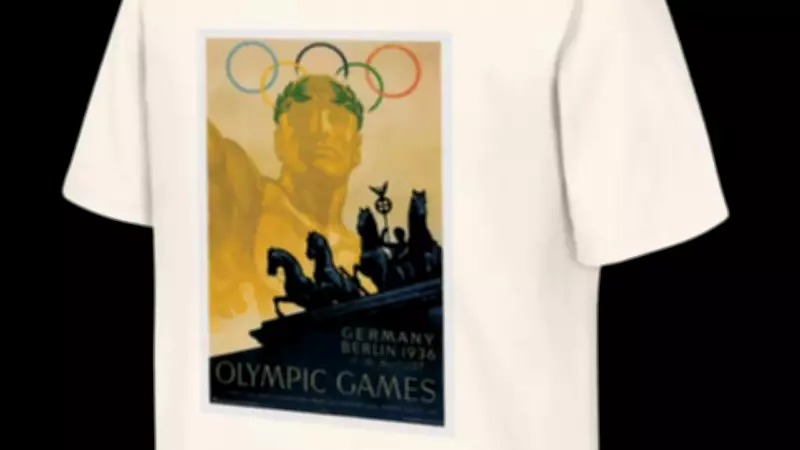
IOC Slammed as 'Tone Deaf' for Selling 1936 Berlin Olympics T-Shirt Amid Nazi Propaganda Accusations
The International Olympic Committee is facing intense criticism and being labeled as 'tone deaf' after selling a t-shirt that features artwork from the 1936 Berlin Olympic Games. Critics have accused the IOC of 'normalising Nazi propaganda' by offering merchandise connected to an event that Adolf Hitler notoriously used to promote Nazi Germany's ideology on a global stage.
Controversial Design and Swift Sell-Out Spark Outrage
The limited-edition t-shirt, which was part of the official Olympic Heritage Collection, sold for $42 on the Olympics website and has shockingly sold out online. The design includes a man wearing a laurel crown, the Olympic rings, and the Brandenburg Gate—a direct reproduction of artwork used in Berlin ninety years ago, approximately three years into Hitler's dictatorial reign.
Many have questioned the IOC's decision to include this particular item in their sale, given that it commemorates one of the darkest periods in German history. Social media platforms have erupted with condemnation, with users expressing disbelief and anger at what they perceive as a severe lapse in judgment.

Social Media Erupts with Criticism and Historical Context
On platform X, one user wrote, "Shocking sell-out—Olympics merch team really thought Nazi-era Berlin art was a good vibe? History lesson needed ASAP." Another added, "Selling Berlin 1936 merch is tone-deaf; it risks normalising Nazi propaganda rather than critically acknowledging that dark chapter in Olympic history."
The 1936 Olympics are a highly sensitive issue because they occurred three years after Hitler rose to power. The Nazi regime exploited the global event to advance its ideals of racial supremacy and antisemitism, blatantly excluding German-Jewish athletes and derogatorily referring to Black competitors as 'non-humans.'
Political and Advocacy Voices Condemn IOC's Actions
German politician Klara Schedlich emphasized that the 1936 Games served as a 'central propaganda tool' for the Nazis. She accused the IOC of 'clearly not reflecting sufficiently on its own history,' stating that without proper context, "the choice of image is problematic and unsuitable for a T-shirt."
Yoav Potash, director of the award-winning Holocaust documentary Among Neighbours, described the t-shirts as a "sickening affront to human decency" in comments to Fox News Digital. He asserted, "To say that the IOC's sale of these shirts is in poor taste would be a gross understatement. The IOC has the benefit of 90 years of hindsight here. We know that Nazi Germany used its role as the Olympic host for propaganda purposes, aiming to showcase supposed Aryan superiority."
Liora Rex, founder of StopAntisemitism, also criticized the IOC, referencing the 1972 Munich Games where "terrorists butchered the Israeli Olympic team, the competition barely paused." She accused the committee of refusing to "properly commemorate the massacre" while claiming that this year, "the Jew-hate is official."
IOC's Defense and Historical Recognition
This is not the first instance of the IOC revisiting the 1936 Olympics; at the 2020 Games, they posted a Throwback Thursday picture commemorating that controversial year. In defense of the t-shirt sale, the IOC explained that the item reproduces the original 1936 poster by German artist Franz Wurbel and is part of a Heritage Collection featuring artwork from every Olympic Games.
In a statement to the New York Post, the IOC acknowledged "the profound historical context surrounding the Berlin 1936 Olympic Games." They highlighted that the games brought together "4,483 athletes from 49 countries competing in 149 events and included remarkable sporting achievements," notably mentioning Jesse Owens, the American track-and-field Olympian who won four gold medals and directly challenged Hitler's racist ideology with his victories.

Broader Context of IOC Controversies
The IOC has been embroiled in other controversies recently, including issues at the 2026 Winter Olympics in Milan and Cortina, where gold, silver, and bronze medals were reported breaking or detaching from their ribbons. Organizers addressed this by identifying a problem with the medal's cord and offering replacements to athletes.
Additionally, during the opening ceremony on February 6, 2026, some accused the event of projecting 'satanic symbolism' when lighting the cauldrons, which allegedly resembled a satanic pentagram used in rituals.
At a time when every event serves as a stage for statement and symbolism, the use of art and creativity must be approached with mindfulness and sensitivity, especially for international committees like the IOC that wield significant global power and prestige. The backlash over the 1936 t-shirt underscores the delicate balance between honoring Olympic heritage and avoiding the glorification of painful historical chapters.