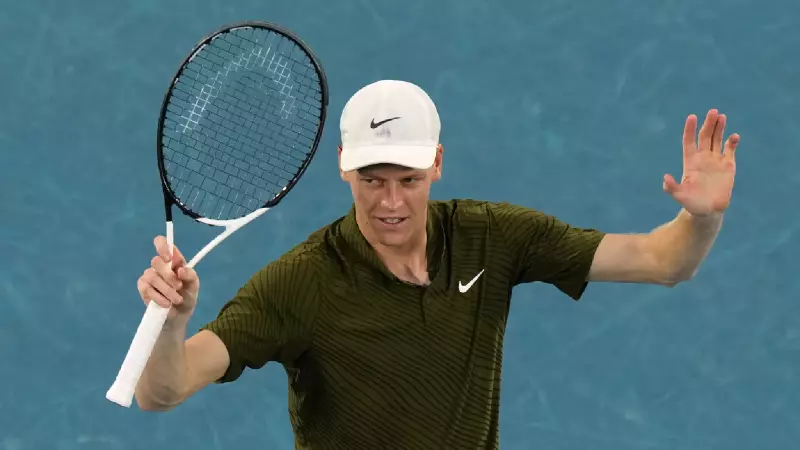
Jannik Sinner's Grueling Battle Against Melbourne's Scorching Heat at Australian Open 2026
The Australian Open 2026 has been defined by relentless heat, with temperatures soaring to test the physical and mental limits of the world's top tennis players. On Saturday, this extreme weather nearly proved too much for world No. 4 Jannik Sinner, who faced a severe challenge during his third-round match against American Eliot Spizzirri.
The Critical Moment: Roof Closure Saves Sinner's Campaign
With the mercury touching 40 degrees Celsius at Melbourne Park, Sinner was visibly struggling through the middle stages of his match. The Italian star battled debilitating cramps and was forced to conserve energy by shortening points, appearing physically compromised as the intense heat took its toll. According to his coach Darren Cahill, there was a deliberate strategy in place: survive until the roof could be closed.
"It's clear that Jannik was very lucky with the timing of the roof closure," Cahill revealed on Monday. "Everyone on the team knew that, at some point, the match would be paused to deploy the retractable roof. Our goal was for him to hold on as best as he could until the end of the third set."

Cahill's Insight: Sinner's Remarkable Self-Management Under Pressure
The turning point arrived just in time. With the third set delicately poised, tournament officials implemented the extreme heat policy, suspending play to close the roof. This extended break allowed Sinner to recover physically and reset mentally—a crucial intervention that Cahill believes showcased one of the Italian's most underrated strengths.
"I've been working with him for a long time, and what he did the other day was one of the most impressive performances I've seen in terms of self-management," Cahill emphasized. The coach had previously cautioned Sinner against underestimating Spizzirri, insisting the match be approached with the same seriousness as a top-10 clash.
Once conditions became manageable under the closed roof, Sinner responded decisively. He overturned a deficit to take the third set 6-4 before sealing the fourth by the same margin, ultimately advancing to the fourth round with a hard-fought victory.
Addressing Heat Vulnerabilities and Maintaining Routine
This episode highlighted Sinner's ongoing struggles in extreme heat—an issue that has surfaced previously, most notably at the Shanghai Masters. Despite these challenges, Cahill remains confident that steps are being taken to address this vulnerability in Sinner's game.
Following this grueling match, tournament organizers offered Sinner the option of moving his next match against compatriot Luciano Darderi to Rod Laver Arena. However, the Italian chose to maintain his routine rather than disrupt his preparation.
"When it was known that Mensik would not play, they offered Jannik the chance to switch to the last session at Rod Laver Arena," Cahill explained. "But he preferred not to change anything. He recovered well and was happy to play at Margaret Court Arena. He has no problem playing there."
Sinner's decision proved wise, as he defeated Darderi in straight sets (6-1, 6-3, 7-6) on Monday, securing his place in the quarter-finals where he will face Ben Shelton on Wednesday.
Broader Implications for Tennis in Extreme Conditions
The Australian Open 2026 has raised important questions about player safety and performance in extreme weather conditions. The tournament's heat policy, which allows for roof closure and match suspensions, proved crucial in this instance, potentially saving Sinner's campaign from premature elimination.
As climate patterns continue to evolve, such scenarios may become more frequent at outdoor tennis tournaments worldwide. Sinner's experience serves as a case study in both the physical demands placed on athletes and the strategic adaptations required to succeed under punishing environmental conditions.
Cahill's revelations provide valuable insight into the behind-the-scenes planning that goes into managing elite athletes during challenging matches. The combination of tactical patience, physical resilience, and timely intervention created the perfect storm for Sinner's survival and subsequent advancement in the tournament.