The term sigma male has emerged as a modern internet archetype, often used to describe men who project independence and operate outside conventional social structures. Think of fictional characters like Tyler Durden or John Wick. However, like much online slang, its meaning has evolved into parody, frequently associated with misogynistic internet personalities appealing to certain subcultures.
The Reality Check: Athletes vs. Regular People
Last year, when influencers Jake Paul and Andrew Tate suffered defeats against professional athletes, some humorously dubbed these losses "9/11 for sigma males." Beyond the internet culture commentary, these events highlighted the immense gap between everyday individuals and elite athletes. This disparity was similarly evident when billionaire Bill Ackman participated in the Hall of Fame Open, struggling to even make contact with the ball against professional competition.
Most non-athletes would not survive in a cage, ring, or court against professionals. Yet, even among elite athletes, there exists a rare breed who access a metaphorical realm their peers can only aspire to reach. They operate on both mental and physical planes that fellow professionals sometimes fail to comprehend.

The Federer Phenomenon: A Place Beyond Recognition
Andre Agassi, himself a tennis legend and the first man to achieve a Career Golden Slam, expressed awe after his 2005 US Open Final loss to Roger Federer. "In the tiebreak, he goes to a place that I don't recognize," Agassi remarked, acknowledging Federer's transcendent ability. This observation underscores how the greatest athletes possess something intangible that sets them apart.
The Big Three: Masters of Their Craft
During their era, the Big Three of tennis demonstrated unparalleled dedication to their sport. Novak Djokovic has maintained a hermit-like discipline for over a decade. Rafael Nadal pushed his body to seemingly impossible limits, prompting John McEnroe to famously ask, "Is he going to play every point like that?" Federer, as Agassi noted, appeared to play professional matches effortlessly, as if wearing a smoking jacket rather than tennis gear.
Each brought unique qualities: Federer danced on court with grace, Nadal covered every surface with relentless intensity, and Djokovic displayed endurance that defies conventional understanding, appearing powered by a perpetual motion machine even at age 38.
Ivan Lendl's Insight: The Package Deal of Greatness
Ivan Lendl, another tennis great who coached Andy Murray, explained in 2017: "The top guys are top guys because they do things a little bit better than the other guys. You put all that into a package and the package is slightly better than the guys below." This encompasses stroke production, movement, physicality, and mental fortitude.
Carlos Alcaraz: A New Generation's Champion
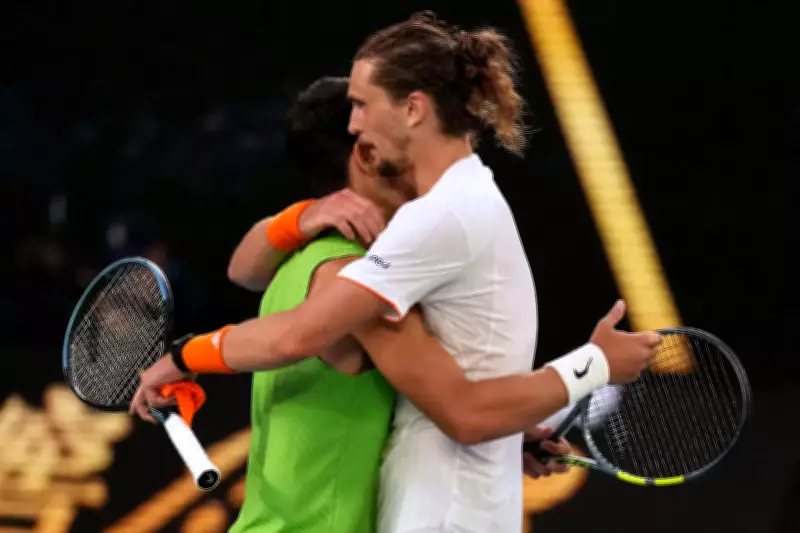
At Melbourne Park during the Australian Open, Carlos Alcaraz demonstrated he shares the same exceptional qualities as the legends before him. Before his semifinal, tournament chatter suggested a predictable path to a final against Jannik Sinner, given their dominance in recent majors. However, Alcaraz's match against Alexander Zverev took an unexpected turn.
Leading by two sets, Alcaraz was suddenly crippled by cramps, reminiscent of Australian cricketer Glenn Maxwell's similar struggle during the 2024 ODI World Cup. Yet, like Maxwell, Alcaraz found a way to persevere. His medical timeout sparked controversy, with Zverev's frustrated reaction generating widespread discussion on Tennis Twitter, including commentary from Boris Becker.
The Comeback: Belief Against All Odds
Even after returning to play, Alcaraz struggled physically but refused to surrender. "I always say you have to believe in yourself, no matter what you're struggling with," he explained post-match. This mindset echoes Lendl's philosophy: "That's how people win tournaments — they fight. You have to push through that pain barrier."

The Spaniard's determination was palpable when, down 5-4 with Zverev serving for the match, he rallied to level at 5-5 and eventually take the lead. The contrast was striking: Zverev, physically dominant and imposing order, versus Alcaraz, who despite limited movement, weaponized chaos through creative drop shots, angled returns, and unpredictable pace changes.
The Mental Battle: Conquering Inner Demons
One pivotal moment captured this dynamic: at 5-5, Alcaraz feinted a drop shot that seemed to mentally unravel Zverev. While Zverev is an accomplished player—the youngest to debut in the top 20 since Djokovic, who beat Federer on grass at 17—he faces the psychological hurdles necessary to claim a Grand Slam title. Nicknamed "Sascha" after Alexander the Great, he must conquer internal demons to achieve greatness.
Alcaraz, conversely, appears unburdened by such mental obstacles. He stands on the cusp of tennis history, potentially becoming the youngest to complete a Career Grand Slam in the Open Era, surpassing Rafael Nadal's record of 24 years and three months. His rivals include Jannik Sinner and the relentless Novak Djokovic, who at 38 continues to chase a record 25 Slam titles.
Legacy in the Making
Regardless of the Australian Open outcome, Alcaraz's remarkable comeback from physical distress will be remembered as a testament to elite athletic resilience. His performance reinforces that true greatness in sports transcends physical superiority, requiring an indomitable spirit and innovative problem-solving when conventional logic suggests defeat is inevitable.
The journey from internet's sigma male archetype to the rarefied air of athletic excellence serves as a powerful reminder: while online personas may project invincibility, the authentic mastery displayed by athletes like Alcaraz, Federer, Nadal, and Djokovic exists in a realm few can ever access or comprehend.