

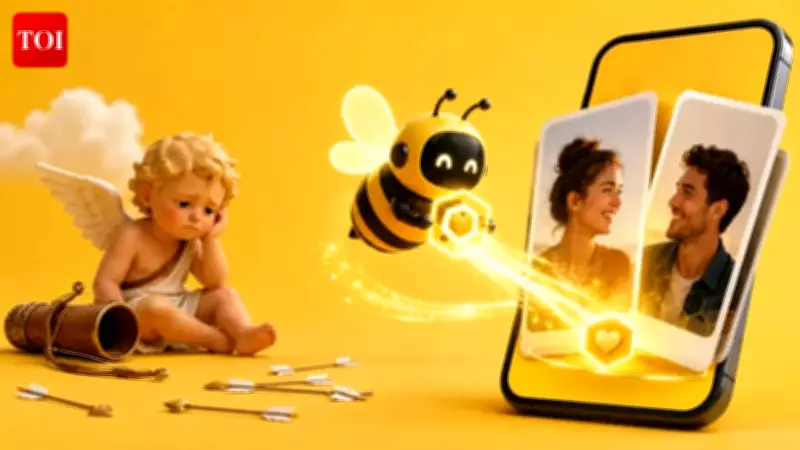
Remember when a friend gave you detailed instructions to show up at a bookstore for a "meet cute"? Decades ago, dating often involved friends setting you up or meeting someone at a party. But the 21st century transformed this, with social media and then dating apps taking over. Apps like Tinder introduced swiping, turning matchmaking into a compatibility checklist. Bumble later empowered women to make the first move. Now, Bumble is pivoting to an AI-enabled experience, moving away from swiping entirely.
The Rise of AI Matchmaker Bee
Bumble's founder Whitney Wolfe Herd announced Bee, an AI matchmaker designed to be "revolutionary for the category." Bee will phase out left/right swiping in favor of an AI-driven matching system, rolling out in Q4 2026. Currently, Bee is being tested in a small New York City pilot. According to Bumble's support page, Bee guides users through questions about relationship preferences, values, and what matters in a partner before searching for compatible people and notifying users in-app.
How Bee Works
Bee will ask users several questions, learning their values, relationship goals, communication style, lifestyle, and dating intentions. It will then search for people "tailored just for you" and ping you when it finds a possible match. Bee will pair two users who share key goals and interests, then notify both with a description of why they might click. Bumble says this reduces browsing and friction, leading to "deeper, more compatible connections." Users will enter a new "Dates" mode where Bee suggests compatible people. Future updates may include Bee suggesting date ideas and collecting anonymous feedback after a date.

Addressing Swipe Fatigue
Bumble's move addresses swipe fatigue, a widespread issue. A Forbes health survey found nearly 78% to 80% of online daters felt emotionally or physically burned out by swiping. Herd said, "people are feeling exhausted, they're feeling fatigued – the swipe has degraded their love lives." Bee aims to vet matches based on the user's preferences, delivering finer prospects with real potential.
Criticism and Concerns
However, critics argue that dating is not about efficiency. Real-life romance is messy and glorious, and trying to turn it into an optimized experience may fail. The AI may provide compatibility checks, but chemistry often involves awkwardness, bad jokes, and unpredictable moments that algorithms cannot predict. Additionally, privacy concerns arise as Bee requires users to share intimate data. Bumble plans to retool profiles into "chapter-based" formats covering hobbies, career, childhood, etc., feeding more data to the AI. This raises questions about data security and surveillance.
AI Companionship Trend
This shift comes amid a growing trend of AI companionship. A 2025 study found 2.44% of Danish high-school students engage in conversations with chatbots for emotional support. Harvard Business Review reported AI companionship and therapy as the top use case of generative AI. Another study found nearly one in five US adults have chatted with an AI romantic companion. Stanford Medicine warns that chatbots simulate deep relationships but lack real emotional pushback, potentially increasing isolation.
Irony for Bumble
For Bumble, which built its brand on "women make the first move," this AI turn is ironic. The system now does the first sorting and emotional framing, moving away from human agency. The wider dating-app industry faces declining users; Bumble's Q1 2026 results showed revenue down 14.1% and paying users down 21.1%. AI-powered romance may be a marketing story, but survival is the business strategy.
The Future of Romance
Will Bee unearth hidden love matches or leave users in a cold mess? Time will tell. But in a world saturated with curated nonchalance, genuine intimacy may require embracing messiness and taking risks, not relying on AI-approved dates. As one observer noted, "any chance you get, pop a pill of an un-airbrushed approach, wear your heart on your sleeve, and pick up those AI-safe arrows — you may miss the target a few times, but at least taking that aim will make you feel more alive than any AI-approved date!"






