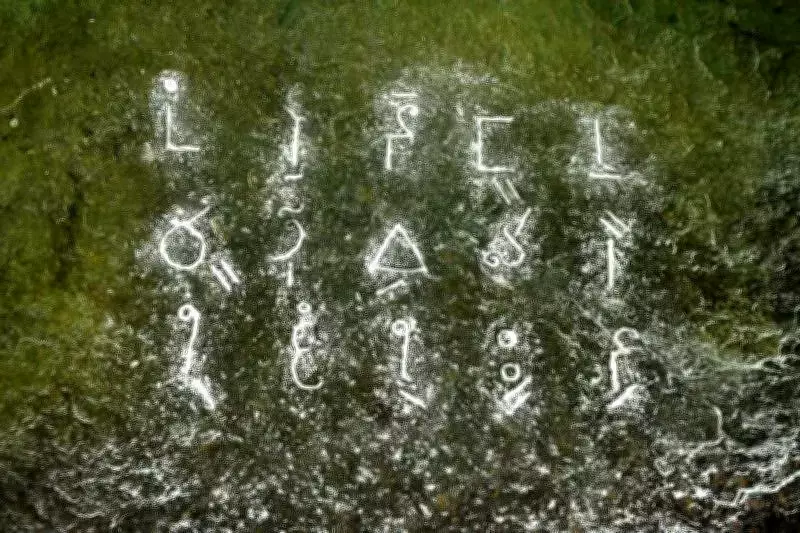
Archaeology enthusiasts have successfully deciphered the enigmatic 'Sanyasi Pudavu' cave inscription in the Courtallam Hills, solving a mystery that had remained unsolved for over a century. The inscription is located inside a massive double-storey cave deep within a forested area frequently visited by elephants. The site is accessible only after a challenging 5.5-kilometer trek through the hills above the Courtallanathar Temple, passing the Main, Shenbagadevi, and Thenaruvi waterfalls.
Details of the Inscription
The cave wall features 15 characters arranged in three lines. Although references to the cave appeared in British government records as early as 1917, the script's meaning and origin had remained unclear. Earlier, archaeologists speculated that the markings could belong to a pre-Brahmi script or an early form of the Indus script. Even Japanese scholar Shu Hikosaka was unable to fully interpret it during his research.
Breakthrough by Researchers
After two and a half years of intensive field research, archaeology researcher Balakrishnan from Trichy and Mathur Pavendhan claimed to have decoded the inscription. 'Fourteen of the 15 characters contain the basic forms of Prakrit Brahmi. However, the scribes used an unconventional system instead of standard diacritic marks,' Balakrishnan explained. 'By applying logical methods along with mathematical permutations and combinations, we were able to decode the script. We used orthography instead of traditional epigraphy, which had failed to identify the characters earlier.'

Meaning of the Inscription
According to the researchers, the inscription contains Tamil words written in a modified Brahmi script. The text reads: 'Um Neri Gnana Vaapi Elore Gajam Ka Eeru.' It translates to: 'Your path is a reservoir filled with wisdom; the essence found in the water bodies of all seven villages is one and the same.' Balakrishnan noted that the script appears to represent a distinct local variation rather than a standard ancient script.
This discovery sheds new light on the region's historical and linguistic heritage, offering a glimpse into the past through a unique script that had baffled experts for generations.