

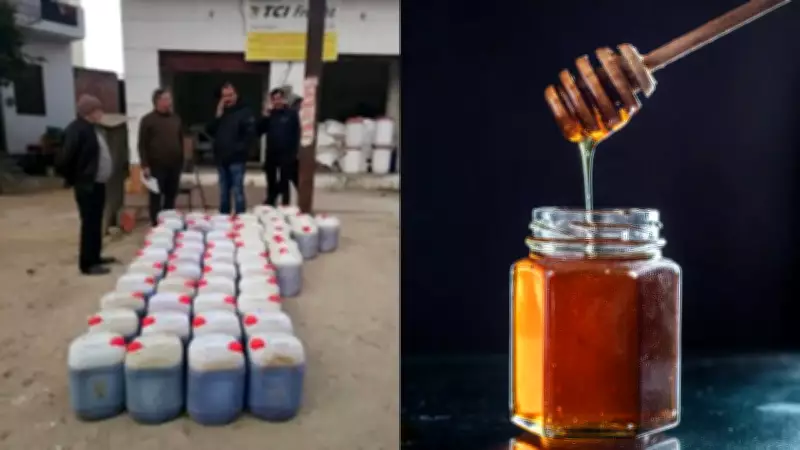
Honey is widely regarded as a natural sweetener with detoxifying and cleansing properties. From Ayurveda to modern nutritionists, honey is often recommended as a healthy alternative to white sugar. However, recent events have raised concerns about the safety of honey available in the market. In a major crackdown, the Food Safety and Standards Authority of India (FSSAI) seized 15,000 kilograms of suspected adulterated honey during an enforcement drive in Hapur, Uttar Pradesh.
Details of the Seizure
According to a post shared by FSSAI on X, samples from the seized stock, valued at approximately Rs 22 lakh, have been collected and sent for laboratory testing. The tests will determine whether the honey meets the required food safety standards. Officials have not yet released the final test results, but the incident highlights the ongoing issue of adulterated food products entering the market. FSSAI stated, "The Uttar Pradesh Food Safety Department has seized 15,000 kg of adulterated honey from Hapur. Samples of honey worth about 22 lakh rupees were taken for testing."
FSSAI Definition of Honey
According to an FSSAI document, the Codex Alimentarius defines honey as a natural sweet product produced by honeybees from the nectar of plants (blossom honey) or from secretions of living parts of plants or excretions of plant-sucking insects (honeydew honey). Bees collect, transform, dehydrate, store, and leave the substance in honeycombs to ripen and mature.

FSSAI Honey Standards
Based on the approval of the Food Authority regarding the detection method for 2-Acetylfuran-3-Glucopyranoside (2-AFGP)/3-0-Alpha-D-Glucosyl Isomaltol, a specific marker for Rice Syrup (SMR), the parameter for SMR was reinstated via a notification dated June 5, 2020, using LC-MS methodology.
Common Adulterants in Honey
To meet high demand, common adulterants added to honey include sugar syrup, High Fructose Corn Syrup (HFCS), rice syrup, invert sugar syrup, molasses, jaggery syrup, starch or flour, artificial flavors and colors, and glucose syrup.
How to Check Honey Purity at Home
FSSAI recommends several simple tests to check honey purity at home:
- Water Test: Fill a glass with room-temperature water and drop a teaspoon of honey into it. Pure honey sinks straight to the bottom without dissolving immediately, while adulterated honey spreads or dissolves quickly. Gently swirl the glass; if it dissolves too easily, the honey may be adulterated.
- Flame Test: Dip a dry cotton wick or matchstick into the honey and try to light it. Pure honey allows the wick to burn steadily. Fake honey often contains added water or sugar syrups that make the wick too damp to ignite.
- Blot Test: Place a small amount of honey on a piece of plain white tissue or blotting paper. Pure honey remains thick and does not soak through. Adulterated honey seeps into the paper quickly, leaving a wet mark due to added water or syrups.
- Fridge Test: Store the honey jar in the refrigerator. Adulterated honey often crystallizes unevenly or separates into layers, while pure honey thickens but maintains a consistent texture.
How to Buy Pure Honey
FSSAI advises buyers to read labels carefully. Look for terms such as "raw," "unprocessed," or "single-origin," but do not rely solely on these words. It is important to choose certified brands that test for C3/C4 sugar adulteration, which can be verified through lab reports or QR codes. Additionally, check for the FSSAI license and batch number, and verify them online on the FSSAI website. Honey with an "untypical" 1H-NMR profile is automatically considered non-authentic or adulterated.
Images courtesy: istock and X






