

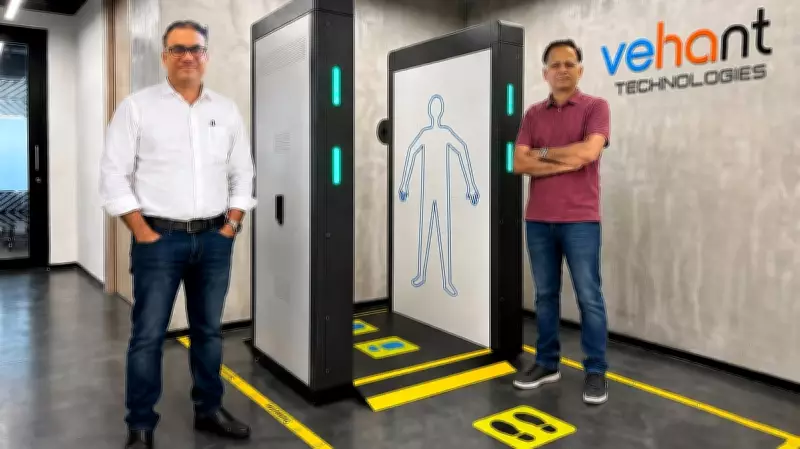
India has achieved a significant milestone in security technology with the introduction of its first indigenous body scanner. Developed by Vehant Technologies in collaboration with the Indian Institute of Technology (IIT) Delhi, the system marks a new era in security screening by detecting both metallic and non-metallic concealed items while prioritizing passenger privacy.
Advanced Detection Capabilities
The body scanner utilizes cutting-edge millimeter wave technology to create a 3D image of the human body, identifying hidden objects without physical contact. Unlike traditional metal detectors, this system can detect non-metallic threats such as plastics, ceramics, and liquids, enhancing security at airports, government buildings, and other sensitive locations.
Privacy Protection
One of the key features of the scanner is its focus on privacy. The system uses an automated algorithm that highlights potential threat areas on a generic avatar rather than displaying the actual image of the person being scanned. This ensures that security personnel can identify risks without compromising individual dignity.

Indigenous Innovation
Developed under the government's 'Make in India' initiative, the scanner reduces dependence on foreign technology and is expected to be more cost-effective than imported alternatives. Vehant Technologies, a homegrown startup, worked closely with researchers at IIT Delhi to design and manufacture the system locally.
Applications and Deployment
The scanner is suitable for high-traffic areas such as airports, railway stations, and metro systems. It can process individuals quickly, minimizing wait times while maintaining high security standards. The system is also portable and can be deployed for temporary events or emergency situations.
Officials believe this innovation will strengthen national security and boost India's reputation as a hub for advanced technology development. The scanner is expected to undergo further trials before widespread adoption across the country.






