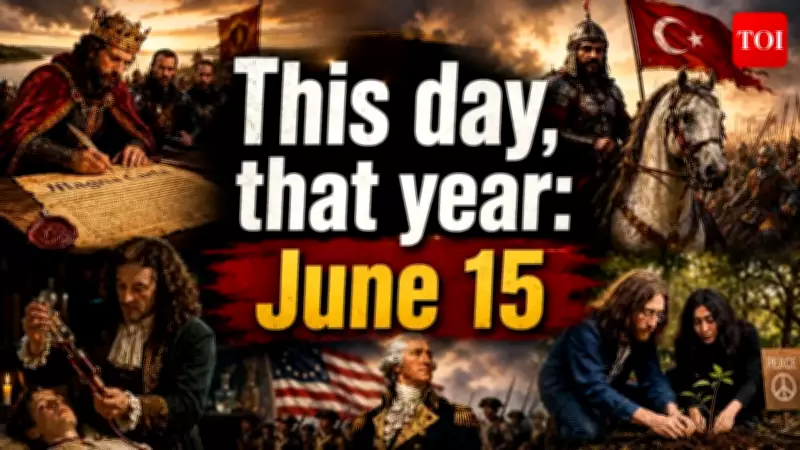
History often arrives unannounced, rarely signaling which moments will echo through centuries. Consider King John in 1215: forced into a meadow by the Thames, he signed Magna Carta out of desperation, unaware it would become a cornerstone of democracy. Similarly, a French doctor transfusing sheep's blood into a boy in 1667 couldn't foresee modern medicine's path, and Bessie Coleman, crossing the Atlantic to learn flying in 1921, quietly broke immovable barriers.
Every June 15 seems to produce turning points. Over 800 years, this date has witnessed lost dynasties, scientific breakthroughs, rights marches, and pop-culture moments. Some are world-famous; others barely make history books, but all left marks. Here's a journey through June 15's biggest events and why they still matter.
1215: Sealing the Magna Carta
On June 15, 1215, King John's excessive taxes and arbitrary rule sparked a rebellion by English barons, forcing him to seal Magna Carta at Runnymede. Initially a peace agreement, it introduced the revolutionary idea that the king must obey the law, inspiring future democracies and fair justice worldwide.

1389: The Battle of Kosovo and Ottoman Rise
The Battle of Kosovo on June 15, 1389, saw Serbian forces attempt to halt Ottoman expansion. Both sides suffered heavy losses, but the Ottomans prevailed, accelerating their influence in Southeastern Europe. For Serbia, it became a defining cultural memory; for the Ottomans, a step toward centuries of Balkan dominance.
1667: First Documented Human Blood Transfusion
On June 15, 1667, French doctor Jean-Baptiste Denys transfused sheep's blood into a sick teenager, who survived. Though risky and scientifically shaky, this procedure nudged medicine toward safe transfusions centuries later.
1775: George Washington Takes Command
The Continental Congress appointed George Washington commander-in-chief of the Continental Army on June 15, 1775. His leadership guided the colonies to independence from Britain, and he later became the first U.S. president.
1864: Equal Pay for Black Soldiers
During the Civil War, Congress passed legislation on June 15, 1864, granting equal pay to Black soldiers in the Union Army, who had previously received lower wages despite equal risks. It was a step toward racial equality, though full justice took much longer.
1883: Germany's National Health Insurance
Chancellor Otto von Bismarck introduced the world's first national health insurance system on June 15, 1883, providing workers with medical care and financial support. This model inspired social safety nets globally.
1908: Women's Rights Movement Goes Global
The World Congress for Women's Rights opened in Amsterdam on June 15, 1908, rallying activists worldwide. It strengthened international cooperation among suffragists, fueling decades-long fights for voting rights and reforms.
1916: Boeing's First Flight
Boeing's first plane, the B&W Seaplane, took flight on June 15, 1916. This humble test run led to jetliners, rockets, and a global aerospace giant that transformed modern travel.
1921: Bessie Coleman Breaks Aviation Barriers
Denied flight training in the U.S. due to racism and sexism, Bessie Coleman learned French and earned her pilot's license in France on June 15, 1921, becoming the first African American and Native American woman to do so. She inspired generations of pilots.
1967: Reagan Signs California Abortion Reform
On June 15, 1967, then-California Governor Ronald Reagan signed the Therapeutic Abortion Act, expanding legal access for rape, incest, or health risks. The issue later became a U.S. political flashpoint.
1968: Lennon and Ono Plant Acorns for Peace
John Lennon and Yoko Ono planted acorns at Coventry Cathedral on June 15, 1968, as a symbolic peace protest during the Vietnam War era, blending celebrity influence with calls for international understanding.
1986: Amnesty International's 'Conspiracy of Hope' Concert
On June 15, 1986, Amnesty International's tour ended with a historic concert at Giants Stadium featuring U2, Sting, Peter Gabriel, and others. It raised awareness about political prisoners and human rights, showcasing music as activism.

2012: Apple I Computer Sells for Record Price
An Apple I computer, built by Steve Jobs and Steve Wozniak in a garage, sold for $374,500 at auction on June 15, 2012, highlighting the personal-computer revolution and Apple's cultural impact.
2018: Stephen Hawking Interred in Westminster Abbey
Physicist Stephen Hawking's ashes were interred between Isaac Newton and Charles Darwin at Westminster Abbey on June 15, 2018, a poetic resting place among scientific giants.
2018: Elizabeth Holmes and Theranos Scandal
On June 15, 2018, Elizabeth Holmes and Theranos were charged with fraud over misleading blood-testing claims. Once valued at billions, the startup's collapse became a Silicon Valley cautionary tale.