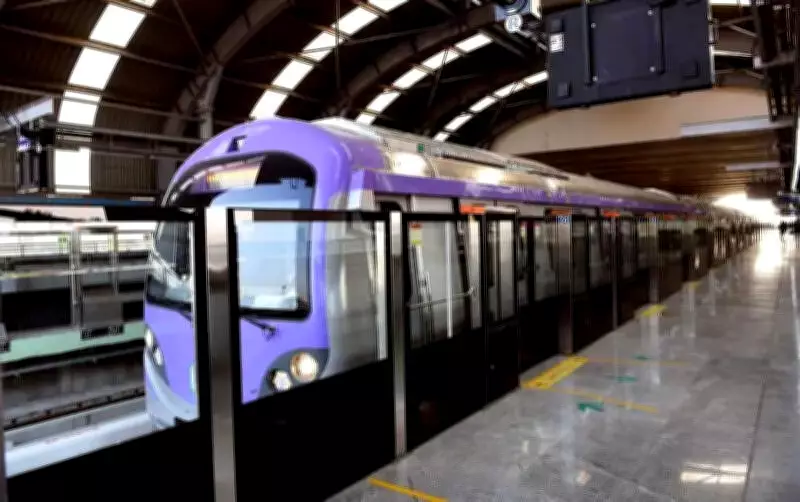
A proposed metro line connecting Baranagar and Barrackpore in Kolkata, stalled for nearly 16 years, received a fresh impetus on Monday. Rail Vikas Nigam Ltd (RVNL), the implementing agency for the corridor, met civic officials at the Kolkata Municipal Corporation (KMC) headquarters to address the issues that have plagued the project.
Project Background and Delays
The 12.5-kilometer Pink Line was sanctioned in 2010 when Mamata Banerjee was the railway minister. A detailed project report (DPR) was prepared in 2011 by RITES but faced hurdles after KMC refused to shift underground water pipelines located along the central verge of BT Road. Sources indicate that underground utilities were not considered during the initial planning, and the DPR was hurriedly drawn up.
In 2011, a KMC study of underground utilities revealed two large pipelines with diameters of 60 inches and 42 inches. A memorandum of understanding (MoU) between the railways and KMC stipulated that the civic body would dismantle these two pipelines and replace them with a new 64-inch diameter pipeline. The new pipeline was installed in October 2012, but the old ones were not dismantled. By then, the Trinamool Congress had withdrawn support from the UPA II government.

When Prime Minister Narendra Modi assumed office in 2014, KMC stated that shifting the pipelines was not feasible, and the Rs 2,069-crore project was put on hold. Since then, it has been kept alive in Union budgetary documents with a minimal allocation of Rs 10 crore annually.
Recent Developments
With a change in government a fortnight ago, the Railway Board decided to give the project a fresh push. A meeting was held at KMC on Monday to end the deadlock and find solutions for shifting the water pipelines that connect the Palta water treatment plant and the Tallah water reservoir.
"The moot point of the discussion was the five separate water transmission lines. Two of them must be shifted to dig piles required to construct the piers for the elevated metro tracks," an official added.
Metro Railway General Manager Subhansu Sekhar Mishra said, "RVNL and KMC placed their respective options to seamlessly shift the utilities. The options will be reviewed so that a consensus can be achieved at the next meeting."
Challenges and Importance
KMC officials emphasized that the water transmission lines are the city's lifeline. The Palta water treatment plant generates 240 million gallons of water daily, which is transmitted to the Tallah reservoir and then supplied to north, central, and parts of south Kolkata. "The slightest disruption to the supply chain will affect hundreds of households. The metro project cannot come up unless the water transmission lines are shifted," an official said.
Sporadic attempts to revive the project over the years failed to achieve a breakthrough. Even in July last year, KMC Mayor Firhad Hakim chaired a meeting with senior KMC officials and Metro Railway to discuss the project, but the impasse persisted. "The Baranagar-Barrackpore corridor was considered to have been virtually shelved, until now," a state official said.
Impact on Real Estate and Commuters
Once the project gets underway, at least 200 large and small realty projects around BT Road are expected to receive a major boost, especially properties between Shyambazar and Barrackpore. "We have been waiting eagerly for the metro project to start. It's been almost 16 years. It takes at least an hour to reach central Kolkata from my house, that too after changing autos to get to the nearest metro station," said Manimoy Chatterjee, a BT Road resident.