

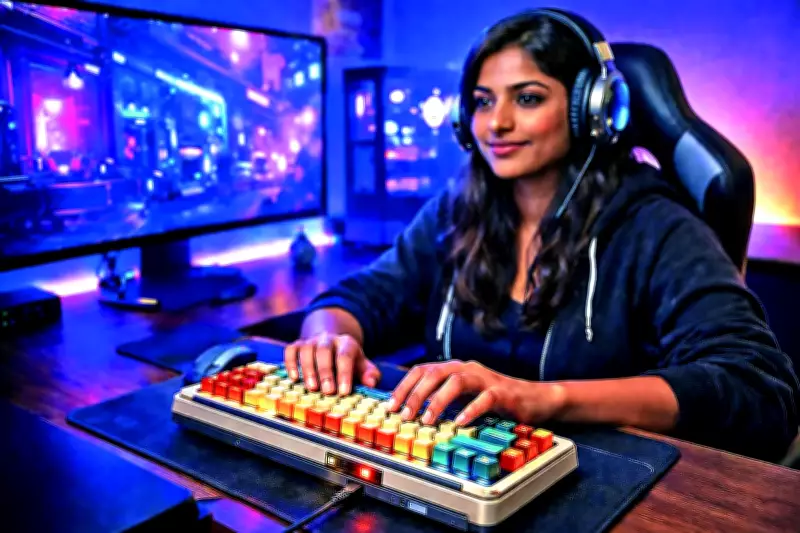
As a growing number of professionals opt for remote jobs, work is becoming an increasingly lonely experience. The only constants are their desks and the hardware they work with. Obviously, many of them are making things exciting by upgrading these constants – the overall desk set-up in general, and the keyboards in particular.
Tired of too many ads? Go ad free now. Now, what is this keyboard upgrade? From a nearly soundless, boring assembly of keys, to every key press filling the room with a satisfying ‘thock!’ Yes, you read that right. Not a click, not the thud of a mechanical keyboard, but something more sensory, more exciting. And in India, the shift is playing out across work-from-home setups, gaming desks and creator studios.
A $2.6 Billion Global Industry
Upgrading keyboards may have begun as a niche DIY hobby, but the industry has grown into a $2.6 billion global market, thanks to a broader shift – away from flat, silent tools, towards objects that offer texture, sound, and a sense of control in everyday digital work. These mechanical keyboards, especially ones with typewriter-style builds with round keycaps and retro aesthetics, are turning work desks into curated, tactile spaces. Scroll through social media, and you’ll see it instantly: glowing desk setups, coordinated colour palettes, cinematic keyboard sound tests. Mechanical keyboards sit right at the centre of this “setup culture.” Platforms like Reddit, especially communities like r/mkindia, have turned it into a shared, constantly evolving ecosystem.

“I got back into mechanical keyboards just before Covid, starting with an imported board that I over-modified and nearly ruined. That’s when I realised how deep this hobby can go. During the pandemic, I connected with the community, both in India and online, and what began as curiosity quickly turned into a full-fledged obsession. Today, I’m deeply involved in the space, designing, sourcing, and helping others build their setups,” says Dwelyn D'silva, a keyboard enthusiast from Mumbai.
Obviously, this isn’t a budget habit. But once you fall in, it’s easy to go deeper – ₹15,000 to ₹25,000 (or more) for custom builds, premium keycaps, and acoustic mods. And the demand isn’t slowing, with brands like Meckeys and StacksKB making the hobby more accessible, offering curated kits, parts and guidance. Shruti Sinha from Keychron reveals that they are adding over 10 new customers daily. Aditya Agarwal, director at StacksKB, points out that the audience is diverse – from young gamers to professionals in their 50s.
“The typing experience is the most important factor here,” he says, highlighting how mechanical switches actuate mid-press, reducing fatigue over long hours. Repeat engagement is strong – about 20–30% of customers return to upgrade, buy another board, or refer others. Customisation drives this: most start with switches and keycaps to tweak feel and sound, then move to smaller layouts like 60% or 40% with tools like QMK for remapping. “For enthusiasts, it goes deeper, lubing switches, adding foam for acoustics, even experimenting with tape mods (with caution). It quickly becomes a rabbit hole,” says Agarwal.
A Reflection of a User’s Personality
For many, the desk is no longer just a workspace. It’s a reflection of one’s personality. “There’s this urge to move slightly back towards analog experiences,” says Shukraditya Bose, a student from Bengaluru. “I made the switch because my laptop keyboard began to feel flat and unexciting,” says Bartik Saha, an entrepreneur from Kolkata, adding, “Since I type a lot every day, it just didn’t feel pleasant anymore.” It’s not nostalgia, but control. Yatharth Sood, a data analyst from Himachal Pradesh who owns 18 keyboards, puts it simply: “It started as something very functional but quickly became personal. These keyboards became a way to personalise that solitary work from home experience.”
“In India, this is still a niche market, but it’s definitely growing. The typical audience includes gamers, software professionals, and people who spend a lot of time at their desks. These are users who are more invested in their setup and are willing to spend on better tools,” says Shruti Sinha, Customer Support Executive at Keychron.

What is This ‘Thock’?
At the core of the obsession is one sound – thock – a deep, cushioned, almost addictive sound that enthusiasts chase obsessively. It’s achieved through a mix of switch types, plate materials, sound-dampening layers, and heavier builds. Dwelyn D'Silva, an HR professional from Mumbai, explains: “In the mechanical keyboard lingo, ‘thock’ is a low-frequency sound... kind of a deep baritone.” The pursuit of the perfect sound has become a hobby in itself for many. For others, the sound helps them focus. “The satisfying sound of my keyboard motivates me to keep writing long essays,” says Jehaan Agarwal, a Class X student from Pune. “I have ADHD, so this really helps.” To this, Shukraditya adds: “What really draws me to retro keyboards is the sound and feel. Typing on them feels very different. It breaks the monotony of using a regular keyboard and makes the whole experience more engaging.”
“It’s not just about typing, it’s about how a keyboard looks, feels and even sounds; that mix of aesthetics, comfort and personal preference is what turns it into a hobby,” says Vihaan Saha, key manager at an Indian brand specialising in portable percussion instruments.
What People Are Spending
- Entry Level (₹4,000 – ₹8,000): First-time buyers, students. Basic hot-swappable boards. Good starting point, minimal customisation.
- Mid-Range (₹8,000 – ₹15,000): Better build, wireless options. Compact layouts (65%, 75%). Ideal for working professionals.
- Premium (₹15,000 – ₹25,000+): Typewriter-style builds, custom keycaps. Aluminium bodies, gasket mounts.
“For me, what really draws me to typewriter-style or retro keyboards is the sound and the feel. Typing on them just feels very different, it breaks the monotony of using a regular keyboard and makes the whole experience more engaging,” says Shukraditya Bose, a student from Bangalore.





