

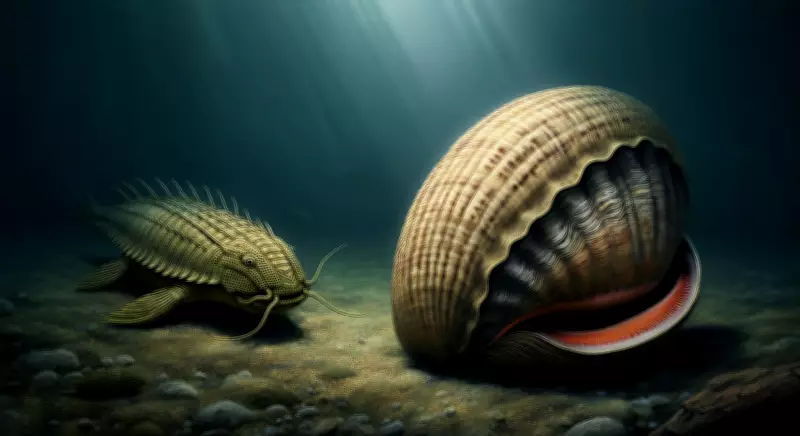
Researchers at the Universidade Estadual de Ponta Grossa in southern Brazil have identified a previously unknown species of ancient marine bivalve from a fossil roughly 400 million years old, adding a new chapter to the story of life in the prehistoric seas that once covered much of South America. The newly named species, Actinopteria grahni, was recovered from rock layers belonging to the Devonian Period, long before dinosaurs walked the Earth. The discovery was made at a fossil-rich outcrop in Ponta Grossa, in the Brazilian state of Paraná, during what began as a routine study of a previously known species in the same genus. The findings were published in the international journal Historical Biology in May 2026, confirming the new species after a detailed comparative analysis of shell morphology.
New Devonian-Era Mollusc Species Discovered in Brazil's Ponta Grossa Formation
The story behind Actinopteria grahni began with fieldwork at a well-known paleontological site locally called Curva 2, located in the Jardim Giana area of Ponta Grossa. This outcrop has been studied by geologists and fossil collectors since the 1980s and forms part of the Ponta Grossa Formation, a sequence of rock layers within the larger Paraná Basin. Researchers initially set out to examine specimens belonging to Actinopteria langei, a species already documented from the region. During the course of this fieldwork, however, additional shell fossils turned up that did not quite match the known species. Closer comparison of these specimens, detailed in the new study published in Historical Biology, revealed consistent differences in shell outline, the shape of the anterior auricle, the posterior expansion of the shell, and the pattern of radial ornamentation, enough to justify classifying the fossils as an entirely new species.
The Paraná Basin: How Brazil's Ancient Sea Floor Preserved 400-Million-Year-Old Marine Life
To understand why fossils like this keep turning up around Ponta Grossa, it helps to look at the geological history of the region. During the Devonian Period, roughly 400 million years ago, much of what is now southern Brazil lay beneath a shallow sea that was part of the vast Paraná Basin, a sedimentary basin that once stretched across an area of about 1.6 million square kilometres, extending from present-day Argentina to the Brazilian state of Tocantins. This ancient sea was frequently disturbed by storms, and it is precisely these storm events that helped preserve so many fossils from the period. Sudden, violent disturbances buried marine organisms quickly in sediment, creating the kind of fossil record that researchers are still studying today in outcrops like the one in Ponta Grossa.

How UEPG Researchers Identified a New Species Among Existing Fossil Collections
The process of confirming Actinopteria grahni as a distinct species took around a year and a half, from the initial recognition of unusual specimens to the final publication. According to a press release from the Paraná state government, the research was carried out by a professor and a student at UEPG, building on a much longer tradition of paleontological work in the region. The first records of Actinopteria fossils in the area date back to the 1960s, when palaeontologist Setembrino Petri first documented specimens from the genus. The new study revisited and expanded on this earlier work, using modern comparative techniques to distinguish Actinopteria grahni from its closest relative, Actinopteria langei, through careful examination of shell casts and impressions preserved in the Ponta Grossa Formation's mudstones and siltstones.

Why the Devonian Period Matters for Understanding Marine Evolution
The Devonian Period, which lasted from roughly 419 to 359 million years ago, is often described as a critical chapter in the evolution of marine biodiversity, sometimes referred to as the Age of Fishes. Bivalve molluscs like Actinopteria were an important part of these ancient marine ecosystems, and their fossilised shells provide valuable clues about how species evolved, adapted to different environments, and spread across the wide, shallow seas that once covered large parts of Gondwana. The genus Actinopteria itself has been recorded not only in Brazil but also in Devonian-age rocks elsewhere, including related pterioid bivalves described from the Paraná Basin's bordering formations, making comparative studies like this one useful for understanding how these molluscs were distributed across ancient ocean basins.
What's Next for Paleontology Research at the Ponta Grossa Fossil Site
The new species has been formally registered, with its details now catalogued in international taxonomic databases, including MolluscaBase, where Actinopteria grahni is recorded alongside its full scientific description and the figures from the original study. The name itself carries its own tribute: it honours the late Carl Yngve Grahn, a researcher whose work on the biostratigraphy of Brazil's Paleozoic rocks, particularly the Devonian strata of the Paraná Basin, helped lay the groundwork for studies like this one. According to the research team, the next step is to search for additional shells of Actinopteria grahni at the Curva 2 site and nearby outcrops, in the hope of finding more complete specimens that could reveal further details about how this ancient mollusc lived, fed, and interacted with the storm-battered sea floor it once called home.
The discovery adds to a growing body of evidence showing that the rock formations around Ponta Grossa remain a rich and still largely untapped source of information about life on Earth hundreds of millions of years before the first dinosaurs appeared, and researchers expect that continued fieldwork in the region will likely turn up further new species in the years ahead.





