Indian kitchens often rely on multiple utensils and cooking methods for different dishes. This makes them run on a rotation of vessels. The kadhai handles the sabzi, the pressure cooker handles dal and rice, the steamer comes out for idlis and momos, and the tawa handles everything else. This juggling act is so ingrained in daily cooking that most home cooks barely notice it anymore. Philips is betting that a segment of that audience is ready to consolidate, and the OneChef, priced at Rs 19,995, is their answer.
We tested the OneChef over several weeks across a wide range of dishes, including chicken kebab, Bhetki Paturi, steamed momos, idlis, paneer tikka, dal, and rice, to understand whether this appliance genuinely earns the counter space it occupies.
Design and Build
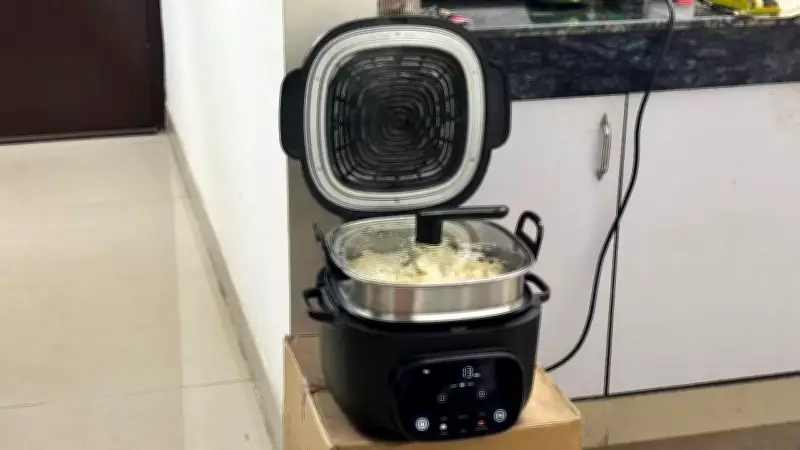
The OneChef is not a small appliance. It comes with a primary cooking pot, a steamer basket, a crisping basket, a booklet, and a brief setup guide. The unit itself has a solid, well-constructed feel. The body is sturdy plastic with a matte finish, and the inner pot has a thick non-stick coating that feels durable enough for regular use. The lid is transparent, which is more useful than it sounds; being able to see what is happening inside without lifting the lid and disrupting cooking makes a genuine difference. However, the lid feels slightly bulky, and with the side handles, you need to be careful when opening it while it is hot.

The control panel is a digital interface with dish-based presets. Labels like Rice, Dal, Chicken, and Paneer make it accessible to most home cooks without requiring a manual first. The display clearly shows temperature and time. Physical buttons are tactile and respond well. The basket handle is sturdy, and the pot sits securely on the base.
The footprint is comparable to a mid-sized electric pressure cooker, so it fits most kitchen counters, though it is not an appliance you can easily tuck into a corner of a smaller kitchen.
Cooking Performance
We started with dishes we expected the OneChef to handle confidently. Idlis came out well; they were consistent in texture, evenly steamed, and free of raw patches. The steamer basket sits at a height that comfortably accommodates standard idli moulds. Momos, which require steady steam over a fixed period, also came out right. The cooking time was close to what you would expect from a traditional steamer, and the results were comparable.
Bhetki Paturi, a Bengali preparation in which fish is marinated and wrapped in a banana leaf before steaming, was a more specific test. The OneChef handled the gentle, enclosed steam environment that the dish needed. The fish was cooked through without falling apart, and the marinade retained its character. This was one of the cleaner outcomes of the entire testing period.
The chicken kebab is used in the crisping basket. The chicken, marinated overnight, was placed in the basket and cooked on high heat. It browned reasonably well on the outside and stayed moist inside, though flipping halfway through was necessary for even colour. The result was not identical to a tandoor, but for a home appliance, it was closer than we expected.
Paneer tikka, which is easy to get wrong and tends to be either rubbery from overcooking or pale from insufficient heat, worked well once we understood the right temperature setting. The first batch was slightly underdone because we followed the preset without adjustment. The second batch, with a manual temperature increase, produced a proper exterior and a soft centre.
Both Dal and rice performed well in the cooker mode. The rice had the right texture, neither mushy nor undercooked. Dal required more time than a pressure cooker would take, which is worth noting if speed is a priority. But unlike a pressure cooker, you can check midway, adjust seasoning, and stir without disrupting the process.
Philips claims that the OneChef features AmbiHeat technology that adapts heat across cooking stages. During testing, the appliance fluctuated between higher and lower heat settings depending on the selected mode. The results also support this, as dishes that need sustained low heat, like slow-cooked gravies, hold up better than they would in a cooker set to a fixed setting.

One consistent observation was that the presets are a starting point, not a final answer. We needed to override temperature and time on most dishes at least once before settling into what worked. This is not a complaint unique to the OneChef; most multi-cookers require this calibration period, but it does mean the first few uses will be a process of experimentation.
The cooking pot has ample space to comfortably feed a family of 3-4. If you are serving a lot of people, you will need to do several batches, especially with things like kebabs.
Easy to Clean
The inner pot, steamer basket, and crisping basket are all non-stick, and the residue wipes off easily. Marinated items, especially anything with thick coatings, leave more to clean, but soaking in warm water for a few minutes handles most of it. None of the parts is difficult to handle.
Verdict
The Philips OneChef is a multi-function cooking appliance that holds its ground across a wide range of Indian dishes. At Rs 19,995, it asks for a significant up-front payment, and the value is most apparent for households that cook varied meals regularly. This means it fits best for those who steam, saute, and slow-cook in the same week. It also works well for families of three to four who want to reduce the number of vessels in rotation, for people who cook both everyday meals and occasional elaborate preparations, and for those who prefer to see and monitor food as it cooks rather than rely on whistle counts or timers.
It is less suited for large households where batch size is regularly a constraint, those looking for a direct replacement for a pressure cooker on speed grounds, or anyone whose cooking repertoire is narrow enough that the versatility goes unused.
The OneChef does not reinvent how Indian food is cooked. What it does is consolidate several everyday cooking functions into one appliance, and it does so with reasonable consistency across different dish types. The calibration period is real, but if the range of dishes you cook regularly maps to what the OneChef handles, it earns its place on the counter.