

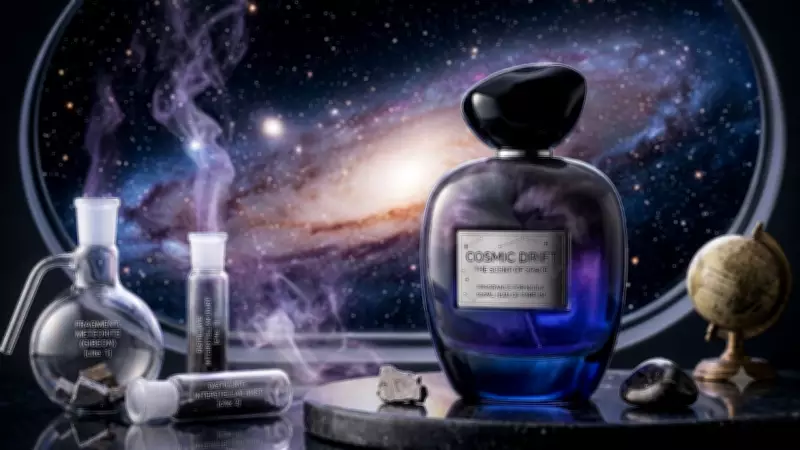
When astronauts return from spacewalks, they often describe bringing back something unexpected into the airlock: a distinctive smell. Over the years, astronauts from multiple missions have compared it to seared steak, hot metal, welding fumes, burnt biscuits and even sweet raspberry-like notes. While outer space itself is a vacuum and cannot be smelled directly, compounds generated during spaceflight interactions can produce odours once astronauts re-enter a pressurised environment. These unusual reports eventually inspired a scientific effort to reproduce the scent for astronaut training. The task fell to British fragrance chemist Steve Pearce, who spent years developing a formulation designed to mimic the aroma astronauts encountered after extravehicular activities. The result became one of the most unusual intersections of chemistry, space exploration and sensory science ever attempted.
Astronauts repeatedly reported a smell unlike anything on Earth
The modern story of space odour began with astronaut observations recorded after spacewalks. Upon re-entering the spacecraft, astronauts noticed that their suits, gloves and equipment carried a distinctive scent. NASA astronaut Don Pettit described it as: "It is hard to describe this smell; it is definitely not the olfactory equivalent of describing the palette sensations of some new food that 'tastes like chicken.' The best description I can come up with is metallic; a rather pleasant sweet metallic sensation. It reminded me of my college summers where I labored for many hours with an arc welding torch repairing heavy equipment for a small logging outfit. It reminded me of pleasant sweet-smelling welding fumes. That is the smell of space." He also compared the smell to welding fumes, seared steak and hot metal. Other astronauts reported similar experiences. The odour appeared after exposure to the vacuum of space and became noticeable only when equipment returned inside the spacecraft where volatile compounds could interact with the cabin atmosphere. Scientists proposed several explanations, including high-energy atomic oxygen reactions, ionised particles and aromatic compounds formed during interactions between spacecraft materials and the space environment. Research into interstellar chemistry provided another intriguing clue. Astronomers have identified compounds known as polycyclic aromatic hydrocarbons throughout interstellar clouds. Some of these molecules are chemically related to substances that contribute to smoky, charred and occasionally sweet aromas familiar on Earth.
Steve Pearce spent years recreating the scent astronauts described
To help astronauts prepare for future missions, NASA commissioned the development of a training odour that could familiarise crews with the smell they might encounter after spacewalks. British chemist Steve Pearce accepted the challenge. According to Pearce: "Astronauts describe the smell as a mixture of gunpowder, seared steak, raspberries and rum." Using astronaut testimonies and available scientific evidence, he spent years refining a formula capable of reproducing those sensory descriptions. The task was particularly difficult because no physical sample of the space environment could simply be bottled and analysed. Instead, Pearce had to translate subjective astronaut accounts into a reproducible fragrance profile. The resulting scent combined metallic, smoky, burnt and slightly sweet notes intended to capture the experience reported by space travellers. What began as a training tool later attracted public fascination, leading to commercial versions marketed as the smell of outer space.


The chemistry behind the raspberry and barbecue comparison
The frequently repeated comparison between space, raspberries and barbecue has scientific roots, although it is often oversimplified. Astronomers have detected ethyl formate in interstellar dust clouds, including the giant molecular cloud Sagittarius B2 near the centre of the Milky Way. Ethyl formate contributes to fruity aromas and is associated with flavours sometimes described as raspberry-like. Researchers reported the detection through observations conducted with the IRAM 30-metre radio telescope in Spain. The molecule is also involved in flavour chemistry on Earth. At the same time, polycyclic aromatic hydrocarbons are widespread throughout the cosmos. These carbon-rich compounds can generate odour associations that resemble smoke, charred food or burnt organic material when analogous compounds are encountered under terrestrial conditions. The smell astronauts report is therefore unlikely to originate from a single chemical source. Instead, it appears to result from a complex combination of chemical reactions involving spacecraft materials, high-energy particles and compounds generated during exposure to the space environment. What makes Pearce's recreation remarkable is not that it perfectly duplicates space itself, but that it translates decades of astronaut observations and scientific evidence into a sensory experience accessible on Earth. The perfume remains a rare example of chemistry allowing people to experience, however approximately, one of the most unusual sensations reported by those who have travelled beyond our planet.





