

Open-Source WiFi Project Detects Human Movement Through Walls Without Cameras
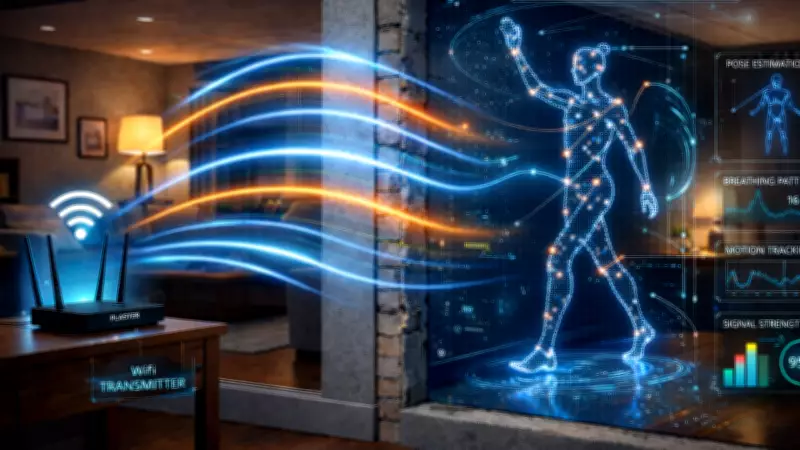
A groundbreaking open-source software project is capturing global attention by demonstrating how ordinary WiFi signals can be utilized to detect human movement behind walls without the need for cameras or wearable devices. The project, known as WiFi DensePose, analyzes subtle variations in wireless signals to estimate a digital skeleton-like representation of individuals moving within adjacent rooms.
How WiFi DensePose Works
In demonstrations shared online, the system successfully tracked body posture, movement, and even potentially breathing-related motion through walls in real time. While this concept might appear futuristic, researchers emphasize that it builds upon more than a decade of scientific exploration showing radio signals can serve as a powerful sensing tool.
The viral project was developed by a programmer identified online as ruvnet, who released the code publicly under an open-source license on GitHub. The system integrates WiFi signal sensing, advanced signal processing, and machine learning models to translate radio signal reflections into estimates of human body movement.

The Science Behind WiFi Sensing
Although the recent implementation has gained popularity for its accessibility, the foundational science has been under study for years. Institutions like Carnegie Mellon University have previously shown that WiFi signals can estimate human body poses. One influential study, titled DensePose from WiFi, revealed that neural networks could map WiFi signal patterns to detailed human pose estimates.
Researchers explain that radio signals interact with the human body in predictable ways, enabling algorithms to infer posture and movement from changes in those signals. As Dina Katabi, a pioneer in WiFi-based motion detection, noted in earlier work: "Wireless signals don’t just carry data. They also carry information about the environment they move through."
Technical Mechanism of Detection
WiFi routers continuously emit radio waves in the 2.4 GHz and 5 GHz frequency bands. These waves propagate through a room, reflecting off walls, furniture, and human bodies. The software relies on Channel State Information (CSI), which describes how the strength and phase of WiFi signals alter as they travel between transmitters and receivers.
When a person moves, even minimally, these signal patterns shift. Advanced algorithms analyze these minute fluctuations to identify motion and estimate the location of body parts. The system processes CSI data using neural networks that produce outputs akin to motion-capture systems used in animation or sports analysis, resulting in a skeletal outline representing a person's position and movement within a room.
In some experiments, the software has also detected micro-movements of the chest, allowing it to sense subtle breathing-related motion.
Hardware Requirements and Implementation
Despite viral claims online, the system cannot currently be activated on most standard household routers. It requires specialized hardware capable of capturing raw WiFi signal data. Many demonstrations utilize multiple ESP32-S3 microcontroller boards equipped with external antennas.
These small devices function as dedicated sensors that collect CSI data from WiFi transmissions. The data is then transmitted to a local computer where the software processes it using programs written in Rust or Python. The entire system operates locally without depending on cloud computing, meaning analysis occurs directly on the device.
This approach enables developers to experiment with WiFi-based sensing without expensive laboratory equipment.
Potential Applications and Research Interest
Scientists have long investigated using radio signals as an alternative to cameras or radar for detecting movement. Radio waves offer several advantages:

- They can penetrate materials like walls or smoke
- They function in complete darkness
- They do not require individuals to wear sensors or devices
Due to these properties, WiFi sensing has attracted interest for various applications. Researchers believe the technology could be beneficial for healthcare monitoring, such as detecting breathing patterns or identifying when elderly patients fall at home. Another potential use is in search and rescue operations, where radio signals might help locate survivors trapped under rubble after earthquakes or building collapses.
Privacy Concerns and Ethical Debate
Simultaneously, the idea of using WiFi signals to detect movement behind walls has ignited debates about surveillance and privacy. Some experts caution that if the technology becomes widely accessible, it could theoretically be misused to monitor movement without people's knowledge.
According to Serge Egelman, technologies that transform everyday infrastructure into sensing systems can raise new ethical questions. "When devices designed for communication suddenly become sensors, it changes the privacy landscape," Egelman remarked in discussions about emerging sensing technologies.
Supporters argue that WiFi sensing systems have advantages over cameras because they do not record identifiable visual images. Instead, they generate abstract motion data rather than photographs or video footage.
Future Prospects of Wireless Sensing
For many researchers, the open-source project offers a glimpse into a future where wireless networks do more than merely connect devices to the internet. Scientists increasingly view radio signals as another form of environmental sensing, similar to radar or lidar.
As wireless technology becomes more potent and machine learning algorithms advance, everyday infrastructure like WiFi networks could potentially be employed to detect movement or support health-monitoring systems in the future. The open-source release of WiFi DensePose illustrates how rapidly these ideas are transitioning from academic laboratories to developers and hobbyists.
Whether the technology ultimately becomes a tool for healthcare and safety or raises new privacy concerns may hinge on how society chooses to regulate and utilize it.





