

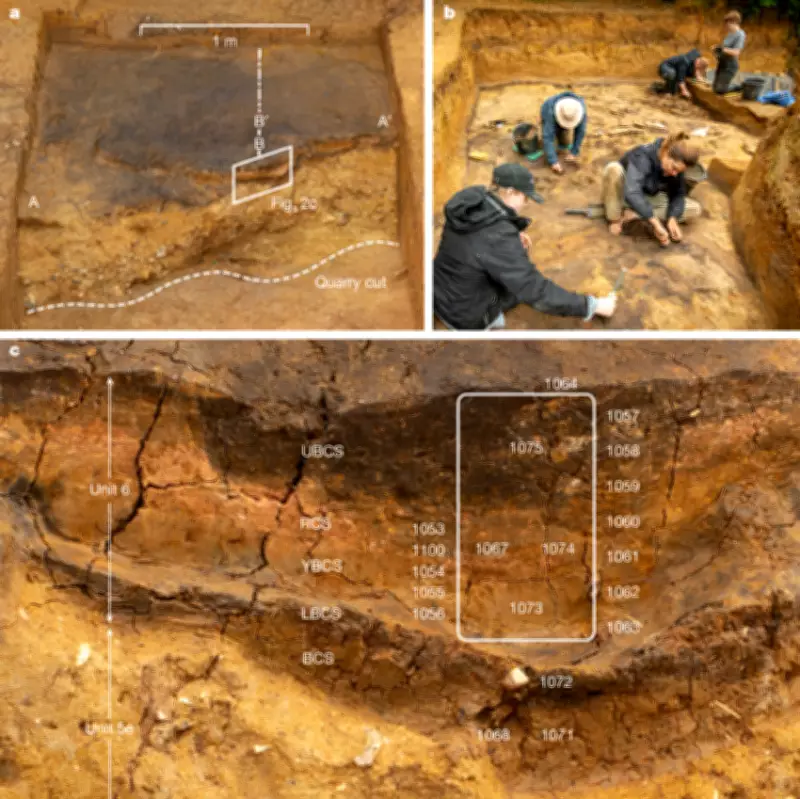
Imagine walking through a serene meadow in the English countryside, unaware that thousands of years ago, your ancestors stood at that very spot, learning to make fire. This fascinating scenario is now a reality, thanks to researchers studying an ordinary pasture in Barnham, Suffolk. In 2025, scientists reported evidence that rewrites our understanding of early human capabilities.
Discovery of Intentional Fire-Making
As researchers excavated the heavily compacted sediment, they did not find towering stone monuments or giant fossils. Instead, they uncovered a modest patch of baked earth, heat-fractured flint handaxes, and two small, dark mineral fragments. The team quickly realized that this delicate footprint represented tangible evidence of a major evolutionary leap. While previous digs had unearthed charcoal and burnt bones showing reliance on natural wildfires, this specific assortment of artefacts revealed a more intentional process. The dark rocks were iron pyrites, minerals known for producing sparks when struck against flint. Thus, instead of waiting for lightning, our ancestors began creating fire manually.
A New Timeline for Prehistoric Discoveries
The sensational discovery of this campsite excited the international scientific community, as it shifted a key evolutionary breakthrough further back in history. According to a research article published in Nature titled Earliest evidence of making fire, the layer of ground where the artefacts were found is about 400,000 years old. This timeline proves that prehistoric ancestors mastered controlled ignition hundreds of millennia before modern humans emerged. Before this finding, the accepted theory was that hominins harvested and nurtured naturally occurring embers from forest fires, with intentional fire-making coming much later. These clustered tools dispelled that theory. As explained in a University College London article, iron pyrite does not occur naturally near the geology of Suffolk fields. This key information proves that early people had the foresight to obtain and bring fire-making tools over distances.

- Iron pyrites and flint were found together, indicating intentional fire-making.
- The site provides tangible evidence of early human innovation and planning.
- Image Credits: Earliest evidence of making fire study Fig 4.
Life-Changing Effects of Having a Flame Within Reach
It is incredible to learn that these people could create fire 400,000 years ago because it completely changes the academic perception of early ancestors' intelligence, planning abilities, and social structure. It gives us a glimpse of what it must have been like to have a flame within reach at all times, something that has become normal in our world. With this tool, these communities gained many evolutionary advantages.
Today, this serene spot in southern England is remembered as an essential yardstick for studying human behaviour. Even the most epic tales in prehistory can be uncovered from inconspicuous hints. The lasting contribution of the Barnham discovery acts as a poignant symbol that human innovation has existed since times long past. Innovation need not come in monumental fashion; sometimes, it only needs two small metallic rocks and some broken flintstone.
It is humbling to know that as families today enjoy the tranquillity of the rolling hills of Suffolk, the tangible evidence of manmade fire rested quietly within a few feet of the grassy surface.






