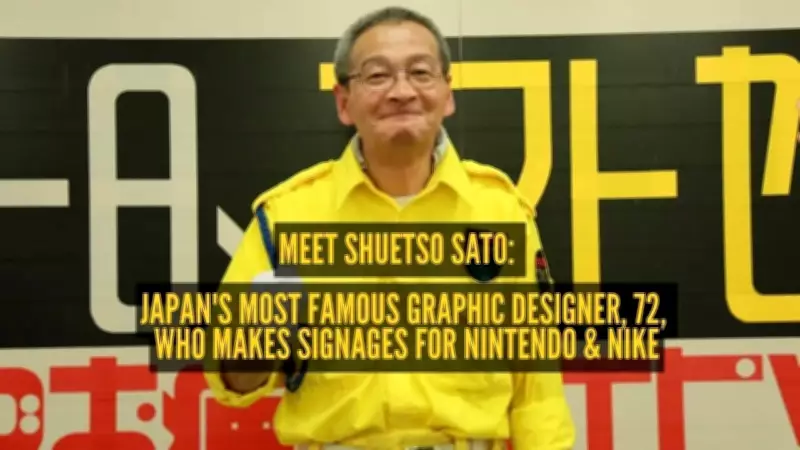
Japan is a country renowned for its graphic prowess, excelling in visual arts like anime and manga. While many assume the pioneers in this field are tech-savvy youth, Japan's most in-demand graphic designer is neither hip nor an artist in training. He is Shuetso Sato, a 72-year-old security guard who has been working the graveyard shift at a train station in Tokyo since 2002.
From Security Guard to Signage Artist
Sato's hidden passion for designing began in 2004 when he was asked to help travelers navigate the crowded, labyrinthine Shinjuku station during renovations. To assist people, he created signage using duct tape and a craft knife, covering the station's walls with directions to train lines, exits, and more. He fell in love with the work, and the results were so effective that the station master kept requesting more. Rather than constructing each kanji stroke individually, Sato often lays down large blocks of tape first before carving letters out of those surfaces.
"No one would think to ask a security guard to make signs or posters, so when someone requests one, I can't help but do my best," said Sato, dressed in a bright-yellow jumpsuit uniform, to Reuters. As more signs went up, his work gained attention. For years, commuters treated these signs as charming features of the station. However, in 2007, Daily Portal Z published an article on Sato, documenting a public event in Koenji that drew nearly 100 people curious to watch him work in real-time. Around the same period, creative collective Trio4, led by artist Yamashita Hikaru, began archiving his signage and amplifying it online. Their archives show Sato's work spreading across niche platforms and eventually mainstream outlets including NHK and Tokyo Shimbun.

Recognition and Major Clients
Soon, Sato received requests from all over Japan to create lettering for movie posters, museum signs, and more. He was even assigned gigs from corporate giants such as Nintendo and Suntory. In 2019, the Toyama Prefectural Museum of Art and Design included Sato in its exhibition "Where Am I? Art and Design Around Signage," positioning his work within broader conversations about wayfinding, design systems, and public communication. In 2025, he won the Japan Sign Design Association's platinum award for his unique typography, now known as "Shuetsu-tai" after his name, characterized by rounded edges aimed at soothing commuters' irritation.
One of his most recent projects is collaborating on a logo for Nike's new brick-and-mortar store, which opened last month in the Shinjuku shopping district. Shun Sasaki, a graphic designer hired by the sporting goods giant, immediately thought of Sato when asked to come up with a logo that evoked Shinjuku. "I was blown away by his cool, powerful lettering," Sasaki said. "He's overflowing with incredible passion - a strong desire to create."
Unconventional Compensation
Interestingly, Sato has never charged a set fee, leaving compensation up to his clients. He only asks for meals to be provided while he works and transportation costs, along with the understanding that he will only use duct tape to create his designs. "For Shinjuku, I think I got a certificate of appreciation from the station master, and a shampoo set," said Sato. Another station master thanked him with new socks. "I couldn't help but laugh at that... But for me, it's just fun, and as long as it makes people happy, that's really all I need," he added. Long after many of the original station walls disappeared, Sato's lettering remains one of the most unlikely visual legacies to have emerged from Tokyo's transit system.