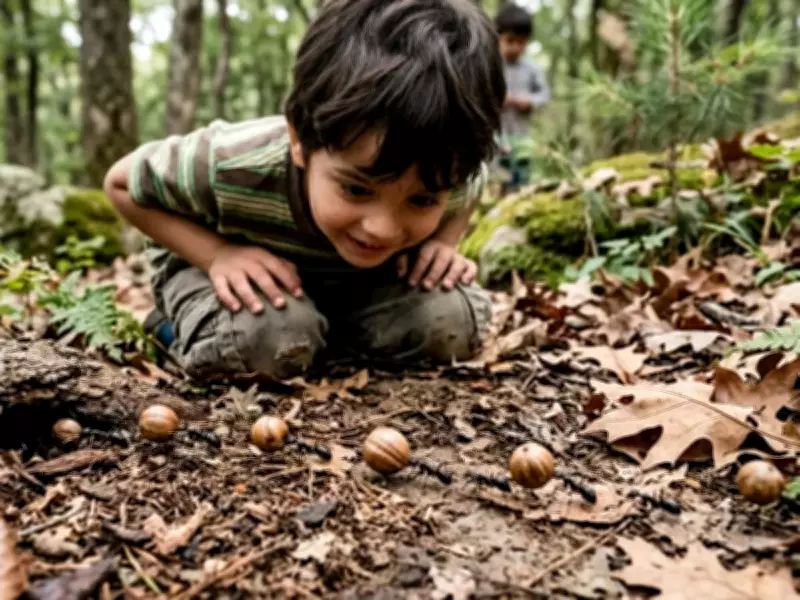
Scientific discoveries do not always emerge from laboratories. In this case, it came from a back garden. An eight-year-old child named Hugo Deans noticed round bodies around an ant hill, initially believing they were seeds. However, they turned out to be oak galls created by wasps on oak trees.
This observation marked the beginning of a study conducted by Penn State University and SUNY. It revealed a previously unknown link between ants, wasps, and oak trees. The discovery was published in The American Naturalist, illustrating the value of seemingly obvious questions posed by children.
What Are Oak Galls?
The name of these peculiar structures reflects their source. Oak galls are round bodies created by certain types of wasps laying eggs inside plant tissue. They develop from the plant's response to a chemical substance secreted by the mother insect during egg-laying.

Typically, they fall to the ground along with leaves in autumn. Until recently, scientists considered them only as shelters for insect larvae. Now, we know there is more behind them. Hugo's father, Andrew Deans, an entomologist at Penn State University, quickly realized what those items actually were. What puzzled him most was not the galls themselves, but the ants transporting them.
Normal Ant Behavior
Ants are well known for collecting seeds from plants in a process called myrmecochory, or seed dispersal by ants. Many seeds contain a fat body called an elaiosome. Professor Andrew Deans explained that ants obtain nourishment from consuming elaiosomes, while plants benefit from dispersed seeds. This natural phenomenon has been known for over a hundred years and is a basic concept in biology classes. In such cases, ants transport seeds to their nests, eat the nutrient-rich part, and leave the rest safe elsewhere to germinate.
Similarity of the Processes
The latest findings demonstrated that ants treated galls in a similar manner. Scientists examined galls formed by two wasp species, Kokkocynips rileyi and Kokkocynips decidua. The galls had a small cap-shaped organ, named “kapéllo” from the Greek word for “hat.” Ants in field experiments collected the galls in a way similar to how they gathered seeds. Laboratory experiments confirmed that ants had equal preference for both objects. The crucial role belongs to the kapéllo. Without it, ants paid little attention to the galls; with the cap present, ants transported them.
Chemical Nature of the Phenomenon
Scientists investigated the chemical composition of the kapéllo and discovered that it contains fatty acids identical to those in elaiosomes. Oleic acid, palmitic acid, and stearic acid are among such compounds known for triggering ants' activity. As the authors state, this chemical similarity serves as an attractive signal to ants, suggesting the object is valuable enough to gather. Gas chromatographic analysis revealed that the chemical properties of the kapéllo coincide with the seed structures preferred by ants.
Why Kapéllo Matters for Wasps
Unlike seeds, wasps have no need for ants in their dispersal; mature wasps can fly. Here, the advantage lies elsewhere. Ant nests are underground and have antimicrobial properties, providing protection for developing wasp larvae against predators, parasites, and fungi. The researchers conclude that wasps have adapted to modify plant tissues in a way that attracts ants. This phenomenon is an example of convergent evolution, where multiple species develop similar adaptations to solve a particular problem.
A Secret Web Right Under Our Nose
The study extends our knowledge of biological relationships between different species. It reveals that not only plants but also other organisms can use ant transportation systems by imitating plant tissues. These findings provide additional insight into the possible influence of ants on forest ecosystems. The movement of insect-made galls underground may impact nutrient and microorganism cycles.

The Child's Role in the Scientific Discovery
Hugo Deans is another case where an observation played an important role. The boy did not intend to refute any theory; he just happened to notice something interesting. Hugo thought they were seeds, based on what he recalled from the moment of his observation. This phenomenon is now considered another illustration of communication among organisms using chemistry. It confirms that even the most studied systems can have something new to discover.
An Inspiration for Curiosity
The discovery of this phenomenon did not require highly sophisticated technology initially. It started with paying attention and being curious. Later, scientists employed methods such as chemical analysis and experiments. The message is simple: nature is full of complicated structures even within our vicinity. Seemingly insignificant discoveries can become significant. In this case, the curiosity of a child led to the discovery of an unknown connection between ants, wasps, and plants.