

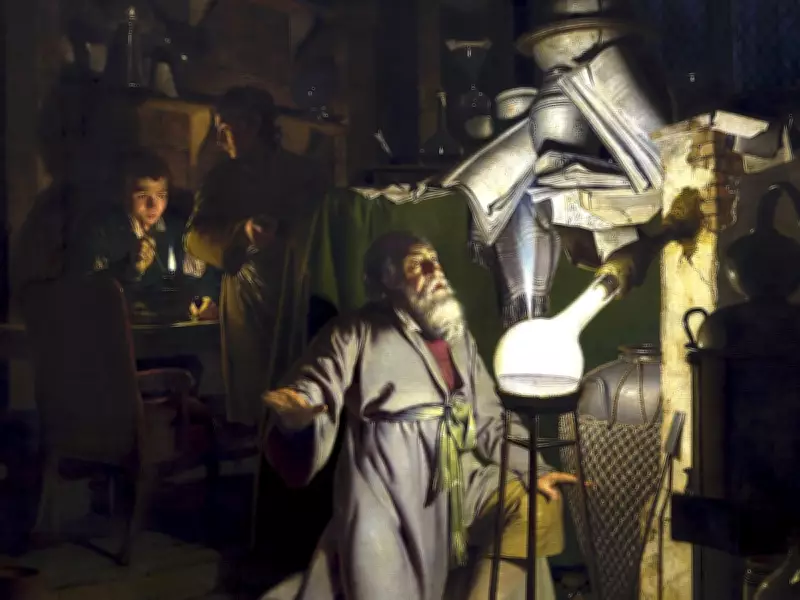
Throughout history, many scientific discoveries have begun as mistakes. Few, however, are as strange as the discovery of phosphorus. In 1669, a German alchemist named Hennig Brand spent months preparing large amounts of urine, hoping to produce gold. Instead, he produced a glow-in-the-dark, waxy substance unlike anything previously seen.
The Search for Gold That Led Elsewhere
Brand lived in Hamburg during a time when alchemy was still viewed as an intriguing mix of mysticism and experimentation. Like many of his contemporaries, he believed that certain substances could be transformed into even more precious ones. According to a 2024 review published in Medical Research Archives and archived by PubMed Central, Brand isolated phosphorus in 1669 while pursuing alchemical gold. It was not a conscious decision to discover a new element; rather, he was following the centuries-old quest of transmutation. The failed search for gold became one of chemistry's famous accidental discoveries.
Why Urine?
Perhaps the strangest part of the story is the substance Brand chose to work with. According to reports, the alchemist used dozens of buckets of urine while trying to find the key to making gold. Urine attracted the attention of some alchemists because of its color and because it was thought to contain concentrated substances produced by the human body. Brand boiled down several large amounts of urine into a thick, dark paste and then heated the mixture intensely, hoping that valuable elements would appear. Instead, a strange, glowing substance formed. This process included concentrating urine into a paste and heating it with sand. An image from the era illustrates a kneeling alchemist in his laboratory, gazing in wonder at the results of his latest experiment.

The Element That Appeared to Make Its Own Light
Not only was phosphorus a new element, but it also possessed unique qualities compared to anything found at that time. This glowing substance emitted a dim light when in contact with air. Its name is believed to come from the Greek word phosphoros, meaning 'light bearer.' During an era when light sources consisted mainly of oil lamps and candles, such a discovery would have appeared revolutionary. The glow observed by Brand was real, though illustrations tend to overemphasize its strength. The pure element isolated was white phosphorus, which glows slightly when exposed to air due to slow oxidation.
A Turning Point from Alchemy to Chemistry
History commonly refers back to Brand's discovery for this reason. Even though he was an alchemist, the element he found could be experimented with, classified, and studied further. In the eyes of historians, Brand's work signifies the start of a move away from mystical experimentation and toward understanding the properties of matter. A review by the Royal Society of Chemistry argues that this work led to the development of phosphorus chemistry and is one of the founding contributions to modern science. Over time, scientists discovered that phosphorus is also found in plants and animals, but initially, it was viewed as merely a curious novelty extracted from urine.
An Accidental Discovery That Still Matters
More than 350 years later, this remains one of the most talked-about scientific discoveries. Although the experiment was messy and failed in its original goal, Brand produced the first recorded isolation of a chemical element, a discovery often regarded as an important milestone in the transition from alchemy to modern chemistry. This is an example of the fact that scientific progress does not have to follow a logical progression. Sometimes important breakthroughs can result from flawed assumptions, unpredictable outcomes, and determination on the part of the scientist. In Brand's case, a quest to discover a mythical element led to the discovery of an altogether new element, which ultimately helped bring science into the modern era.






