

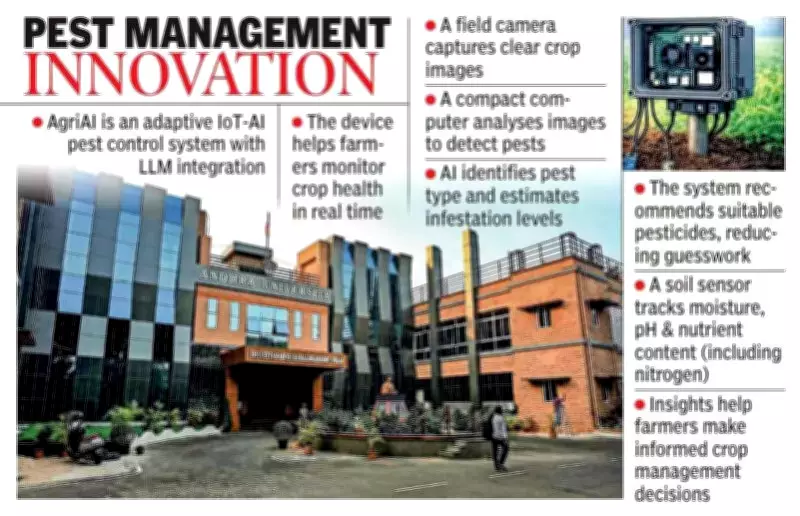
Andhra University Innovates with AgriAI for Advanced Pest Management
In a significant breakthrough for agricultural technology, a team of researchers at the Dr BR Ambedkar Chair, Andhra University, has developed an AgriAI device. This adaptive IoT-AI pest control system, integrated with Large Language Models (LLM), offers a cutting-edge solution for real-time pest management and crop health monitoring.
How the AgriAI System Works
The system is designed to simplify farming practices by leveraging advanced technology. A camera installed in the field captures high-resolution images of crops, which are then analyzed by a compact computer. Using artificial intelligence, the device detects pests, identifies their types, and estimates the level of infestation. Based on this analysis, it recommends the most suitable pesticides, helping farmers avoid guesswork and reduce unnecessary chemical spraying.
This targeted approach not only enhances crop protection but also promotes sustainable farming by minimizing excessive pesticide use. Additionally, the system includes soil sensors that measure key parameters such as moisture, pH, and nutrient content, including nitrogen levels. This data provides farmers with comprehensive insights into soil health, enabling informed decisions for better crop management.

User-Friendly Features and Accessibility
All collected information, including pest detection results, pesticide recommendations, and soil conditions, is processed and converted into simple summaries available in both English and Telugu. This ensures that farmers, even those with limited technical knowledge, can easily understand and utilize the technology. The complete field data is uploaded to a dedicated website for monitoring and record-keeping, and it is also sent to the Telegram mobile application via a bot named AgriAI bot, allowing convenient access for users.
Grassroots Development and Impact
Prof M James Stephen, the principal investigator and chair professor of the Dr BR Ambedkar Chair, highlighted the project's origins in field-based research. The journey began with extensive surveys across five adopted villages in Pendurthi mandal, Visakhapatnam district, involving over 1,000 field samples to capture real pest management challenges. From this grassroots data, a team of doctoral scholars, students, and volunteers developed and tested a non-chemical, AI-driven pest control system.
Prof Stephen expressed gratitude to the Dr Ambedkar Foundation under the Union ministry of social justice and empowerment for their support, emphasizing that this research serves the last mile of agriculture. The device was recently launched in Pinagadi village, Pendurthi mandal, and inaugurated by Manoj Tiwari, director of the Dr Ambedkar Foundation.
This innovation is set to transform smallholder agriculture by providing a technology-driven, sustainable approach to pest control, ultimately improving crop yields and farmer livelihoods.






