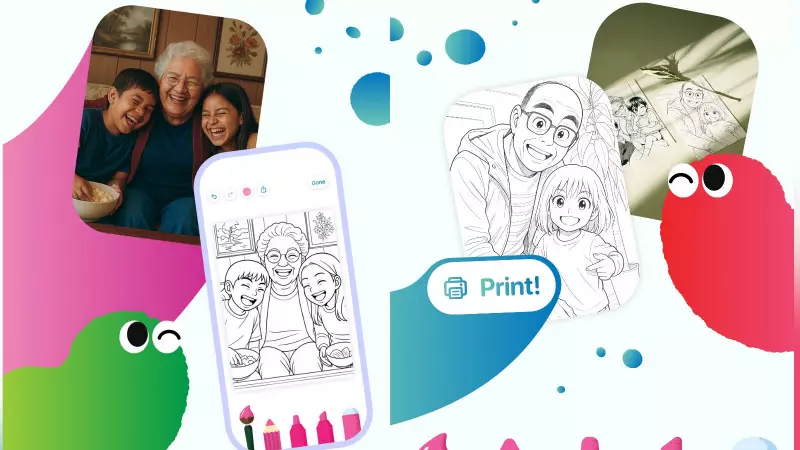
A new artificial intelligence application is offering Indian parents a novel way to engage their children creatively. The app, named Splat, uses generative AI to convert everyday photographs into custom, printable colouring book pages.
How Splat Transforms Personal Memories
Developed by the tech startup Lone Palm Labs, which also owns the private photo-sharing app Retro, Splat allows users to upload photos from their camera roll. These can be pictures of family members, beloved pets, or favourite places. The AI then processes the image, converting it into a black-and-white line drawing suitable for colouring.
Beyond personal photos, the platform also lets users generate colouring pages from a wide array of kid-friendly educational themes. Categories include animals, space exploration, flowers, fairy tale scenes, robots, and various vehicles. Users can select different artistic styles for the conversion, such as anime, 3D movie, manga, cartoon, or comic aesthetics.

Pricing, Availability, and Safety Features
The app is readily available for download by users in India on both the iOS App Store and Google Play Store for Android devices. Splat operates on a freemium model. It offers one generative AI project as a free trial. For continued use, parents can choose between a weekly subscription costing $4.99, which allows the generation and printing of 25 pages per week, or an annual plan priced at $49.99 for 500 pages per year.
In terms of child safety, the app incorporates basic parental controls. It attempts to block in-app purchases and access to settings by requiring authentication, typically asking for the parent's birth year to proceed.
The Broader Context of AI and Child Development
The launch of Splat occurs during a significant debate among parents and educators about the role of AI in children's lives. Many are cautiously weighing the benefits of mainstream AI tools like OpenAI's ChatGPT and Google's Gemini for younger users.
This discussion was recently highlighted when Garry Tan, CEO of Y Combinator, shared that he helped his 10-year-old son use Google's Gemini-powered Nano Banana to complete a crayon-shading page. His post on social media platform X attracted criticism, with some arguing that such tools could potentially hinder the development of fine motor skills and patience in children. Tan later deleted the post.
Splat enters a market filled with websites offering free, ready-made colouring pages, which are often cluttered with advertisements and difficult to navigate. By offering a personalised alternative, it aims to provide a unique value proposition. It is not the only app exploring this niche; another called Stickerbox allows users to print AI-generated stickers for colouring.
The trend extends beyond software, as seen with products like Moflin, a robotic pet built by Casio that uses AI to develop its personality over time. As these technologies evolve, apps like Splat represent one approach to harnessing generative AI with the specific goal of stimulating creativity and imagination in a controlled, personal context for children.