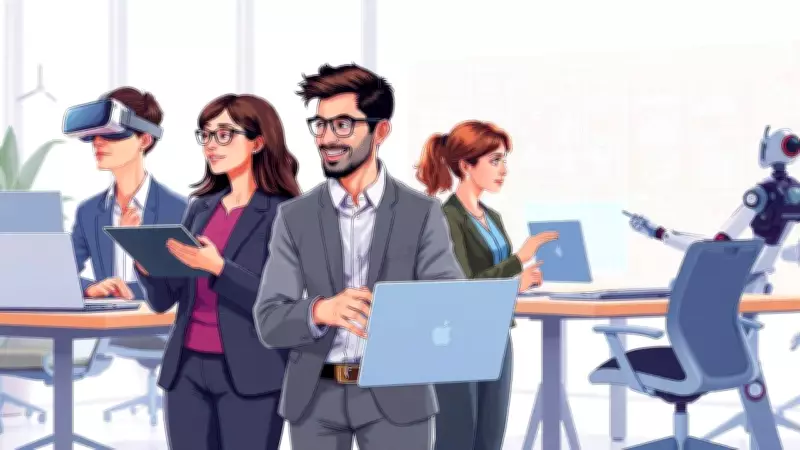
Growing Uncertainty: Over Half of Professionals Fear AI's Career Impact
A significant and increasing proportion of professionals across industries are expressing deep uncertainty about how artificial intelligence will fundamentally reshape their career trajectories and long-term employment prospects. This mounting concern is substantiated by recent comprehensive research, highlighting a workforce grappling with the implications of rapid technological advancement.
Survey Reveals Widespread Apprehension About Job Security
A major survey conducted by the Pew Research Center has uncovered that 52 per cent of workers are actively concerned about the potential impact of AI on their workplaces and professional futures. This statistic underscores a pervasive sense of anxiety. Furthermore, the data reveals that nearly one-third of respondents explicitly anticipate fewer long-term job opportunities as AI integration accelerates, pointing to a tangible fear of displacement.
Not All Careers Are Equally Exposed to Automation
Simultaneously, emerging analysis provides a crucial counterpoint to the prevailing anxiety. New data suggests that exposure to AI-driven automation is not uniform across all professions. The AI-Resistant Careers Index, developed by Resume Now, systematically identifies specific jobs that are statistically less likely to be replaced by automation. This index evaluates roles based on three core human traits: adaptability, stress tolerance, and self-control. Positions scoring highly in these areas demonstrate greater resilience.

Collectively, these findings signal a defining and irreversible shift in the labor market. The inherent value of work is progressively moving towards skills and capabilities that are intrinsically harder to automate—skills rooted in complex human cognition and interaction. Below, we explore four such critical skills that are projected to become increasingly relevant and valuable by 2026.
High-Stakes Decision-Making Under Pressure
Some of the most automation-resistant roles are found in high-pressure fields like healthcare. Surgeons, emergency physicians, and nurse anesthetists operate in dynamic, unpredictable environments where critical decisions must be made in real time, often with incomplete information. A patient's condition may deteriorate unexpectedly, or a surgical procedure may encounter unforeseen complications. In these scenarios, action cannot be delayed for complete data analysis. The human ability to synthesize information, assess risk, and make decisive choices under extreme pressure becomes central. While AI can provide invaluable support in diagnosis and data analysis, it cannot assume responsibility for immediate, life-altering actions when outcomes remain uncertain.
Adaptability in Unstable and Evolving Conditions
Artificial intelligence typically performs optimally within stable, rule-based environments. However, a vast array of professions do not operate under such predictable conditions. Cybersecurity analysts, for instance, must respond to threats that evolve at breakneck speed. Financial managers navigate markets that react violently to unexpected geopolitical or economic events. Construction managers oversee projects where site conditions, weather, and supply chains frequently force changes to the best-laid plans. Across these diverse roles, the capacity for adaptability and flexible problem-solving matters far more than routine, repetitive efficiency. The World Economic Forum, in its influential Future of Jobs Report, has identified adaptability and resilience among the fastest-growing skills required across all industries through 2030. Workers who can dynamically adjust to shifting conditions are far more likely to remain relevant than those reliant on fixed, automatable processes.

Accountability and Ownership in Leadership Decisions
Senior leadership and executive roles continue to demonstrate strong resistance to automation for a distinct, ethical reason: they require genuine accountability. Chief executives, attorneys, and senior organizational leaders make strategic decisions that profoundly affect entire companies, communities, and individuals beyond their immediate teams. These decisions carry legal, financial, and social consequences that simply cannot be ethically or legally delegated to an algorithmic system. While AI can provide sophisticated data modeling and projections to inform these choices, the technology itself cannot be held responsible for the outcomes. The fundamental human need for ownership, ethical judgment, and answerability ensures these high-level roles remain firmly dependent on human oversight and decision-making.
Emotional Intelligence in Meaningful Human Interaction
A multitude of roles necessitate direct, nuanced interaction with people during emotionally charged or high-stakes moments. This includes physicians delivering difficult diagnoses, veterinarians comforting pet owners, or managers guiding teams through periods of crisis. While AI can process natural language and identify behavioral patterns at scale, it cannot fully interpret subtle human emotions, cultural context, or unspoken needs. Managing a team's morale during a corporate restructuring or advising a client through a personal financial dilemma requires more than accessing information; it requires empathy, active listening, and the ability to build trust. Emotional intelligence—the capacity to perceive, understand, and manage emotions in oneself and others—remains one of the least automatable human skills and continues to be in high demand across sectors.
The Broader Implication for the Future Workforce
This ongoing shift represents more than a mere technological evolution; it signifies a fundamental redefinition of work itself. Jobs that synergistically combine decision-making under pressure, dynamic adaptability, ethical accountability, and skilled human interaction are far more likely to remain stable and in demand. These core competencies do not primarily depend on computational speed or data-processing scale. Instead, they depend on nuanced human judgment, ethical reasoning, and contextual understanding. Consequently, the strategic advantage for workers in 2026 and beyond may not stem from attempting to compete directly with AI on its own terms. The sustainable advantage may well come from a deliberate and focused cultivation of the profoundly human capabilities that artificial intelligence, by its very nature, cannot replicate.