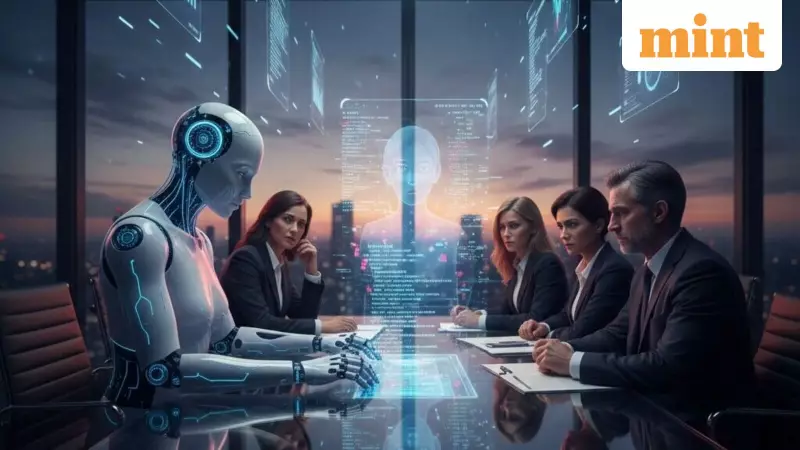
Picture a company leader who is available around the clock, never shows bias, and makes flawlessly accurate decisions that boost profits. This might sound like an ideal boss, but there's a catch: this leader is not human. As we move through 2026, the concept of an artificial intelligence (AI) serving as a chief executive officer has shifted from science fiction to a tangible, though experimental, corporate reality.
The Pioneers: Mika and Tang Yu Take the Helm
While the majority of firms are still led by people, a few bold companies have begun trials with machine-led management. One of the most prominent examples is Mika, the so-called 'Humanoid CEO' of the Colombian luxury spirits company Dictador. Created by Hanson Robotics, the same makers of the famous robot Sophia, Mika is a physical robot with a public-facing role designed to embody the brand's 'Game Changer' ethos.
Mika's responsibilities go beyond publicity. She is tasked with identifying potential clients through deep data analysis, selecting artists for collaborations, and overseeing complex projects. Her leadership philosophy is rooted in data-driven precision, operating in a "future present" state by constantly scanning real-time market data to predict trends and reduce risk. As Mika herself highlights, she offers the advantage of 24/7 availability and unbiased decision-making, without needing weekends off.

However, the experiment has shown mixed outcomes. While Mika is a high-profile marketing tool, Dictador's revenue growth has trailed the industry average. Her limitations were publicly exposed during a Fox interview where her responses suffered noticeable pauses—an awkward scenario of a boss "buffering." Despite this, she remains in her position, providing valuable lessons on AI integration.
The Efficiency Expert: AI's Operational Mastery
Another landmark case emerged in August 2022 when Chinese gaming titan NetDragon Websoft appointed an AI named Ms Tang Yu as the rotating CEO of its flagship subsidiary. Dismissed by some as a publicity stunt, NetDragon positioned Tang Yu as a central hub for operational excellence.
Her core functions focus on streamlining internal processes and improving work quality. By instantly processing enormous datasets, she supports rational, data-backed decisions, eliminating human guesswork and bias. The results were initially impressive: in the six months following her appointment, investor confidence surged, boosting the company's stock value by 10% and outperforming the Hang Seng Index. Internally, her non-stop operation led to a 15% reduction in operational delays and a striking 15.6% cut in operating expenses.
Yet, Tang Yu's limitations became starkly apparent when confronted with broader economic challenges. In the first half of 2025, despite her efficiency gains, she could not prevent a 27.9% year-on-year drop in total revenue, proving that operational optimization alone cannot shield a company from major market headwinds.
The Human Element: Why AI Can't Go It Alone
The central critique of AI leadership is clear: while an algorithm can optimize a process, it cannot inspire a team or win its complete trust. True leadership requires a blend of data-driven strategy and intrinsically human qualities like empathy, strategic foresight, and the ability to motivate. A machine cannot replicate the spontaneous warmth of a human boss offering genuine praise, a moment that can define a career.
Furthermore, significant legal and ethical questions remain unanswered. Who is liable for an AI's costly mistake? How would an AI handle an unprecedented crisis like the COVID-19 pandemic? What are the security risks if such a system is hacked?
The future, therefore, points not to replacement, but to partnership. This hybrid model is already visible in today's top corporations. Microsoft's Satya Nadella uses advanced AI like GPT-5 to prepare for critical meetings, while Apple's Tim Cook leverages AI for "time recovery," freeing him to focus on high-level strategy. These leaders exemplify a synergistic path where machines manage data and analytics, and humans manage people, relationships, and vision.

The world is at an inflection point where AI's influence is becoming as pervasive as the internet's. The choice to avoid it will soon be unavailable. The journey ahead is about harnessing AI's formidable analytical power while fiercely preserving the irreplaceable human touch that defines great leadership.